

Layer 2 blockchains are an important part of the Ethereum ecosystem. They are built to onboard new users and enable mass adoption of blockchain technology. But how do Layer 2 blockchains make this possible? And why are transactions cheaper and faster on L2s? This guide explains everything about Layer 2 scaling solutions.
What Is a Layer 2 in Blockchain?
The Definition of Layer 2
A Layer 2 network is a secondary blockchain that lives inside another network known as Layer 1. It processes and executes transactions off the main chain and sends the results to the Layer 1 chain.
Layer 2 blockchains are also known as Layer 2 solutions because they solve scalability problems.
Why Blockchains Need Layer 2 Solutions
Layer 1 blockchains like Ethereum have scalability limitations. They need Layer 2 blockchains to handle more transactions per second (TPS) and to reduce gas fees.
They also accelerate the adoption of cryptocurrencies and decentralized apps (dApps).
The Relationship Between Layer 1 and Layer 2
Layer 1 is the base chain that provides security and consensus. Layer 2 handles thousands of transactions quickly and cheaply, but it still relies on a Layer 1 blockchain to verify and finalize everything.
How Does a Layer 2 Work?
Off-Chain Processing and On-Chain Settlement
Layer 2 blockchains are compatible with Ethereum. Users can send and receive tokens or interact with smart contracts on them. An L2 uses a different mechanism to compute and process transactions off-chain, making it highly scalable.
Next, L2s lump transactions together and send them to the base layer. This step depends on the type of Layer 2 solution being used. Some solutions send a cryptographic proof to the base layer. Others assume all transactions are valid.
Finally, L2s send the data to L1 through a smart contract. The base layer resolves any disputes and adds valid transactions to the next block.
Security Inherited from the Base Layer
Layer 2 solutions inherit their security from Ethereum. Such solutions have a smart contract deployed on Layer 1. Other L2s rely on a bridge to communicate. The smart contract receives final balances and the state of the L2 network. The base layer then verifies the submitted data through proofs or dispute mechanisms.
Since Layer 2 transactions happen off-chain, Ethereum becomes the ultimate source of truth due to its consensus mechanism and immutability. Any fraud proofs, validity proofs, or state commitments submitted by L2 networks are ultimately finalized on the base layer. This mitigates any malicious behavior that takes place on L2 networks.
Transaction Speed and Cost Reduction
Transacting on L2 networks is fast and cheap. Such secondary networks are excellent for frequent traders. Transactions on Layer 2 networks are processed fast because they go through a sequencer. A sequencer is a server or a cluster of servers that processes transactions. It can be centralized or decentralized, and it may be operated by individuals, businesses, or third-party operators.
Transacting on L2 networks is cheap because the sequencer bundles transactions and sends them to the base layer as a single transaction. This approach splits the gas fees of one base-layer transaction between L2 users, which drastically reduces gas fees.
Types of Layer 2 Solutions
Rollups (Optimistic Rollups, ZK-Rollups)
Rollups are a way to bundle hundreds of transactions on Layer 2 networks into a single transaction on Layer 1. There are two types of L2 rollups:
- Optimistic rollups
- Zero-knowledge proof (ZK) rollups.
Both types bundle Layer 2 transactions, but they interact with the base layer differently.
Optimistic Rollups
Optimistic Rollups execute transactions off-chain and send the data to the base layer via calldata or blobs. This approach assumes that all transactions are valid, hence the name. Optimistic Rollups also compress transaction data before sending it to Ethereum to reduce cost.
When Ethereum’s smart contract receives transaction data, anyone can challenge this optimistic assumption using fraud proofs within a specific dispute window. Ethereum essentially takes an “innocent until proven guilty” approach when dealing with Optimistic Rollups.
This dispute window varies and depends on the Layer 2 solution. And the people who challenge this assumption are Ethereum participants known as validators or watchers.
If a fraud proof succeeds, Ethereum reverts the invalid state, and the malicious sequencer is penalized by losing its staked ETH collateral. The correct state is then enforced on the base layer.
If no valid fraud proof is submitted during the dispute period, the batch of transactions is considered valid and finalized on Ethereum.
ZK-Rollups
Zero-knowledge-proof Rollups (ZK-rollups) work in a similar way to Optimistic Rollups. They execute thousands of transactions off-chain and submit the data to smart contracts that live on the base layer. However, instead of assuming that all transactions are valid, ZK-Rollups prove that every transaction is valid before sending it to Ethereum. This is achieved by generating cryptographic proofs, also known as zero-knowledge proofs, which mathematically verify the correctness of the entire batch.
ZK-rollups rely on an operator (aka prover or sequencer) to process transactions, generate proofs, and send them to Ethereum. Some rollups rely on centralized operators while others use semi-decentralized provers. Proofs are verified instantly, hence there’s no dispute period, and users access their funds immediately. Once the validity proof is accepted by Ethereum’s smart contract, the transaction data is added to the next confirmed block on the base layer.
State Channels
State channels are a different way to scale Ethereum. A single state channel lets two or more people send and receive tokens, fast and cheap, without on-chain settlement. Once they finish transacting, they can submit the final state and transaction summary to Ethereum.
A state channel is peer-to-peer (p2p) and is governed by a multi-signature smart contract. To open a state channel, peers must lock funds in a smart contract built on the base layer. The locked funds are collateral to ensure honesty and prevent disputes. Any state change is executed and validated by those peers. This approach reduces gas fees, computation on Ethereum, and speeds transactions.
In case of a dispute between participants, the issue is resolved on the base layer, where the latest signed state can be enforced by Ethereum’s consensus.
State channels have some limitations. They require peers to stay online all the time and monitor the channel. Also, they’re not user-friendly, and it’s difficult to monitor multiple channels simultaneously.
Plasma Chains
A Plasma chain is a separate chain linked to the base layer, known as the root chain or parent chain in this case. Plasma chains, also called child chains, are managed by a smart contract deployed on the parent chain.
Plasma chains process and verify transactions off-chain, reducing verification loads on Ethereum. They rely on one operator or multiple operators to organize and execute transactions, making them faster. However, only the final state is periodically submitted to Ethereum for security anchoring.
To utilize a Plasma chain, a user must deposit Ether or ERC-20 tokens into a smart contract. The operator creates new tokens equivalent to the user’s funds. To exit the Plasma chain, a withdrawal request must be submitted. Then, the request is challenged via a fraud-proof for around 7 days. If the challenge fails, the withdrawal request is approved and executed. But if the challenge succeeds, the operator is penalized.
While Plasma chains seem to operate like rollups, they have some limitations. Long exit queues from a Plasma chain to Ethereum face a critical issue of data unavailability. This is because the Plasma chain operator stores the data and only submits it to Ethereum periodically. On the other hand, rollups provide full transaction data every time a user wants to trade or withdraw funds.
Sidechains (and why they differ from true L2s)
Sidechains are not Layer 2 networks; however, they help Ethereum scale. They are separate blockchains that connect to Ethereum through a bridge. Sidechains have different block specifications and consensus mechanisms. They disinherit Ethereum’s security properties and do not post transaction data or state roots back to Ethereum. This makes them prone to malicious attacks and centralization.
To achieve high throughput, sidechains implement larger block sizes and higher gas limits. Running bigger blocks at fast processing times requires powerful hardware. This makes it difficult for everyone to run a full node, resulting in centralization and malicious attacks.
Sidechains are EVM-compatible, making Ethereum dApps run with minimal changes. Sidechains interact with Ethereum via a bridge, which is a collection of smart contracts deployed on both chains. The bridge implements a mint and burn mechanism, allowing users to enter a sidechain, transact, and exit back to Ethereum.
Popular Layer 2 Projects in 2025
Arbitrum
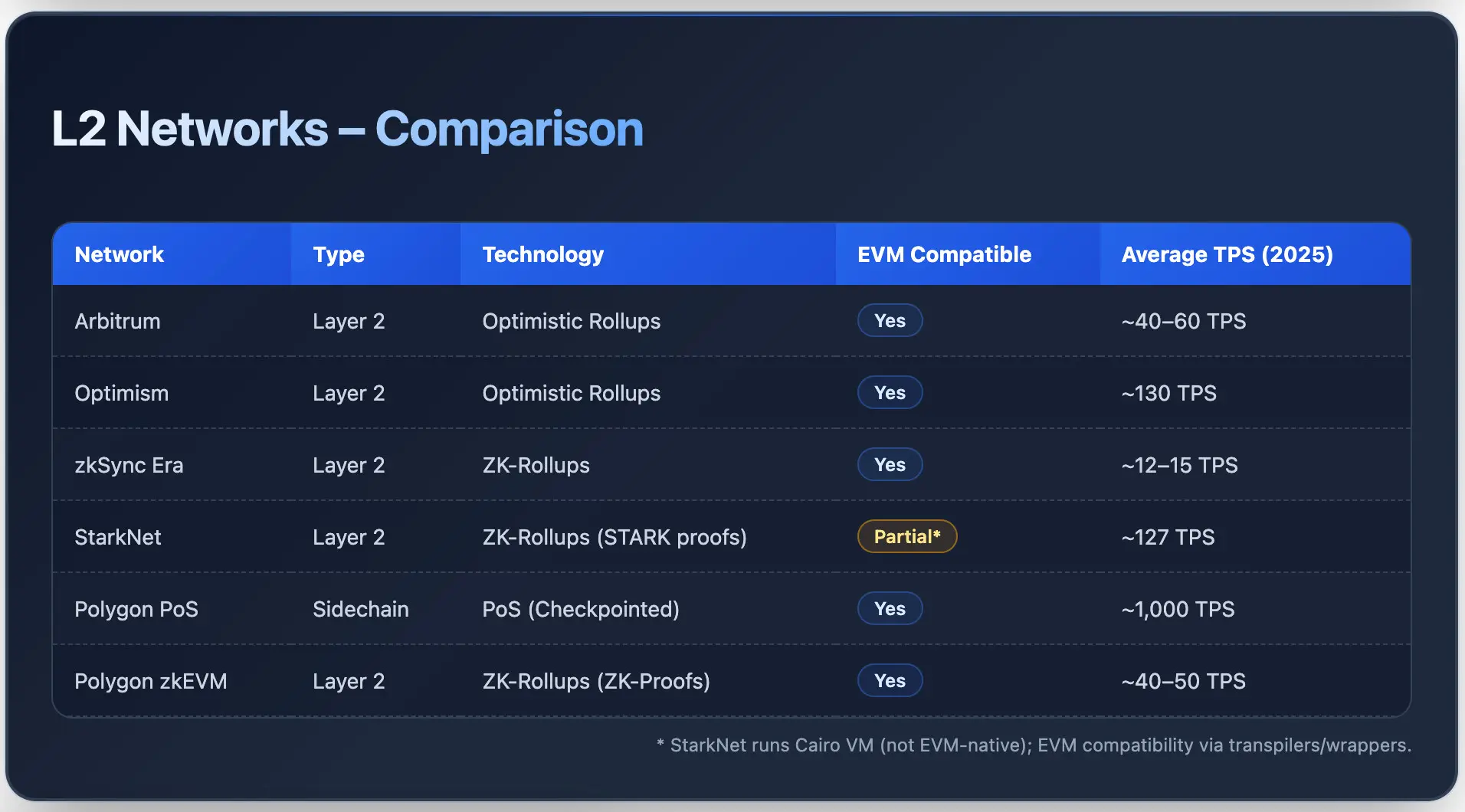
Arbitrum is an L2 that uses Optimistic Rollups to process transactions off-chain and post them to Ethereum. It offers lower fees to traders while relying on Ethereum’s security.
Arbitrum supports the Ethereum Virtual Machine (EVM), making it easy for developers to deploy smart contracts with minimal changes. The L2 has a fleet of products, including Arbitrum One, Arbitrum Nova, and Arbitrum Orbit, which serve DeFi, gaming, and business dApps.
The average gas cost per transaction ranged between $0.007 and $0.015 in June of 2025. Swapping a token costs $0.30 on average, and transactions are finalized within minutes.
Optimism
Optimism is an Ethereum-compatible L2 that relies on Optimistic Rollups. Just like Arbitrum, Optimism executes transactions off-chain and sends the bundled data to Ethereum. The L2 offers low gas fees and a high TPS rate.
Optimism is built with a modular OP Stack, which allows developers to deploy EVM smart contracts with ease. As of 2025, the Optimism Superchain has processed 2.47 billion transactions and secured ~$3.4 billion in total value locked (TVL). The network has an average block time of 200 milliseconds.
zkSync Era
zkSync Era is a layer 2 scaling solution for Ethereum, and it uses ZK rollups. It works in a similar way to Optimism and Arbitrum; however, it’s different and uses ZK rollup technology. zkSync processes transactions off-chain, proving their validity before sending them to Ethereum.
The average daily transactions on zkSync grew from 290,000 in Q4 2024 to 1.1 million in Q1 2025. The average fees also dropped to $0.03 per transaction in Q1 2025. Based on data collected from zkSync’s blockchain explorer, the network has processed around 465 million transactions, with an average block time of 2 to 4 seconds.
StarkNet
StarkNet is an L2 that uses ZK-rollups, or validity rollups, built on Ethereum. The L2 uses STARK proofs to ensure every off-chain transaction bundle is verified before settlement on the base layer.
In mid-2025, StarkNet reached Stage 1 decentralization, a milestone in a framework for rollup networks proposed by Vitalik Buterin. It means StarkNet’s rollups have passed key technical and governance thresholds, bringing the network closer to full decentralization.
StarkNet supports Cairo-based smart contracts and native account abstraction. The average transaction fee on StarkNet is extremely low, around $0.0013. The network recorded over 127 TPS in late 2024, with sub-2-second confirmation times.
Polygon PoS and Polygon zkEVM
Polygon PoS is a high-throughput sidechain. It’s EVM-compatible and helps in scaling Ethereum. The sidechain uses a dual-layer architecture and processes transactions off the base chain. It has periodic checkpoints ensuring settlement and security on Ethereum. Polygon PoS has a transaction throughput of ~1,000 TPS and supports millions of users with gas fees under $0.01.
Polygon zkEVM is an L2 network. It is fully EVM compatible and uses ZK-Proofs to verify transactions before posting them on Ethereum. As of 2025, Polygon zkEVM processes around 40 to 50 TPS, with peak capacity reaching over 200 TPS during testing. The average gas fees range between $0.02 and $0.05 per transaction, which is about 90% cheaper compared to Ethereum.
Benefits of Layer 2 Blockchains
Lower Transaction Fees
One of the main benefits of Layer 2 blockchains is lower transaction fees. During the 2021 bull market, Ethereum charged users hundreds or even thousands of dollars due to network congestion. Layer 2 networks solve this by bundling transactions and splitting the cost of a single Ethereum transaction among many users, making fees minimal.
Faster Transaction Speeds
Layer 2 networks offer near-instant transactions because they rely on a sequencer to order and process transactions quickly. Ethereum, on the other hand, takes longer to confirm transactions due to its decentralized validator network.
Scalability for DeFi, NFTs, and Gaming
Layer 2 blockchains provide the ideal playground for DeFi, NFTs, and gaming dApps to thrive and gain mass adoption. Since transaction fees are negligible, sending and receiving coins or in-game items and other types of NFTs is easy and almost instant.
Improved User Experience
L2 networks provide a better user experience, especially for new users. They provide reduced latency, lower entry costs, and simplify interactions with dApps. Users benefit from near-instant transactions and smoother access to dApps without experiencing congestion compared to the base layer.
Challenges and Risks of Layer 2s
Security Assumptions
Layer 2 networks inherit their security from Ethereum but introduce their own trust assumptions. Sequencers, bridges, and data availability layers can become critical points of failure. If invalid data is submitted or if a proof challenge fails, operators could lose their ETH stake, and users might lose funds or experience delays.
User Experience & Bridging Risks
Moving tokens between L1 and L2 or vice versa has some risks. Users could lose funds or experience delays due to complex UX or poor wallet integration, which drives users away despite low fees and high throughput.
Centralization Concerns
L2 networks are technically centralized because they rely on a sequencer operated by selected validators. This could lead to censorship, downtime, and technical failures, reducing decentralization and user trust.
Regulatory Uncertainty
L2 networks operate in a gray area. Institutions are not adopting L2 networks at the moment because rules around custody, coin classification, and infrastructure are unclear.
Layer 2 vs Layer 1: Key Differences
Settlement and Security
Layer 1 and Layer 2 networks operate differently in terms of settlement and security. L1s settle transactions directly, while L2s rely on the base chain settlement layer. L1s have full security through a consensus mechanism and a network of validators, while L2s’ security is dependent on Layer 1.
Speed and Throughput
Layer 1 and Layer 2 blockchains have different speeds and throughput rates. L1s, like Ethereum, are limited to tens of transactions per second (around 10 to 15 TPS).
L2 networks handle hundreds or thousands of TPS since they process transactions off-chain.
In essence, L2s are faster than L1s, making them ideal for real-time interactions with users and dApps.
Use Cases and Trade-Offs
L1s are excellent for high-value transactions where decentralization is critical. For example, Ethereum is used by stablecoin issuers and institutional DeFi platforms like Aave. L1s are also ideal for transferring NFTs like CryptoPunks and Pudgy Penguins since they are high-value items.
L2s are ideal for frequent, low-fee transactions like micropayments, gaming, or high-frequency trading. L2 trade-offs are fast and cheap transactions, but with centralization and weaker security.
The Future of Layer 2 Scaling
Ethereum’s Rollup-Centric Roadmap
Ethereum’s roadmap includes dank sharding and proto-dank sharding.
Under EIP-4844, proto-dank sharding will bring cheap blob data for L2s, while dank sharding aims to scale Ethereum rollups to 100,000 TPS. This is possible by making L2 data abundant and cheaper.
The main goal of the roadmap is to further lower L2 gas fees while increasing throughput. Moreover, the upgrade will focus on strengthening L1’s security and settlement.
Cross-L2 Interoperability
Cross-L2 interoperability is a concept introduced by Optimism. The concept named Superchain introduces seamless communication between OP Stack L2 chains.
Superchain aims to eliminate isolated rollups and merge security and governance across multiple L2s. This will make it possible to move transactions between L2s through the Cross-L2 Inbox, bridging contracts, and standardized fault proofs.
Atomic cross-chain calls will be possible, along with unification in gas tokens and liquidity across L2s. For example, OP Stack L2s such as Base, Mode, Zora Network, and Frax Tool can communicate, forming a Superchain.
Layer 3 Solutions on the Horizon
Layer 3 solutions are different from L2s. Layer 2s are general-purpose scaling solutions for Ethereum, while L3s work on scaling dApps. L3s handle customized use cases to lower fees and scale transactions, like in gaming, enterprise apps, or privacy-focused rollups.
StarkNet’s L3 Appchains, zkSync’s Hyperchains, and Arbitrum Orbit are examples of L3 implementations. These solutions let developers utilize their own rollups while inheriting L2 security.
