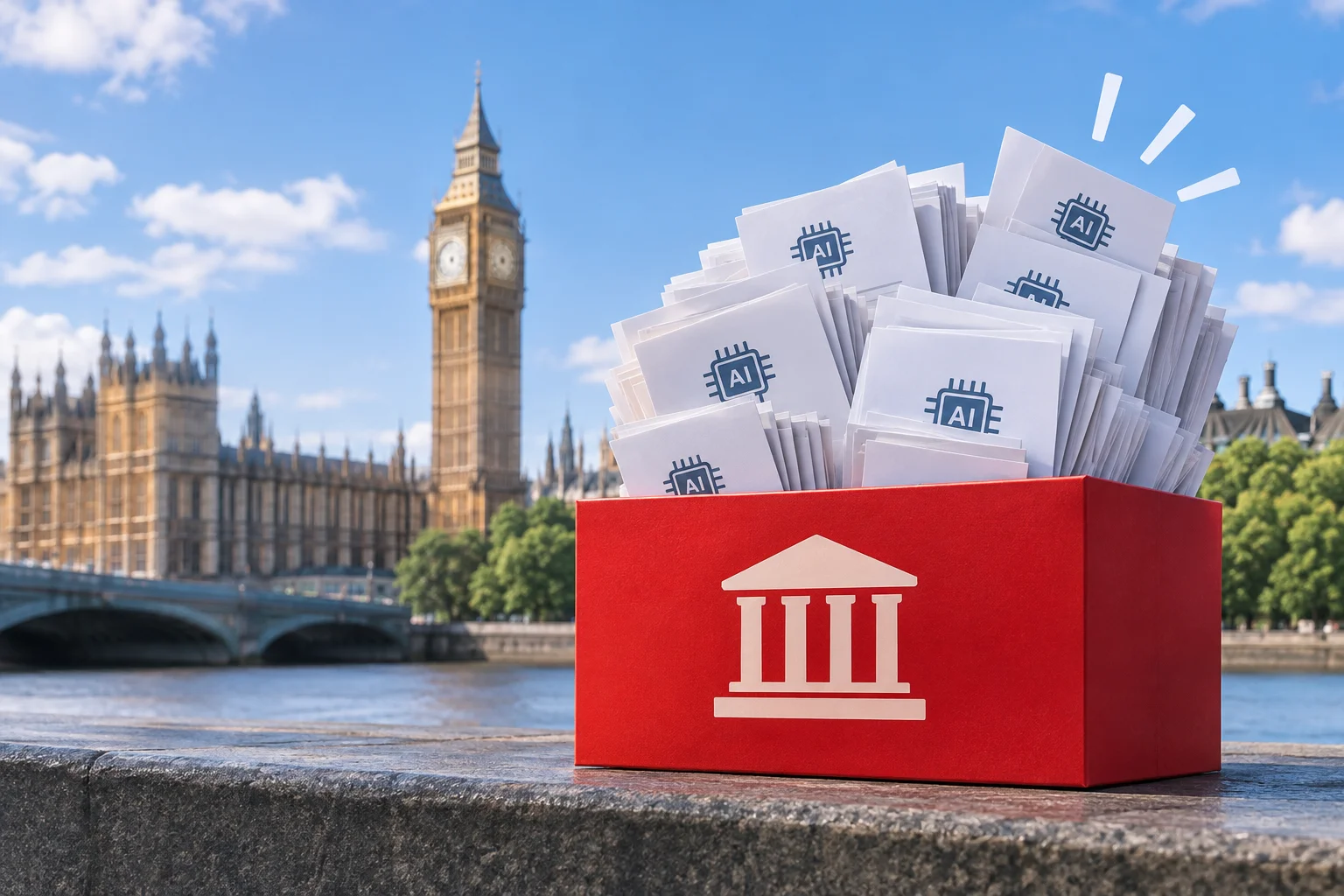
The UK's Financial Conduct Authority (FCA) received more applications for its innovation services in the first half of 2026 than in all of 2025, it said Tuesday. Artificial intelligence featured in 37% of proposals, up from 31% last year.
The services allow firms to test new ideas in a controlled environment or ask how existing rules apply to a product. Most demand came from newcomers, Colin Payne, the FCA's head of innovation, wrote in a blog post.
Among applicants, 92% were using the FCA's innovation services for the first time, and 64% of proposed products had a retail element. Payments and digital assets accounted for the largest sector-specific share of recent applications.
The figures come as the five-month window the FCA opened on September 30 for crypto firms seeking authorization remains open. It closes on February 28, 2027.
London's trading industry is coming home!
Stablecoin Tests and AI Proposals

Payne wrote that the applications so far suggest that "innovation is scaling up, becoming more sophisticated,".
The FCA said about a third of applications combined activities from more than one sector. Payne cited the sandbox's stablecoin cohort as an example. In February, the regulator selected Revolut, Monee Financial Technologies, ReStabilise and VVTX from 20 applicants for the group.
The cohort tested how proposed requirements for UK stablecoin issuers could work in practice. The FCA halved the planned capital buffer for issuers to 1% when it finalized the rules in June. They take effect on October 25, 2027.
The FCA said in February that firms in the cohort will still need authorization under the new regime. FM Intelligence's license and registration monitor tracks this kind of change in status across regulators' registers.
Payne wrote that firms are exploring how to deploy, oversee and govern AI. Proposals included tools to help consumers manage their finances, support business payment processes and provide customers with more personalized guidance.
A separate AI Live Testing service welcomed a second cohort of eight firms in April, including Barclays, Lloyds Banking Group and UBS. Their tests are scheduled to finish by the end of 2026.
The Financial Times reported in October that the FCA is not preparing AI-specific rules for the industry, even as the regulator plans to use AI to automate parts of its own supervision.
Sandbox Demand Keeps Climbing
The half-year total extends a rise already reflected in annual figures published by the FCA. In 2025/26, the FCA recorded 332 applications across the Regulatory Sandbox, Innovation Pathways and its Digital Sandbox, about 89% more than the 176 received a year earlier.
Sandbox applications increased 173% to 142 and, for the first time, exceeded applications to Innovation Pathways, which received 113. A separate AI testbed, the Supercharged Sandbox, established by the FCA with Nvidia in 2025, received 132 applications and supported 23 firms.
The regulator accepted 10% of sandbox applicants in 2025/26. According to FinanceMagnates.com's calculation, the sandbox received about 2.7 times as many applications as the 52 it received in 2024/25, while accepting one in ten.
Payne's post said around 70% of sandbox applications came from firms that were two years old or younger. Preliminary research suggests that about 71% of past participants were still active as of September 2026, he wrote, adding that the analysis is ongoing.
The regulator now also runs themed cohorts alongside its standing services. A climate scenarios cohort opened for applications on October 1, while registrations for its Quantum Experimentation Group, which will test quantum machine learning for money laundering detection, remain open until December 31.