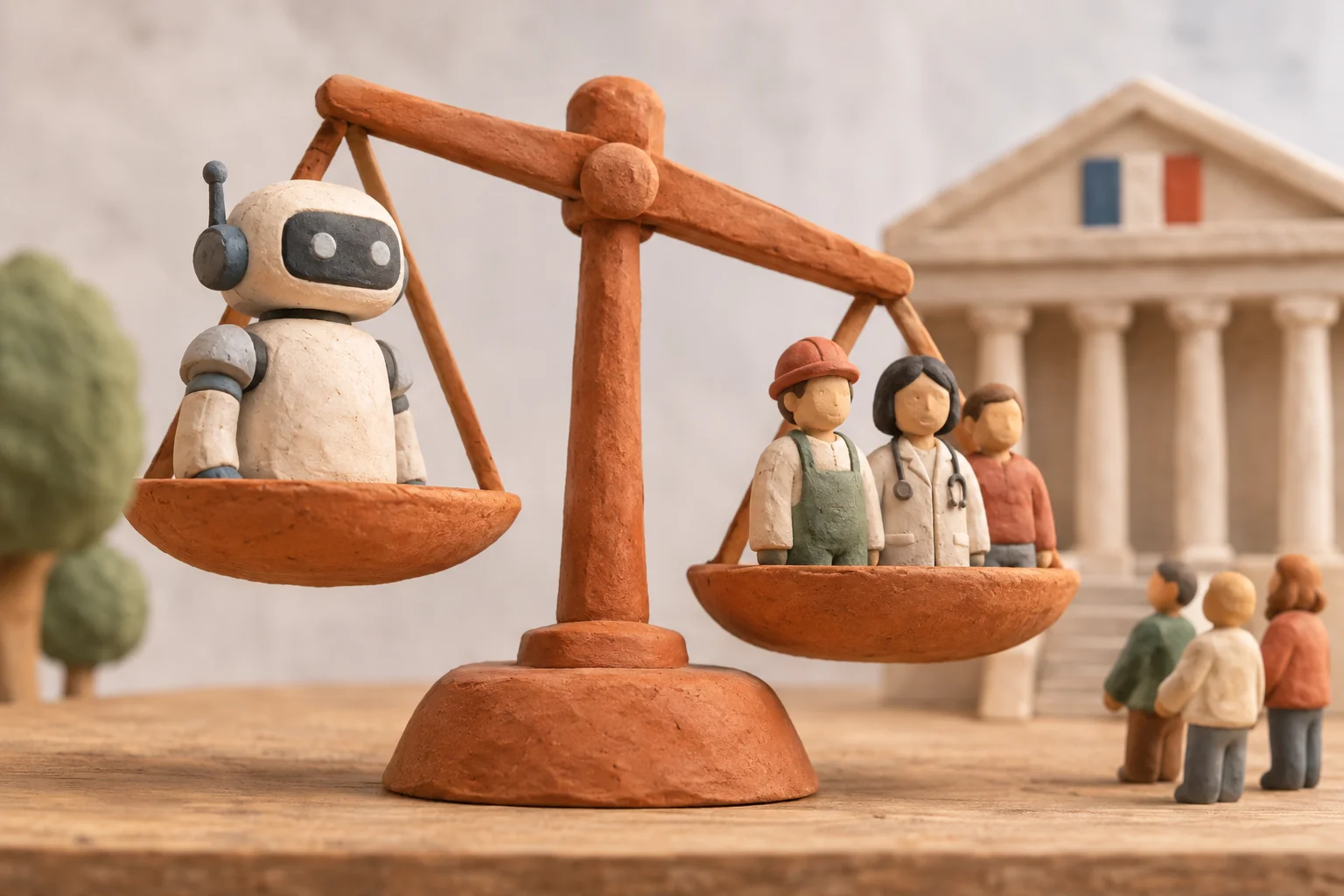
Having AI and robots contribute in order to lighten payroll contributions: Michel-Édouard Leclerc is putting the funding of social protection back on the table as automation advances. Already championed by Bill Gates and, in France, by Benoît Hamon during the 2017 presidential election, the idea still faces difficulties of definition and implementation.
Having AI contribute to raise wages
Michel-Édouard Leclerc wants to rethink the funding of social protection. The chairman of the strategic committee of E.Leclerc centers proposes shifting part of the contributions linked to work onto artificial intelligence, robotics and digital technology. In his view, this could bring net wages closer to gross wages without abandoning the French social model.
The executive advocates widening the contribution base, in other words the activities and income subject to levies. He would notably include technologies that compete with human labor, as well as part of imported services.
To bring net wages closer to gross wages and preserve our social model, I propose widening the base of contributors to the competitors of "human" labor, to AI, to robotics, and why not to part of imported services.
We can no longer… pic.twitter.com/b1Uur70JNs
- Michel-Édouard Leclerc (@Leclerc_MEL) November 16, 2026
He believes this change would spread the funding of social protection more widely, while demographic aging and automation weaken a system financed largely by wage contributions. He calls on Bercy to study costed scenarios and on candidates for the 2027 presidential election to take up the issue.
An idea already championed by Benoît Hamon and Bill Gates
The proposal is not new. Benoît Hamon, the Socialist Party candidate, had advocated a contribution on robots during the 2017 presidential campaign. That same year, the European Parliament rejected a proposed tax intended to fund support for workers replaced by machines.
Bill Gates has also defended this principle since 2017. The Microsoft co-founder raised it again in an essay published on August 26, then in an interview given to CNN on October 11. He notably proposes taxing robots and tokens, the units used to measure and bill the consumption of AI models.
His argument rests on a tax asymmetry: employing a person triggers levies on their salary, whereas investing in a machine can qualify for deductions. A contribution on automation could finance retraining and social protection, while also slowing some substitution of human labor.
In Germany, Digital Minister Karsten Wildberger also argued in mid-October for taxing the revenues generated by this technology to finance the transition.
A contribution that is hard to define
It remains to be defined what would be taxed. An industrial robotic arm, accounting software and an AI capable of writing code can all automate tasks, but their operation and their effects on employment differ.
South Korea is often presented as a pioneer in this area. However, the measure introduced in 2018 consisted of reducing certain tax advantages linked to automation investments, not of establishing a contribution comparable to an employee's payroll levy.
A general tax could also affect tools that assist employees and increase their productivity. Its application also raises an international question: how should AI services supplied from abroad be treated without penalizing only local businesses? At this stage, Michel-Édouard Leclerc proposes neither a rate, nor a precise mechanism, nor a revenue estimate.