
A Bitcoin address that had not moved coins since February 2011 transferred 75 $BTC on Nov. 17, according to Galaxy Research. At the current price of $64,935 per $BTC, the coins are worth around $4.87 million.
The address is listed as a defendant in a $250 billion lawsuit in New York Supreme Court. The plaintiffs are seeking to have early Bitcoin wallets declared "lost." Galaxy Research said several other addresses on the same list also moved coins in 2026.
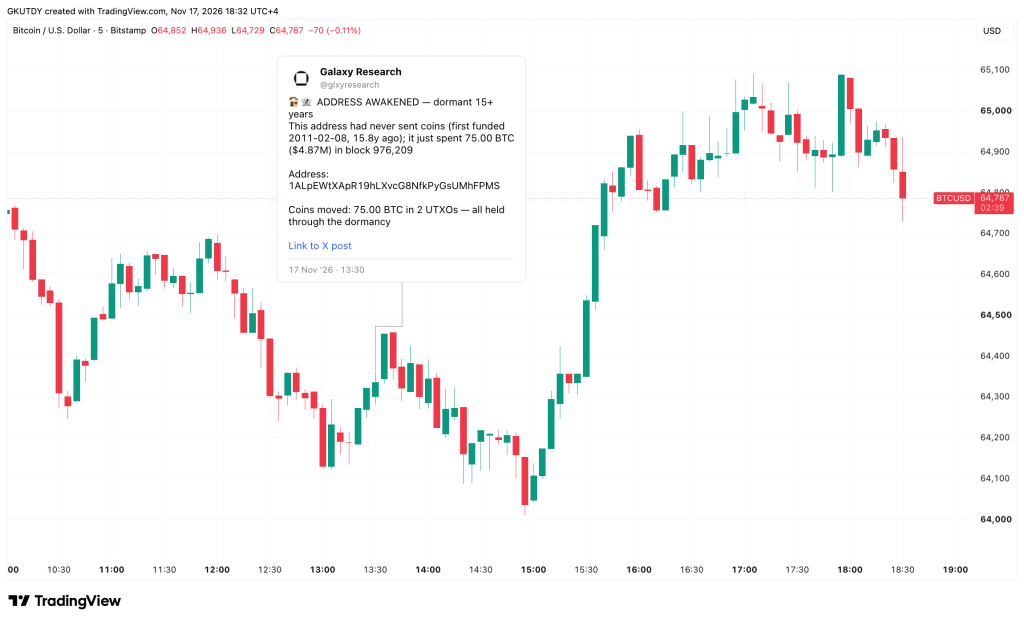
Galaxy Research analysts said the address 1ALpEWtXApR19hLXvcG8NfkPyGsUMhFPMS first moved coins early on Nov. 17, in block 976,209. It was first funded on Feb. 8, 2011, when Bitcoin was trading at about $0.90. After 15.8 years, the coins were sent to an unknown address with a 399-satoshi fee, or about 26 cents, representing a paper gain of more than 7,000,000%.
Onchain databases label the wallet Noah Doe #3409 (Salomon Client Dusted). That label led to its inclusion among the defendants in the high-profile case ABC Company, XYZ Company, and Noah Doe v. John Does 1–39,069.
According to the lawsuit, an anonymous plaintiff using the pseudonym Noah Doe and two companies are seeking rights to 39,069 Bitcoin wallets that have not moved coins for more than five years. The plaintiffs said the wallets hold about 3.8 million $BTC, worth around $250 billion at the current price.
Noah Doe plaintiffs invoke New York lost-property law
The plaintiffs brought the lawsuit under New York's lost-and-found law, Article 7-B of the Personal Property Law. Under the law, someone who finds lost property must give it to the police. If the owner does not claim it within the required period, the property goes to the finder. In the lawsuit, the plaintiffs valued each address at less than $10 and argued that the waiting period for such items was one year.
They "found" dormant addresses using an algorithm, saved them to USB flash drives and took them to the New York Police Department (NYPD). They then notified the owners on the blockchain through microtransactions containing embedded messages (OP_RETURN). The practice is known as "dusting,", and the campaign is tied to Salomon Brothers Strategic Advisors. After the waiting period expired, the plaintiffs asked the court to recognize the coins as theirs.
The case has been put on hold several times amid motions to dismiss and amicus curiae briefs from outside experts. At a hearing on Sept. 8, the Bitcoin Policy Institute asked to intervene as a defendant, while The Digital Chamber asked to join the case as amicus curiae. Galaxy Research described it as a case "in which anonymous plaintiffs are seeking to claim legal title over Satoshi's coins."
Will Owens of Galaxy Research, who attended the hearing, said The Digital Chamber's arguments were "well pleaded" and that "the judge sounded sympathetic to them."
Critics of the lawsuit argue that Article 7-B was written for things that can be picked up and handed over for safekeeping. It was not written for blockchain records when the "finder" does not hold the private keys.
In September, Galaxy head of research Alex Thorn also said the Lost and Found Property Law includes "protection from 'Noah Doe-style' dormancy attacks on legal ownership."