
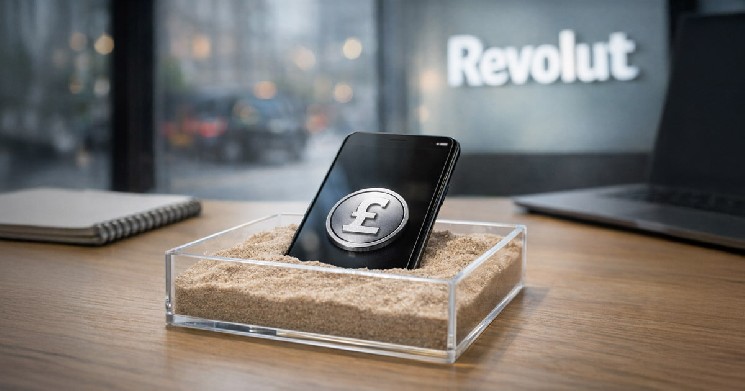

Revolut is preparing to trial a pound-backed stablecoin inside a regulated stablecoin sandbox in the UK, with testing expected within the current quarter. While this might look like another fintech pilot in the long history of crypto payment tests, the more interesting part sits upstream of the token itself.
Revolut has what most stablecoin projects spend years trying to build: distribution inside ordinary money habits. Over 12 million users in the UK open the app daily to check balances, move funds, split bills, pay subscriptions, exchange currencies, and send money across borders.
A stablecoin placed inside that flow and that big of an audience succeeds or fails on product clarity and on supervision that keeps the instrument understandable to users. In that frame, the trial is for a new container for everyday balances.
The FCA selected four firms for the trial, including Revolut, and framed the program as real-world testing with safeguards so policy can be shaped around live behavior. In the UK, that supervised path is the route that changes crypto from a concept to regulated payment methods.
What it means to spend stablecoins inside a consumer app
Most people experience payments as a sequence: keep a balance, send it, spend it, and trust that the transaction finishes cleanly. A stablecoin inside Revolut turns that sequence into a set of choices with different rights, risks, and mechanics.
To fully understand the difference, we need to start with the balance. A stablecoin balance is a claim on reserve assets held by an issuer, structured to hold a 1:1 value with the pound. The promise users care about is simple: £10 in, £10 out, whenever they want it. Supervisors are the ones focusing on the conditions that make that promise durable, including reserve quality, custody, redemption rights, and operational controls.
Then comes transfer. In the app, transfers can stay inside Revolut’s own ledger, where the system updates balances without touching a public blockchain. Transfers can also run onto external rails, where the stablecoin leaves the platform and lands in another wallet or another venue.
The FCA’s sandbox material describes Revolut’s concept as something customers can buy, hold, sell, and transfer both within the platform and “across the crypto ecosystem.” That phrasing means it’s a product designed to function as both a payment balance and a crypto-native instrument.
And last comes spending. There are two broad ways the product can support it. The app can convert stablecoins to fiat at the point of sale and pay a merchant through existing card or transfer rails, making the stablecoin a funding source behind the scenes. The app can also support merchant acceptance of the stablecoin itself, making it the unit of settlement.
The first path lowers friction because merchants won’t need any new tooling. The second path opens room for lower-cost settlement, programmable payments, and cross-border flows that skip layers and layers of intermediaries.
The UK’s regulatory line: a clear product with explicit protections
Once stablecoins move from exchanges into consumer finance apps, the main risk becomes confusion. A stablecoin can feel like cash in an app, while the legal and prudential protections couldn’t be more different from a bank deposit. Supervisors care about branding, disclosures, and the exact protections that attach to each balance type.
The Bank of England has advised banks to use distinct branding for stablecoins to reduce confusion with deposit protection. The principle is simple: a person seeing “£1,000” in an app should understand whether the balance sits under deposit protection, which entity stands behind it, and what happens in a failure scenario.
This is also where the UK’s institutional stance comes through. The Governor of the Bank of England, Andrew Bailey, said he preferred tokenized deposits over stablecoins. That’s because tokenized deposits keep money inside the banking perimeter while modernizing how the representation and settlement layers look.
Stablecoins, however, are a parallel instrument that can live outside bank balance sheets, even when fully backed, and that forced supervisors to define what “money-like” means in both law and in consumer expectations.
The UK is running this debate through a controlled environment with a small cohort of companies and very tight guardrails. The FCA calls is “supervised experimentation in real-world conditions with safeguards.”
That’s the bridge crypto needs to cross to reach the magical land of regulated payments: a pilot with oversight and reporting.
Revolut’s base effect in Europe: tiny volumes, big room for distribution
One statistic explains why a small trial like this can carry weight outside the UK: European non-dollar stablecoins, including euro, pound, and Swiss franc tokens, make up less than 0.2% of the global stablecoin volume.
Treat that number as a map of behavior. The global stablecoin economy is dollar-first, built around trading venues, cross-border dollar access, and crypto-market settlement.
But in Europe, stablecoins still sit at the edge of daily use. In a region starting from a base this small, distribution can do a lot of work, much more than marketing. If people already have the app, the adoption question becomes a product question: Does the stablecoin balance feel useful enough to keep?
A pound stablecoin inside an app with a large user base becomes a distribution test in a market that barely appears on stablecoin volume charts. The numbers can stay modest, but the behavioral change can still happen quickly, with users treating a stablecoin as a normal balance.
Why supervisors are opening the door now
The UK has been busy building a roadmap that positions stablecoins within a wider payments modernisation plan for some time. The FCA said stablecoin payments were a priority for 2026 and tied that work to its sandbox so firms can test issuance and payment use cases under its supervision.
That’s in line with the schedule set in HM Treasury’s Payments Forward Plan, which lays out consultation and rulemaking steps for 2026 and 2027, including work on systemic stablecoins, FCA policy, and an eventual regime going live in late 2027.
The most important part of this is the staged route: pilot cohorts first, then the policy framework that can support broader rollout.
Europe’s stablecoin stack is forming, and the timelines are telling
Revolut’s trial sits on the fintech side of the market: user distribution, wallets, and spending behavior. European banks are building the other side: regulated issuance meant to anchor stablecoins closer to institutional money.
A consortium of major European banks formed a company called Qivalis with plans for a MiCA-compliant euro stablecoin, targeting the second half of 2026. UniCredit, which is part of the consortium, said it was building a European alternative in a market dominated by US-linked issuers.
Put this together, and you get a two-part build. Fintech companies can make stablecoin balances feel normal through everyday use. Banks can push issuance toward regulated money frameworks, with governance and reserve practices that supervisors can audit.
If both of these things happen at the same time, Europe will get a stablecoin market that looks like a payments instrument that can plug into tokenized securities settlement, cross-border transfer systems, and merchant flows.
That’s the wider context for the UK sandbox test. The token might be local, but the arena is global: who sets the norms for what stablecoins are for, how they’re supervised, and how they sit next to bank deposits.
What would count as real usage?
However, even if the trial turns out to be a huge success, that won’t prove mass adoption. So, what signals real use other than a contained pilot?
One of the first signs of adoption would be transfers. If users can send stablecoins to each other as easily as they send fiat inside Revolut, that’s a meaningful behavioral win. It turns the stablecoin into a person-to-person rail rather than a trading feature.
Then we’d see spending. Internal conversion can still matter, especially if it lowers costs or improves cross-border speed, while keeping the stablecoin invisible to merchants. But direct settlement is a larger leap because it pushes stablecoins into the part of the economy where consumers meet real-world pricing, refunds, disputes, and chargebacks.
Pricing will do its own sorting. If stablecoin transfers manage to undercut card and correspondent banking costs, usage will have a very practical reason to persist. But if the experience lands on top of the same fees, usage will likely stay thin.
Revolut’s trial won’t immediately usher in a new age of adoption, but it will most likely have a significant effect on the market. It already shows that regulators are willing to take a bet on stablecoins and see how they fare in a payment app as large as Revolut.
Europe’s non-dollar stablecoins barely register in global volume, and that’s why distribution and regulatory permission carry so much weight. When the base is this small, a credible container can move the curve faster than any token launch can.
The UK is now letting that container be tested with oversight, on a schedule that treats stablecoins as part of the payments system rather than a side project.
