
Has post-CPI FUD created another chance to buy when others are fearful?
Santiment analysts appear to think so. Their report says retail traders are extremely bearish, with just 0.82 bullish comments for each bearish comment about Bitcoin. Such pessimism could, however, point to a contrarian buying opportunity, as extreme retail fear has historically emerged near market bottoms.
The timing is no coincidence. Retail optimism has been waning as the U.S. economy continues to grapple with sticky inflation. U.S. headline CPI rose 0.4% in October, compared with expectations of 0.3%, while core CPI rose 0.3%, against expectations of 0.2%. The result has been a shift in market expectations.
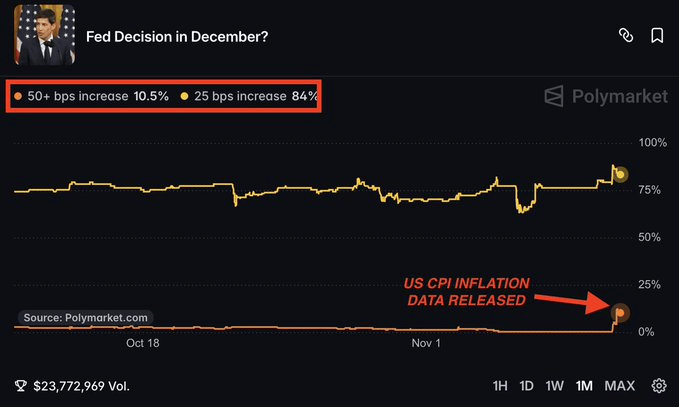
As the chart above shows, expectations for rate hikes have climbed quickly. For example, the odds of a 50-basis-point increase in December have risen to 11%, while the expected probability of a 25-basis-point increase is 84%. This has put the Fed’s December decision back in focus.
The concerns go beyond that. Peter Schiff has also weighed in on worries about persistent inflation. He noted that CPI rose 0.4% in October, bringing the total increase in 2026 to 4.15%, with two months still remaining in the year. If the trend persists, inflation could reach 5% by year-end, putting further pressure on the Fed to maintain tight monetary policy.
Bitcoin [$BTC] may therefore be seeing a rise in retail pessimism alongside an increasingly bearish macro outlook. That could support Santiment’s contrarian indicator—but does the heightened macro risk make it too risky to “buy the dip?”
Santiment’s contrarian Bitcoin-buying signal faces a reality check
The post-CPI reaction has also triggered another crypto wipeout.
Notably, there have been three episodes of long liquidations exceeding $500 million in less than two weeks since the start of November. This points to major waves of market deleveraging, as traders are forced out of their long positions. Yet, despite these leverage resets, a bearish bias still appeared to prevail.
More importantly, on-chain data has added to the pressure. Tether’s supply is shrinking much faster than it did during the FTX collapse.
For example, over the last 60 days, USDT’s market capitalization fell by $6.6 billion—more than twice its decline in December 2022. Meanwhile, as Bitcoin dropped from $79,000 to $73,000 last week, large holders cut their balances by more than 34,000 $BTC, worth roughly $2.6 billion.
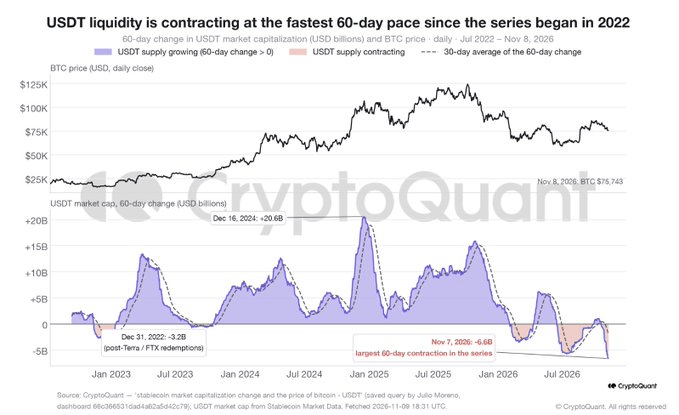
In short, the market is not yet showing clear signs of contrarian buying.
Instead, reduced liquidity and a lack of solid smart-money accumulation suggested that this downturn may not represent the usual transition phase from short-term to long-term holders. That would make retail pessimism a weaker signal of a market bottom, particularly as large holders continue to reduce their exposure.
As a result, Santiment’s contrarian indicator is in question. Given inflation concerns, rising expectations for a December rate hike, and weak on-chain indicators, the risk-reward profile of this Bitcoin dip could be unfavorable—especially since the market may still face a deeper correction.
Final Summary
-
Rising retail fear could create a Bitcoin buying opportunity, but inflation and rate-hike concerns are adding pressure.
-
Falling liquidity, whale selling, and heavy long liquidations mean the market could face further downside.
Add A Comment
Comments are closed.