
After the November 2026 U.S. midterm elections, Bitcoin briefly rose above $81,000, but the rally soon faded. Bitcoin initially held up well after Democrats swept Congress, but a sell-off in tech stocks quickly erased its gains
$BTC has since fallen to $73,700, leaving traders focused on what the election result really means for Bitcoin and crypto.
Bitcoin Post-Election Price Timeline
On U.S. midterm election day, $BTC closed near $77,435, but the initial response was not bullish. As early results pointed to Democrats taking control of both the House and Senate, Bitcoin slipped to an intraday low near $75,649.
The selling was short-lived. As the election result became clearer, traders returned to Bitcoin calls, helping $BTC stage a sharp V-shaped recovery. Buying pushed Bitcoin to a post-election high of $81,196.
Perhaps the recovery did not last.
By November 5, Bitcoin had retreated toward $75,942 as U.S. technology stocks underwent a sharp sell-off. Over the weekend and into November 9, $BTC continued to trade between $74,500 and $76,100.
The latest decline followed October U.S. CPI data showing inflation rose 0.4% month over month, above the 0.3% forecast. Core CPI also came in at 0.3%, compared with expectations of 0.2%. Bitcoin fell toward $73,400 after the report.
Why Is Bitcoin’s Post-Midterm Rally Losing Steam?
Bitcoin’s main challenge is that the election removed one source of uncertainty without easing the broader pressure.
A Democratic majority in Congress could make it more difficult for major pro-crypto proposals to advance, including renewed efforts related to the CLARITY Act and a potential Strategic Bitcoin Reserve.
The election result may also affect Bitcoin miners expanding into AI. According to CoinGeek, new Democratic governors in Texas, Georgia, and New Mexico have pledged to pause or halt data center projects. This could make it harder for miners to grow their AI businesses.
However, Core Scientific plans to exit mining by Q4 2026, while IREN expects mining to make up a small part of its business in 2027.
That leaves Bitcoin in a difficult position. Attention has now shifted from the election result to whether Bitcoin can reclaim the levels it lost after the rally.
Historical Midterm Data Suggests Bitcoin Could Still Recover
The fading rally does not necessarily mean Bitcoin’s post-midterm cycle is over. Coinpedia news reports that Bitcoin gained in the 12 months after each of the previous three U.S. midterm elections. $BTC rose 24.5% after the 2014 election, 44.9% after 2018, and 92.3% after 2022.
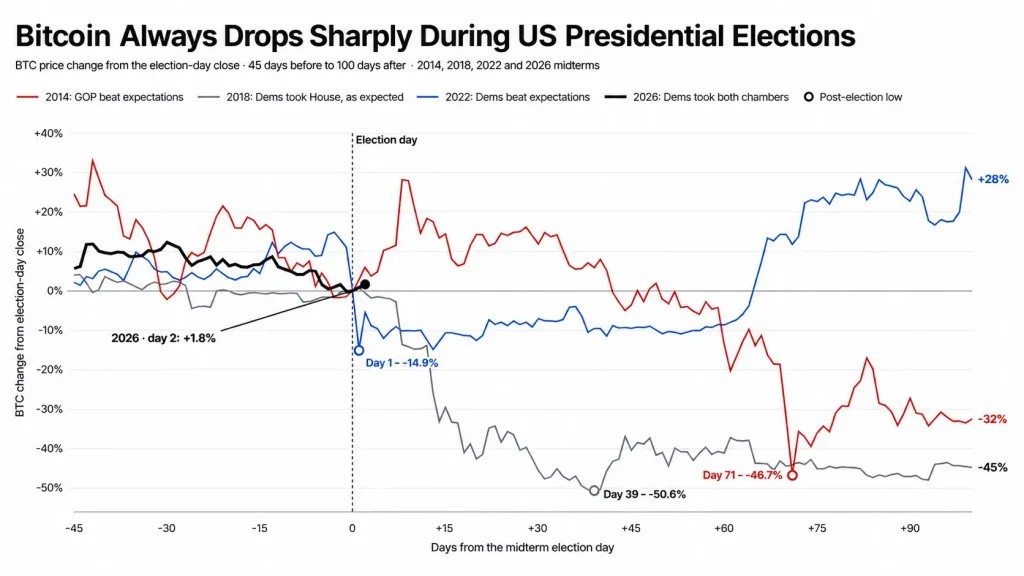
In previous cycles, Bitcoin often reached a major bottom after the midterm election, rather than just before it.
Historical data shows that bottoms occurred 71 days after the 2014 election, 39 days after 2018, and 13 days after 2022. In 2026, however, Bitcoin had already reached around $57,718 in July, well before the November election.
That makes the current cycle different.
For now, Bitcoin’s post-election rally has lost momentum. However, historical data shows Bitcoin has often bottomed 13 to 71 days after midterm elections before beginning to recover. This suggests the market’s next move may not become clear in the first few days.
Add A Comment
Comments are closed.