


There is no credible evidence that the U.S. National Security Agency (NSA) created Bitcoin, and comparisons between Bitcoin’s white paper and a 1996 NSA paper on electronic cash are extremely misleading at best.
No Smoking Gun: The NSA’s 1996 Paper Is Not Bitcoin, and It’s Not Even Close
Conspiracy theories flourish in the absence of facts, and among the most persistent in the cryptocurrency community is the claim that Bitcoin was created by the U.S. National Security Agency (NSA). This theory hinges on the existence of a 1996 research paper titled “How to Make a Mint: The Cryptography of Anonymous Electronic Cash,” authored by NSA cryptographers. But a closer, fact-based examination reveals the fundamental flaws in this argument and affirms that the NSA did not — and could not — have created Bitcoin.
The NSA paper, released more than a decade before the Bitcoin white paper in 2008, is a literature survey of existing cryptographic research on digital cash. It discusses various centralized, privacy-focused e-cash schemes and their security implications. While it introduces concepts like public-key cryptography, blind signatures, and anonymity mechanisms — all of which had been established in academic literature by the early 1990s — the paper stops far short of proposing a decentralized or trustless system. That alone sets it apart from Bitcoin’s radically different architecture.
The NSA’s paper is not at all like Bitcoin and relies on a centralized entity (a bank) for verification and security. Image Source: The NSA paper called “How to Make a Mint: The Cryptography of Anonymous Electronic Cash.”
The Bitcoin white paper, authored by the pseudonymous Satoshi Nakamoto, introduced a groundbreaking innovation: decentralized consensus through proof-of-work (PoW) and a distributed ledger (blockchain) with no need for a central authority. This idea does not appear anywhere in the NSA’s 1996 document. In fact, all of the NSA’s example systems depend on a central financial institution like a central bank to issue, verify, and redeem digital currency tokens. Bitcoin was built precisely to avoid that centralized trust model.
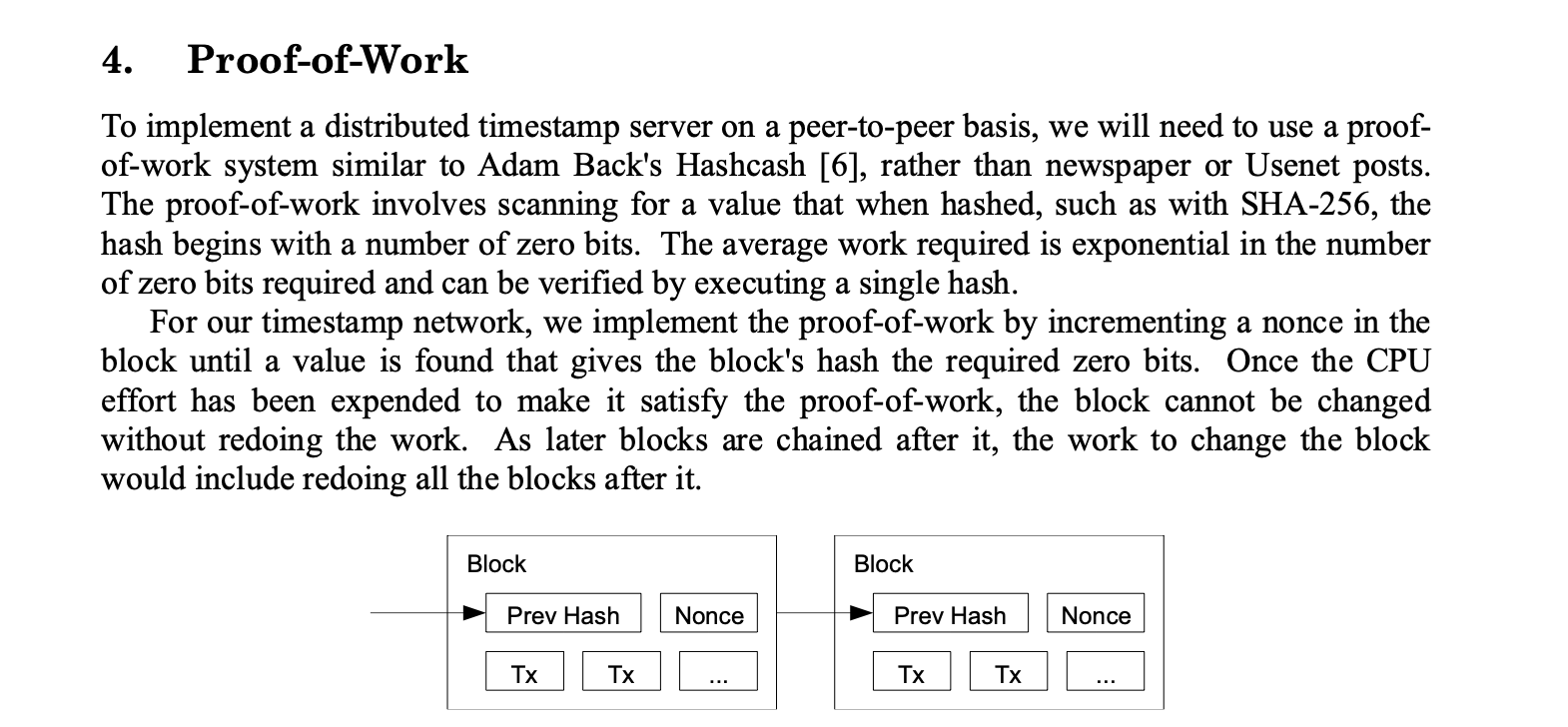
The NSA’s paper does not include Proof-of-Work (PoW), and it relies on previous designs like e-cash that ultimately failed due to centralization. Image Source: Bitcoin white paper.
The conspiracy theory that the NSA created Bitcoin is often couched in circumstantial suggestions, with zero hard evidence. These include the NSA’s longstanding involvement in cryptography, its employment of skilled mathematicians, or its early involvement in standards like SHA-256 — the hash function used in Bitcoin’s mining algorithm. But none of these points constitute proof. That a government agency contributed to the development of foundational technologies is not evidence of authorship. If this logic held, every software project built on TCP/IP or AES encryption and the Internet itself could be attributed to a U.S. government agency.
Moreover, there is no hard documentation, whistleblower testimony, leaked memos, internal code repositories, or corroborated witness accounts suggesting the NSA ever worked on a project resembling Bitcoin. In an era where classified programs and surveillance operations have been exposed by insiders like Edward Snowden, it is inconceivable that a state-originated Bitcoin project would remain entirely undetected for over a decade, especially after achieving global prominence. Furthermore, the renowned whistleblower Snowden is a $BTC proponent.

Edward Snowden is a renowned NSA whistleblower, and he supports $BTC. Why would an NSA whistleblower support something the NSA created?
Claims that Satoshi Nakamoto’s writing style, code, or behavior are consistent with intelligence operations are entirely speculative and unsupported by linguistic or any forensic analysis. In fact, detailed textual studies have shown that Satoshi wrote with British spelling conventions and displayed philosophical leanings — particularly regarding libertarianism and distrust of centralized banking — that directly conflict with the mission and motives of a U.S. intelligence agency.
Technically, the NSA paper and Bitcoin differ in nearly every meaningful respect. The NSA’s proposed systems rely on blind signatures, a technique invented by David Chaum in the 1980s to allow for anonymous but verifiable transactions — but still needs to be mediated by a bank. Bitcoin, by contrast, relies on public key cryptography for transaction validation and on a decentralized consensus system to prevent double-spending. The NSA paper even acknowledges that such systems are “far less satisfactory” from a law enforcement perspective — a position that further contradicts the development of a censorship-resistant, pseudonymous currency like $BTC.
The theory also ignores the cultural and philosophical context surrounding Bitcoin’s launch. The Bitcoin white paper was released in the wake of the 2008 global financial crisis — a period marked by distrust of central banks, bailouts, and opaque monetary policy. Its timing and the embedded message in the Bitcoin genesis block referencing a Times headline about bank bailouts, point clearly to an anti-establishment motivation. A creation by the NSA, tasked with securing state infrastructure and surveillance, would contradict the ethos embodied by Bitcoin’s design and launch narrative.
It is also important to note that the NSA paper never proposes a blockchain, never outlines PoW mining, and never introduces a mechanism for issuing a fixed monetary supply independent of institutional control. These features are central to Bitcoin’s innovation and absent from any pre-Bitcoin research by the NSA or any government-affiliated group that has ever existed.
That Bitcoin draws upon earlier cryptographic primitives is not in dispute. All scientific and technological advances build on prior work. But drawing a line from Chaum’s digital cash proposals or the NSA’s summary of the same to the creation of Bitcoin is like claiming the Wright brothers didn’t invent the airplane because they used physics that Newton described. Foundational principles do not imply authorship.
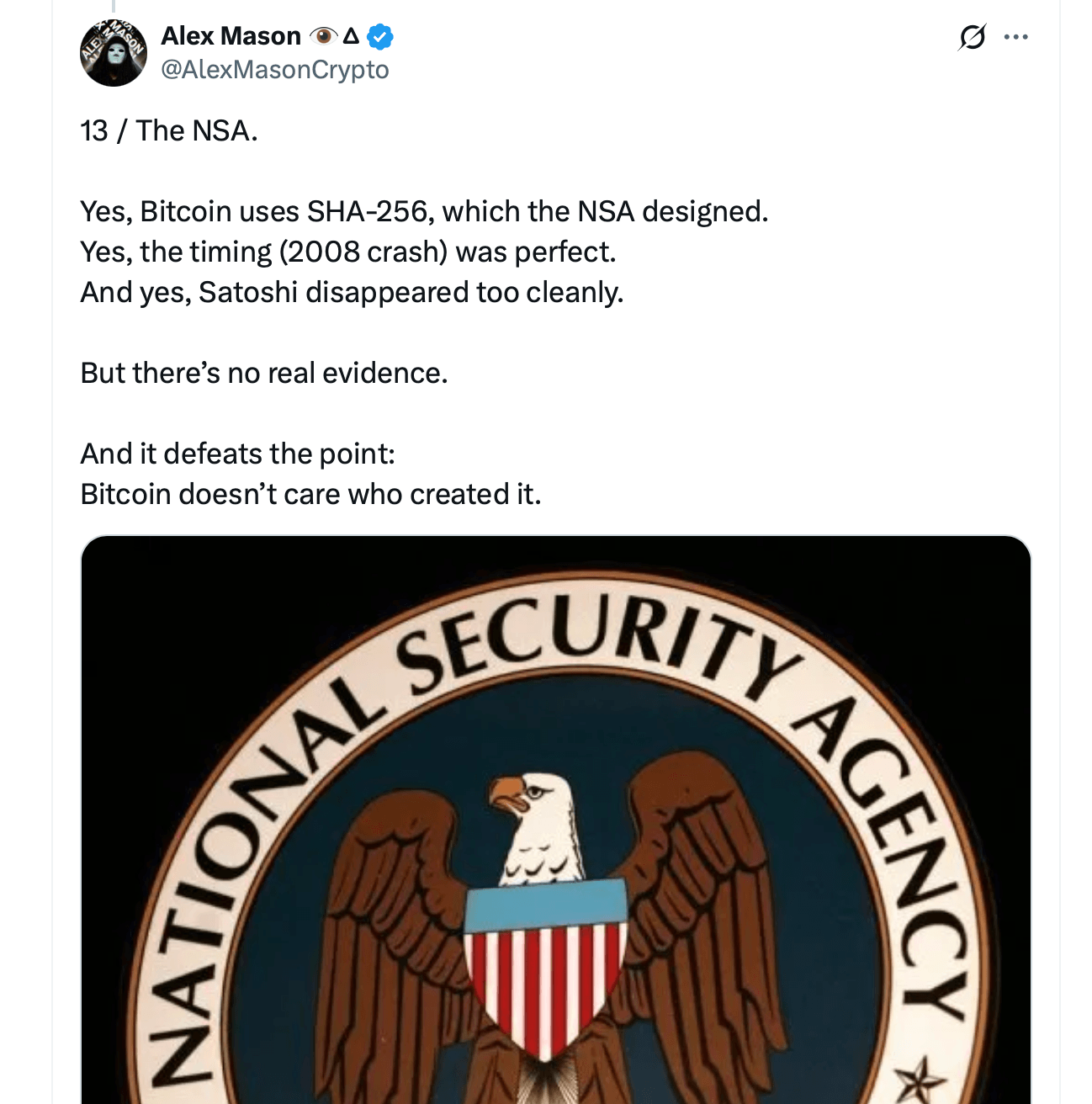
Bitcoin operates as a decentralized, open-source protocol that functions independently of its creator, meaning its value and security derive from code, consensus, and network participation—not identity or anything tied to an issuer or creator. The protocol is publicly auditable, the code is open-source, and its rules are enforced by users and miners worldwide, rendering speculation about its origins irrelevant to its operation. Believing absurd theories about its creation distracts from the technology’s real-world implications and ignores the transparent, trustless design that makes such foolish ideas moot.
Finally, promoting the idea that the NSA created Bitcoin does a disservice to open-source communities and decentralization advocates who have worked to strengthen the protocol, build infrastructure, and expand access to the technology. This theory is so absurd and it sows fear, uncertainty, and doubt (FUD) without contributing anything meaningful to the historical or technical record.
People who cling to theories like “the NSA created Bitcoin” often misunderstand the fundamental principles of how Bitcoin works—particularly its decentralized nature and trustless architecture. These theories tend to reflect a limited grasp of open-source systems and a discomfort with concepts that challenge traditional, centralized models of control.
Essentially, the theory that the NSA created Bitcoin is not supported by documentation, logic, reason, or technical comparison. The 1996 NSA paper is an academic overview of highly centralized, bank-dependent electronic cash systems, which contrasts fundamentally with Bitcoin’s decentralized and trustless design. The Bitcoin white paper introduced an entirely novel solution to the double-spending problem — a breakthrough the NSA paper neither describes nor hints at. Until hard evidence emerges, the claim that Bitcoin originated as a government project should be dismissed as foolishness and for what it is: a baseless conspiracy theory, not a credible hypothesis.
