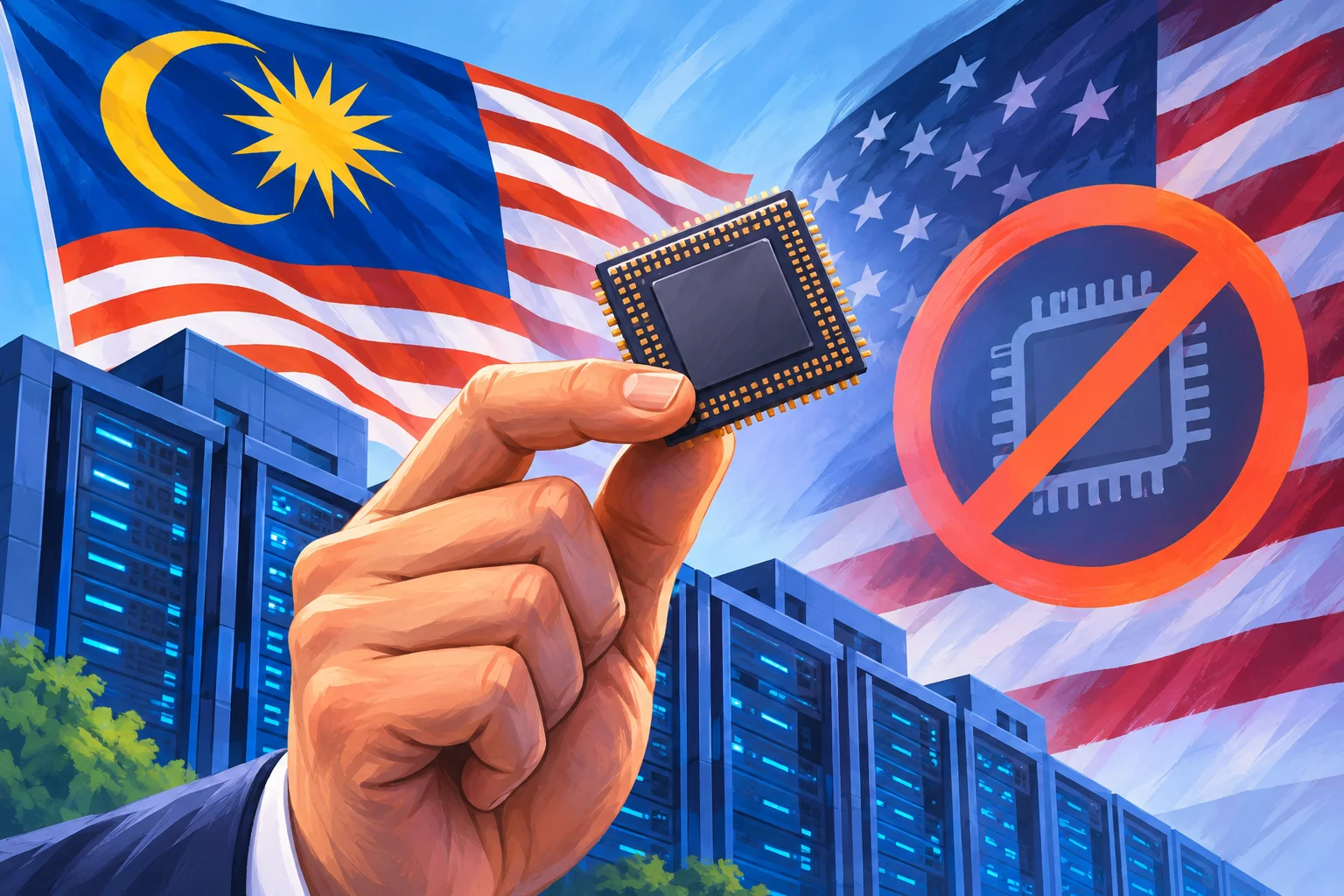
Malaysia has told its data centre industry to follow Washington’s rules on advanced AI chips. Investment, Trade and Industry Minister Datuk Seri Johari Abdul Ghani said on November 18, 2026 that data centre operators in the country must comply with new US export restrictions on high-end semiconductors.
The deadline is close. The US rule takes effect on November 19, 2026, giving the industry about a day between the warning and the deadline.
What the US rule actually does
The restrictions stem from an interim final rule issued by the US Bureau of Industry and Security (BIS), the Commerce Department agency responsible for export controls. Such a rule takes effect immediately while comments are being collected.
Under the rule, certain advanced semiconductors shipped to Malaysia will require an export license. Singapore, Thailand, Indonesia and Brazil face the same requirement. The concern is that the chips could be diverted to destinations Washington wants to keep them from reaching.
The rule also covers more than chip shipments. It sets licensing requirements for data centres that provide significant AI computing capacity to restricted entities, particularly those in China.
Johari told Reuters that data centre operators should comply with the US chip rules, describing the semiconductors as strategic assets. He also said he was unsure how the new rules would affect financing requirements for individual firms.
“Malaysia remains open to investment, and the new US rules and regulation will give investors and partners clear direction when operating in Malaysia,” Johari said.
In separate remarks to local media, Johari said Malaysia would seek clarification from US authorities about the restrictions. He specifically raised licensing and the provision of data centre services to third parties.
State news agency Bernama reported that Johari said the government would notify all 117 approved data centre projects in the country once the requirements had been communicated. Of those 117 projects, 55 were operational as of mid-November 2026.
A rapidly growing sector faces closer scrutiny
Malaysia’s data centre sector has expanded rapidly. The country has attracted nearly $100 billion in data centre investment since 2021, becoming Southeast Asia’s fastest-growing hub. Much of the activity is concentrated in Johor, the southern state across the border from Singapore.
This is not Malaysia’s first move toward greater oversight. In July 2025, the government introduced a Strategic Trade Permit requirement for US-origin high-performance AI chips. It required local permits for the same type of hardware Washington was already monitoring.
Kuala Lumpur is also drafting legislation that would require data centre operators to disclose detailed operational information, including electricity use and GPU imports.
A separate investigation is under way into the Malaysian unit of Singapore-based cloud company Megaspeed, also known as Speedmatrix. The company is reportedly under US scrutiny over possible re-export violations. No findings have been announced, and the investigation is ongoing.
What the rules mean for Malaysia’s data centre expansion
Uncertainty is the most immediate concern, as the minister has acknowledged. He has said he does not know how the rules will affect financing, and Malaysia is still seeking clarification on licensing and third-party services.
Demand from US hyperscalers, or large cloud providers, and a diverse investor base are expected to help cushion the impact. Bank Negara Malaysia, the central bank, expects the sector to continue growing through 2030, with Johor remaining at its centre.
Johari described the rules as giving investors “clear direction,”, presenting compliance as a selling point.
Several developments warrant attention. First, Malaysia is awaiting US authorities’ response on licensing and third-party services. Second, the proposed domestic disclosure law would give Malaysian regulators their own picture of energy use and chip imports. Third, the Megaspeed investigation is the first visible test of how strictly the new framework will be enforced.