
Close Menu
  • Coins
    • Bitcoin
    • Ethereum
    • Altcoins
    • NFT
  • Blockchain
  • DeFi
  • Metaverse
  • Regulation
  • Other
    • Exchanges
    • ICO
    • GameFi
    • Mining
    • Legal
  • MarketCap
What's Hot

How The February Bullish Trend Can Push It 20% Higher

02/05/2026

Eightco shares jump on $125 million funding commitment, investment in OpenAI, Beast Industries

02/05/2026

XRP Has Not Yet Priced in These Three Bullish Developments

02/05/2026
Facebook X (Twitter) Instagram
  • Back to NBTC homepage
  • Privacy Policy
  • Contact
X (Twitter) Telegram Facebook LinkedIn RSS
NBTC News
  • Coins
    1. Bitcoin
    2. Ethereum
    3. Altcoins
    4. NFT
    5. View All

    How The February Bullish Trend Can Push It 20% Higher

    02/05/2026

    Bitcoin faces structural pressure as institutional selling quietly rises: What’s next?

    02/05/2026

    Is Bitcoin price forming a bear flag at $66,900 as its daily MACD reaches its deepest negative reading in months?

    02/05/2026

    Here’s what ‘cracking’ bitcoin in 9 minutes by quantum computers actually means

    01/05/2026

    Will Ethereum hold $2,300 or slip lower from here?

    02/05/2026

    Ethereum is Trading -10.90% Below Our Price Prediction for May 02, 2026

    01/05/2026

    Galaxy Digital Sends ETH Worth $104 Million to Bybit, Binance and OKX, Sparking Selloff Concerns

    01/05/2026

    Viral Comparison Divides Crypto Community

    01/05/2026

    XRP Has Not Yet Priced in These Three Bullish Developments

    02/05/2026

    The great AmEx partnership with XRP that wasn’t

    01/05/2026

    SHIB Burns Collapse by 100% to Lowest Values This Month

    01/05/2026

    Dogecoin Soars 28% in Active Addresses: Are Bulls Active?

    01/05/2026

    The only rally during Bitcoin 2026 was Ethereum NFTs

    30/04/2026

    Are NFTs signaling a market shift? THESE indicators say yes

    28/04/2026

    Bored Ape NFT prices jump 81 percent as sales drop

    28/04/2026

    NFTs Attempt Another Comeback as Blue Chips Surge

    28/04/2026

    How The February Bullish Trend Can Push It 20% Higher

    02/05/2026

    Eightco shares jump on $125 million funding commitment, investment in OpenAI, Beast Industries

    02/05/2026

    XRP Has Not Yet Priced in These Three Bullish Developments

    02/05/2026

    Ripple Expands Korea Presence with Landmark Kbank Partnership

    02/05/2026
  • Blockchain

    Oobit delivers secure, controlled spending access for AI agents with Agent Cards launch

    02/05/2026

    Circle Launches Gas-Free ‘Nanopayments’ on Mainnet Across 11 Blockchains

    02/05/2026

    DGrid AI Partners Pieverse to Build Web3 AI Agent Infrastructure

    02/05/2026

    A Revolutionary Memory SDK Empowering AI Agents with Verifiable, Portable Memory

    01/05/2026

    Injective Unveils Platform for Autonomous AI Trading Agents With On-Chain Identity and Fee Rails

    01/05/2026
  • DeFi

    Andre Cronje says DeFi is ‘no longer DeFi’ as builders debate circuit breakers

    01/05/2026

    Aave scrambles to revive lending in wake of KelpDAO exploit

    01/05/2026

    DefiLlama Chain Rankings Highlight Ink’s 33% TVL Drop: What’s Behind the Drop?

    01/05/2026

    Sky Token Price Plunges Despite Record $124M Q1 Revenue as DeFi Giant Chooses Safety Over Returns

    01/05/2026

    Bitget Wallet and VeloraDEX for Deeper Liquidity and Better Pricing

    01/05/2026
  • Metaverse

    ‘8,000 Jobs’—Polymarket Sees Tech Layoff Surge As Meta AI Push Bites

    18/04/2026

    Planet Hares Partners With Magne.AI To Bridge Web3 Metaverse With Smartphone Mobile-Ready Applications For Mass Adoption

    08/04/2026

    Mark Zuckerberg’s Meta launches new AI initiative after metaverse retreat

    25/03/2026

    Meta partners with Arm to develop new CPUs for AI deployments

    24/03/2026

    Land values capitulate as $24M metaverse plot collapses to just $9,000

    20/03/2026
  • Regulation

    Eightco shares jump on $125 million funding commitment, investment in OpenAI, Beast Industries

    02/05/2026

    Wall Street Giants Morgan Stanley and Goldman Sachs Revise FED Interest Rate Forecasts! Worst-Case Scenario Revealed!

    01/05/2026

    MoonPay Offers Stablecoin Bonuses to Drafted Athletes in X Games League Push

    01/05/2026

    Circle’s outperformance highlights USDC’s staying power, says bullish Wall Street analyst

    01/05/2026

    DWF Ventures Reveals Crucial Potential for South Korea’s Financial Future

    01/05/2026
  • Other
    1. Exchanges
    2. ICO
    3. GameFi
    4. Mining
    5. Legal
    6. View All

    Ripple Expands Korea Presence with Landmark Kbank Partnership

    02/05/2026

    South Korean Court Halts Bithumb Suspension Following a Legal Battle

    02/05/2026

    Coinbase to Delist This Ethereum-Based Stablecoin in May

    02/05/2026

    Coinbase’s asset manager to offer stablecoin credit fund with tokenized share class

    01/05/2026

    ICO market slows sharply with only six completions in 2026

    30/04/2026

    South Korea Poised to Lift Ban on Domestic ICOs After 7 Years

    19/12/2025

    Why 2025’s Token Boom Looks Both Familiar and Dangerous

    31/10/2025

    ICO for bitcoin yield farming chain Corn screams we’re so back

    22/01/2025

    UXLINK and FishWar Partner to Redefine AI-Powered Social Gaming on Sei Network

    30/04/2026

    B3.Fun Partners With Neobank Veera To Supercharge Web3 Gaming Engagement With RWA-DeFi Applications

    30/04/2026

    B.AI and CROSS Transform the Future of AI in Web3 Gaming

    28/04/2026

    Tomoland Partners With Anome Protocol To Advance Web3 Gaming Engagement With DeFi Applications

    25/04/2026

    Why Bitcoin miners are moving toward AI (and what it really means)

    30/04/2026

    MARA Holdings to buy Long Ridge Energy in $1.5 billion AI data center push

    30/04/2026

    Hyperscale Data Q1 Revenue Surges 76% YoY to $44M, Boosts BTC Holdings Strategy

    30/04/2026

    Big Tech’s multi-billion dollar AI bets are still on track as Mag 7 giants report earnings

    30/04/2026

    Donald Trump to Speak at Florida Crypto Event on Clarity Act

    30/04/2026

    Trump Says World Becoming a ‘Casino’ as Soldier Charged Over Polymarket Maduro Bets

    30/04/2026

    Why Crypto’s Most Important Bill Is Stalling at 50/50 Odds Despite Presidential Backing

    30/04/2026

    New Cryptocurrency Bans Are Coming! Here Are the Details…

    30/04/2026

    How The February Bullish Trend Can Push It 20% Higher

    02/05/2026

    Eightco shares jump on $125 million funding commitment, investment in OpenAI, Beast Industries

    02/05/2026

    XRP Has Not Yet Priced in These Three Bullish Developments

    02/05/2026

    Ripple Expands Korea Presence with Landmark Kbank Partnership

    02/05/2026
  • MarketCap
NBTC News
Home»Blockchain»L2 Scaling Challenges May Undermine Ethereum and Bitcoin’s Long-Term Security
Blockchain

L2 Scaling Challenges May Undermine Ethereum and Bitcoin’s Long-Term Security

NBTCBy NBTC07/10/2024No Comments6 Mins Read
Share
Facebook Twitter LinkedIn Pinterest Email


Ethereum and Bitcoin, two of the world’s largest blockchains, are facing significant challenges in scaling their networks. As more users and transactions move to layer two (L2) solutions, these systems could undermine the security and sustainability of the base layer (L1), with fees and rewards for miners and validators dwindling.

Growing L2 Adoption Raises Concerns for Base Layers

Both Ethereum and Bitcoin are grappling with a fundamental issue: how to scale their networks to accommodate the growing number of users without sacrificing security or decentralization. Recently, Cybercapital founder Justin Bons presented his theory that Layer 2 (L2) platforms are “parasitic” to Ethereum. Bons has long cautioned about the growing influence of Ethereum L2 solutions on the main chain, as well as on other blockchains adopting L2 scaling methods. The following is an overview of the dilemma confronting Layer 1 (L1) blockchains such as Bitcoin and Ethereum.

In their current state, neither blockchain can process transactions at speeds comparable to centralized systems like Visa or Mastercard, and the fees for using the base layer can be prohibitively high. Since 2015, modifying Bitcoin’s consensus layer to improve scalability has sparked ongoing debate, leading advocates to increasingly favor L2 solutions like the Lightning Network. Ethereum core developers have likewise leaned toward enabling L2s like Arbitrum, Optimism, Base, and Linea to thrive.

These L2s promise faster transactions and lower fees, but they also introduce a new set of challenges. Layer two solutions, by design, offload transactions from the base layer, or L1, onto a secondary layer. For Ethereum, L2s like Arbitrum and Optimism bundle multiple transactions into a single L1 transaction, reducing costs and increasing throughput. For Bitcoin, the Lightning Network allows users to transact off-chain, only settling on the main blockchain when absolutely necessary. While these solutions have been celebrated for enhancing transaction speeds and reducing fees, they present a potential threat to the security and economic model of L1 blockchains.

Rent Paid to L1 (Ethereum) according to growthepie.xyz.

Ethereum’s layer one once benefited significantly from the activity on these L2s. In November 2023, L2 solutions like Arbitrum, Base, Optimism, and Linea contributed an estimated $200,000 in daily rent fees to Ethereum’s L1. By December, these fees soared to as much as $1.5 million per day. However, the financial support has since dwindled. From December 2023 to March 2024, L2 payments to Ethereum fell to under $250,000 per day, only to spike to around $1.7 million at the start of March. By the end of April 2024, these fees dropped drastically, with less than $10,000 per day being paid to the Ethereum mainnet. This decline raises questions about the long-term sustainability of Ethereum’s L1 infrastructure if most activity shifts permanently to L2s.

Bitcoin faces a similar issue. Once bitcoin (BTC) is moved to the Lightning Network or other Bitcoin sidechains, transactions bypass the main chain, leaving miners without the fees they would traditionally earn from processing transactions. The economic security of Bitcoin relies on the incentives provided to miners, both through transaction fees and the block reward, which halves roughly every four years. As fees move off-chain, there is growing concern that Bitcoin miners may no longer have sufficient economic motivation to continue securing the network, making it potentially less secure over time.
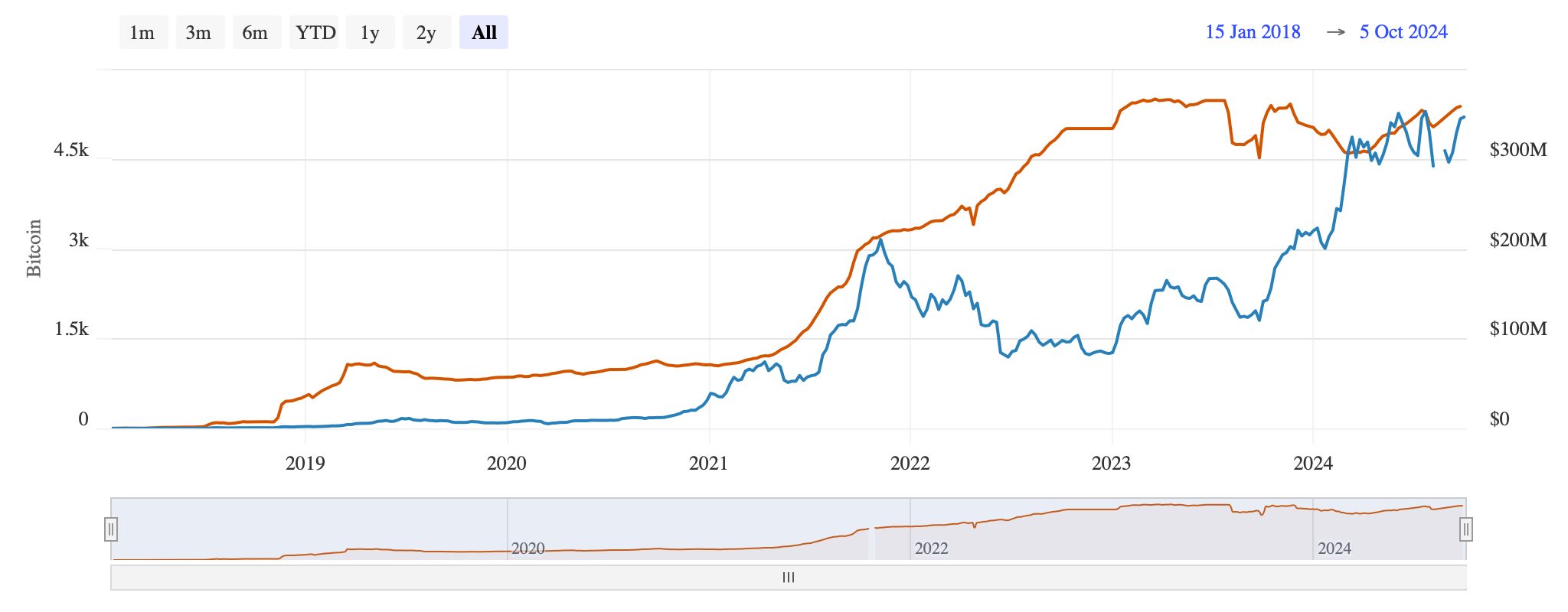
As of Oct. 6, 2024, the capacity of Bitcoin’s Lightning Network (LN) is approximately 5,360 BTC, according to data from bitcoinvisuals.com. Miners only receive fees when bitcoin (BTC) is moved on or off Lightning Channels, meaning that no fees are paid to them while transactions occur off-chain on LN. Similarly, wrapped bitcoin (WBTC) and other tokenized forms of bitcoin do not contribute significant fees to the L1 once they have been converted.

Alongside Bons, Nikita Zhavoronkov, Blockchair’s lead developer, has voiced worries regarding Bitcoin’s shrinking security budget. The fundamental problem lies in the fact that both Ethereum and Bitcoin were designed with the expectation that users would pay to use the base layer. These fees are a crucial part of maintaining the security of the blockchain, especially as block rewards decrease over time. If too many transactions occur on L2s, the L1 could suffer from insufficient fees, reducing the incentives for validators and miners to secure the network.

L2 solutions like Arbitrum and Optimism, while providing immediate benefits in terms of scalability and cost efficiency, could undermine the long-term viability of Ethereum’s L1 if they are not designed to contribute sufficiently to the base layer. Likewise, Bitcoin’s Lightning Network, while it addresses some of Bitcoin’s scalability concerns, removes miners from the transaction loop entirely, making BTC’s security model reliant solely on diminishing block rewards.

While there is no doubt that L2 solutions provide a temporary fix to the scalability issues of both Ethereum and Bitcoin, they raise important questions about the long-term health of these networks. If L1 blockchains rely on a steady stream of fees to incentivize miners and validators, and if those fees are increasingly being captured by L2 solutions, the economic model of these blockchains could become unbalanced.
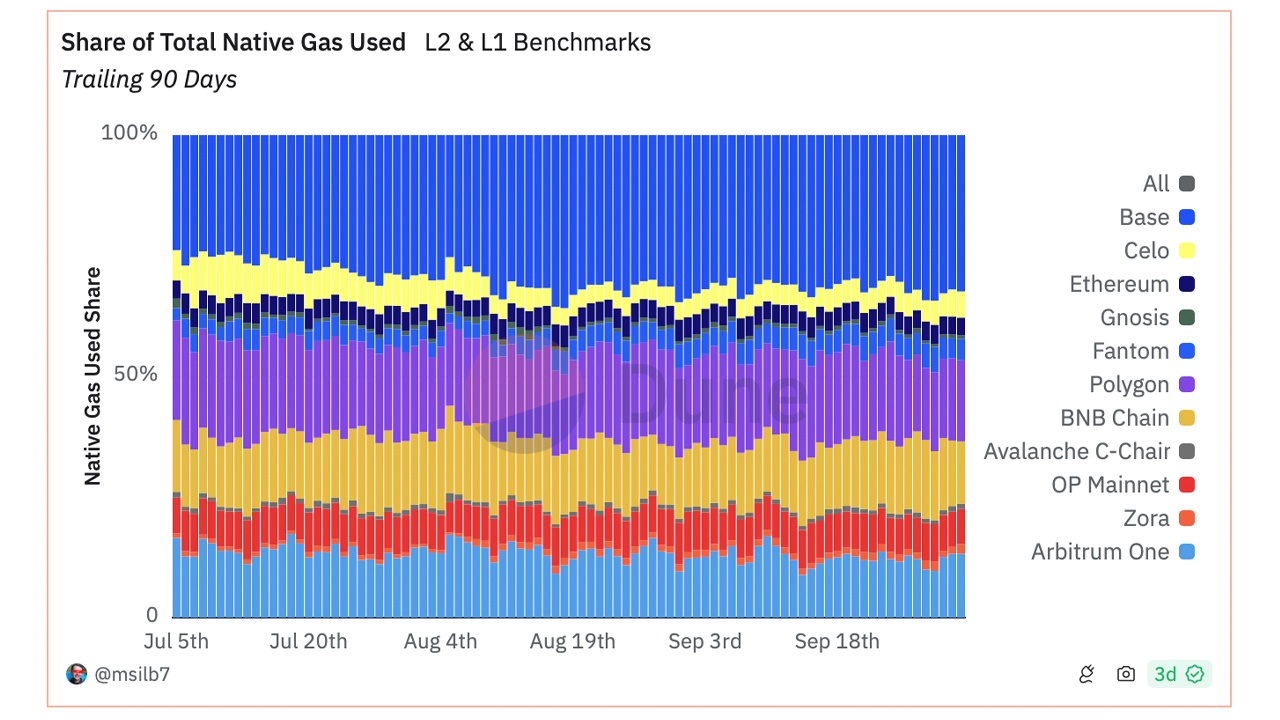
Dune.com statistics on the Share of Total Native Gas Used -L2 & L1 Benchmarks as of Oct. 6, 2024.

The ultimate goal for both Ethereum and Bitcoin has always been to create decentralized, secure networks that can handle global demand. However, if L2 solutions continue to pull transactions away from L1 without providing sufficient fees to the base layer, the security and decentralization of these networks could be at risk. Finding a balance between L1 and L2 activity is crucial for the future of blockchain scalability. The matter of rewards also fails to address the critiques against L2 concepts, which are often seen as significantly more centralized than the main chain, leaving them more vulnerable to attacks and theft.

In conclusion, while L2 solutions offer clear benefits in terms of transaction speed and cost, they also introduce significant risks to the long-term sustainability of Ethereum and Bitcoin. Without a mechanism to ensure that L2s contribute meaningfully to the base layer’s security and infrastructure, these solutions may prove to be more of a temporary workaround than a permanent solution. Both the Ethereum and Bitcoin communities will need to carefully consider how to scale their networks without compromising the fundamental principles that make them unique in the world of decentralized finance.

As mainstream adoption approaches, the urgency for Ethereum and Bitcoin communities to address these scaling issues intensifies. If a sustainable balance between L1 and L2 is not established soon, the security and decentralization of these blockchains could be jeopardized in the years to come. Resolving these challenges is crucial to maintaining the integrity of the networks and ensuring their long-term viability.

What do you think about the L2 issues the Bitcoin network and Ethereum protocol face? Tell us in the comments section below.

Share. Facebook Twitter Pinterest LinkedIn Tumblr Email
NBTC

Related Posts

Oobit delivers secure, controlled spending access for AI agents with Agent Cards launch

02/05/2026

Circle Launches Gas-Free ‘Nanopayments’ on Mainnet Across 11 Blockchains

02/05/2026

DGrid AI Partners Pieverse to Build Web3 AI Agent Infrastructure

02/05/2026

A Revolutionary Memory SDK Empowering AI Agents with Verifiable, Portable Memory

01/05/2026
Add A Comment

Comments are closed.

Top Posts
Get Informed

Subscribe to Updates

Get the latest news from NBTC regarding crypto, blockchains and web3 related topics.

Your source for the serious news. This website is crafted specifically to for crazy and hot cryptonews. Visit our main page for more tons of news.

We're social. Connect with us:

Facebook X (Twitter) LinkedIn RSS
Top Insights

How The February Bullish Trend Can Push It 20% Higher

02/05/2026

Eightco shares jump on $125 million funding commitment, investment in OpenAI, Beast Industries

02/05/2026

XRP Has Not Yet Priced in These Three Bullish Developments

02/05/2026
Get Informed

Subscribe to Updates

Get the latest news from NBTC regarding crypto, blockchains and web3 related topics.

Type above and press Enter to search. Press Esc to cancel.