

Close Menu
  • Coins
    • Bitcoin
    • Ethereum
    • Altcoins
    • NFT
  • Blockchain
  • DeFi
  • Metaverse
  • Regulation
  • Other
    • Exchanges
    • ICO
    • GameFi
    • Mining
    • Legal
  • MarketCap
What's Hot

Michigan State Pension Fund Boosts Strategy Holdings by 141%

17/08/2026

Cardano hands core development to outside teams in decentralization push

17/08/2026

Bitcoin’s first institutional bear market is starting to take shape and draining liquidity

17/08/2026
Facebook X (Twitter) Instagram
  • Back to NBTC homepage
  • Privacy Policy
  • Contact
X (Twitter) Telegram Facebook LinkedIn RSS
NBTC News
  • Coins
    1. Bitcoin
    2. Ethereum
    3. Altcoins
    4. NFT
    5. View All

    Bitcoin’s first institutional bear market is starting to take shape and draining liquidity

    17/08/2026

    Global M2 jumps $1 trillion, yet BTC could still fall – Why?

    17/08/2026

    Bitcoin Red Team Says AI Is Finding Critical Exploits Across Core Projects

    17/08/2026

    Bitcoin’s BIP-110 enters mandatory signaling with miner support below 3%

    17/08/2026

    FG Nexus dumped all its Ethereum at a $45 million loss to buy mobile home parks—after earning just $144,000 in staking rewards

    16/08/2026

    Ethereum Foundation Ditches Poseidon Hash for SHA2 and BLAKE2s on Layer One

    16/08/2026

    Gaming firm GameSquare boasts a $26M Ethereum fortune, but quiet debt fine print leaves just $2.1M in real cash

    16/08/2026

    Ethereum’s post-quantum roadmap puts banks on a 2027 deadline nobody is talking about

    16/08/2026

    Cardano hands core development to outside teams in decentralization push

    17/08/2026

    Community Rejects Claims of Official Ownership

    17/08/2026

    A Well-Known Market Whale Sold a Large Amount of This Altcoin, Leading to a Price Drop

    17/08/2026

    39.27 Trillion SHIB on Robinhood, So Who Holds More?

    17/08/2026

    Artprice’s AI-First Shift Raises the Stakes for NFT and Tokenized Art Valuation

    15/08/2026

    Robinhood Chain NFT Volume Surges Past Ethereum, But Analysts Warn of FOMO

    14/08/2026

    Jeffrey Huang Sells BAYC NFT at Loss to Sustain ETH Long Position

    14/08/2026

    Spritehood NFTs raise $1.28M on Robinhood Chain

    12/08/2026

    Michigan State Pension Fund Boosts Strategy Holdings by 141%

    17/08/2026

    Cardano hands core development to outside teams in decentralization push

    17/08/2026

    Bitcoin’s first institutional bear market is starting to take shape and draining liquidity

    17/08/2026

    Biotech company asks shareholders to dilute stock by 951% to hoard illiquid crypto token instead of funding its own drug

    17/08/2026
  • Blockchain

    Robinhood’s Kerbrat pushes tokenization as memecoins rule its token-less L2

    17/08/2026

    Tether CEO Paolo Ardoino Denies Reports of Company Building Its Own Blockchain

    17/08/2026

    BIP-110 Breakaway Chain Faces a Long Fight to Survive

    17/08/2026

    MUFG to test real-time blockchain settlement for Japanese government bond trades

    16/08/2026

    Koscom and NH Investment & Securities Partner to Advance Tokenized Securities Platform

    15/08/2026
  • DeFi

    Neutrl pauses NUSD redemptions over undisclosed reserve issue

    14/08/2026

    Uniswap Founder Says Team Renounced Creator Fees From Employee Testing

    14/08/2026

    SushiSwap-Backed Pools.fun Announces Protocol Token Launch with Buyback and Airdrop Plans

    13/08/2026

    ‘DeFi doesn’t exist anymore,’ just onchain finance: Andre Cronje

    13/08/2026

    Ether.fi rolls out next-generation neobank services

    13/08/2026
  • Metaverse

    Is Solana Gaming Back? Kintara Activity Fuels Renewed Optimism in Onchain MMOs

    24/06/2026

    The Sandbox launches AI game engine ‘The Sandbox Studio’ for next-generation creators

    10/06/2026

    Meta commits $13M in funding for Oversight Board through 2028

    29/05/2026

    Why Animoca’s Yat Siu says the future is 100 billion AI agents

    07/05/2026

    ‘8,000 Jobs’—Polymarket Sees Tech Layoff Surge As Meta AI Push Bites

    18/04/2026
  • Regulation

    Michigan State Pension Fund Boosts Strategy Holdings by 141%

    17/08/2026

    Biotech company asks shareholders to dilute stock by 951% to hoard illiquid crypto token instead of funding its own drug

    17/08/2026

    India’s Gen Z Is Fueling Record Crypto Adoption; Here’s How They’re Investing

    17/08/2026

    Everyone has the perps convergence backwards

    17/08/2026

    Coinbase spent 5 years building a life raft away from Bitcoin and still managed to lose $359M

    17/08/2026
  • Other
    1. Exchanges
    2. ICO
    3. GameFi
    4. Mining
    5. Legal
    6. View All

    RLUSD’s Next Big Move? Google and Mastercard Integration Fuel AI Payments

    17/08/2026

    The good and the bad of perps, according to crypto traders

    17/08/2026

    Crypto exchanges’ traditional assets hit $1.45T volume in H1 2026

    17/08/2026

    Crypto Card Services Suspended at Ready and Solflare After Kulipa Bankruptcy

    17/08/2026

    ICO market slows sharply with only six completions in 2026

    30/04/2026

    South Korea Poised to Lift Ban on Domestic ICOs After 7 Years

    19/12/2025

    Why 2025’s Token Boom Looks Both Familiar and Dangerous

    31/10/2025

    ICO for bitcoin yield farming chain Corn screams we’re so back

    22/01/2025

    GameShame Studios founder details Raijin Protocol’s roadmap in NeoPod’s sixth AMA

    13/08/2026

    How BC.GAME is turning players into stakeholders

    04/08/2026

    YGG Play Shuts Down Services as Yield Guild Pivots to AI Data

    01/08/2026

    why gameplay now beats crypto rewards

    29/07/2026

    Bitdeer Sells All 253.4 BTC Mined This Week, Continuing Zero-Treasury Policy

    15/08/2026

    Why the world’s second-largest Bitcoin mining power is shutting down rigs in its capital city

    15/08/2026

    Bitcoin Hashrate Slips 17% Off Record as Miners Chase AI

    15/08/2026

    Soluna has 6.3 GW of data center projects on paper, only 192 MW are operating

    14/08/2026

    U.S Treasury Secretary slams Democrats’ CLARITY Act holdout

    16/08/2026

    SEC Threatens Own Crypto Rules as Morgan Stanley and BNY Mellon Accelerate Institutional Push

    16/08/2026

    The White House Will Review It This Weekend

    16/08/2026

    Moneyflip CEO charged in $40K murder-for-hire plot

    16/08/2026

    Michigan State Pension Fund Boosts Strategy Holdings by 141%

    17/08/2026

    Cardano hands core development to outside teams in decentralization push

    17/08/2026

    Bitcoin’s first institutional bear market is starting to take shape and draining liquidity

    17/08/2026

    Biotech company asks shareholders to dilute stock by 951% to hoard illiquid crypto token instead of funding its own drug

    17/08/2026
  • MarketCap
NBTC News
Home»Regulation»How 10 cows in Brazil unlocked a tokenized path to bridge an $8 trillion global finance gap
Regulation

How 10 cows in Brazil unlocked a tokenized path to bridge an $8 trillion global finance gap

NBTCBy NBTC27/07/2026No Comments6 Mins Read
Share
Facebook Twitter LinkedIn Pinterest Email


Ten dairy cows in Paraná, Brazil, carried encrypted identities that Cowmed collars had built from each animal’s health, behavior, and location data into B3 this week.

Those identities turned the cows into collateral for nearly $20,000 in credit, and the record behind them aims to shrink the haircut lenders apply and stop lenders from pledging the same animal twice.

Brazil’s pilot proves the mechanics work at a small scale, and the bigger opportunity sits in countries where farmers own valuable livestock and cannot borrow against it because they lack the land titles banks require.

The global gap between what small businesses need to borrow and what they can access runs to $5.7 trillion, climbing to $8 trillion once informal enterprises count too. Sub-Saharan Africa alone accounts for roughly $331 billion of that gap, and the African Development Bank puts credit access among African smallholder farmers at just 6%.

Livestock represents wealth these farmers already own, so the test becomes whether digital identity, collateral registries, insurance and lender claims can connect well enough to turn that wealth into a loan a bank will make.

Graphic shows a $5.7 trillion global MSME finance gap and just 6% credit access among African smallholder farmers.

Where the infrastructure already exists

Ethiopia holds Africa’s largest livestock population, and its central bank already runs an electronic registry that names cattle, camels, sheep, goats and poultry as eligible collateral.

The country is also building an official livestock identification and traceability system, and its 2025-2030 agricultural finance roadmap puts financing demand for livestock costs and herd replenishment at roughly ETB 911 billion.

Ethiopia has both legal recognition and an identity layer taking shape, but lenders still lack reliable valuation, insurance, health data and a clear way to recover the loan if a borrower defaults.

Nigeria carries the largest near-term financing gap in the group, with the IFC putting unmet credit demand among Nigerian small businesses at about $32.2 billion.

A central bank registry already lets farmers pledge livestock, including unborn offspring, and checks whether the same animal has already secured another loan elsewhere.

A separate identification system tags cattle with ear tags and digital passports, and a $500 million livestock program running through 2028 sets aside $70 million specifically for access to finance.

Nigeria already has the registry, the animal identification system and the financing program as separate pieces, with no single product yet connecting them into one loan process.

Kenya’s Movable Property Security Rights Registry runs around the clock, and the country’s agricultural data systems had registered over 7.2 million farmers by 2025.

Lenders registered 34,638 livestock assets as collateral in the year to June 2023, part of roughly KSh 5.1 trillion in credit that movable assets supported overall.

That makes Kenya the group’s control case, with a centralized registry that already accepts livestock at scale there, so tokenization has to prove it lowers the haircut, cuts the interest rate, and confirms an animal is still alive and healthy.

It also has to speed substitution when an animal dies or is sold, and stop lenders from pledging the same animal twice, something the centralized registry may already handle on its own.

Fewer than 200,000 of Pakistan’s 3.2 million small and medium enterprises have formal credit access. Livestock still accounts for about 14.6% of GDP and over 62% of agricultural value added.

In Sindh province, just over 10% of farmers hold formal loans, and roughly 80% of rural livestock holders have no land to pledge. Banks generally decline animals as collateral because livestock insurance barely exists, and the World Bank found only 16% of farmers holding seven to 50 animals qualified as bankable under current conditions.

Death, disease, theft, and drought can still wipe out a herd, and banks need insurance in place before they will accept livestock as collateral at all.

Pakistan makes the clearest case that tokenization needs insurance and reliable veterinary data bundled in. Rural borrowers already risk taking on larger loans against animals that stay uninsured and that a bank could still seize if the loan fails.

Where this goes from here

Mongolia introduced a web-based registry for movable property, and livestock made up 24% of the roughly 90,000 early pledge notices since it was implemented, and later data put livestock near 25% of the 670,000 pledge notices recorded by June 2023, all without a blockchain involved.

Modern electronic registries already handle the core work of recording collateral and setting creditor priority, a point the World Bank has traced directly. Connecting animal identity, health data, insurance coverage, market value and legal claims across separate systems is the work interoperability still has to finish.

A digitally verified animal has to unlock a bigger loan, a lower interest rate, a faster approval, a cheaper insurance premium or a better recovery rate than the same animal gets under ordinary underwriting. Borrowing terms carry the proof, measured in what a bank lends and at what price.

In the bull case, Ethiopia links its animal identity system to its collateral registry, and Nigeria connects its registry, ear-tag system, and financing program into one lending product.

Kenya’s existing scale gives both a template to copy: insurance and veterinary data become part of the underwriting process, haircuts shrink, approval times drop, and loan-to-value ratios climb.

Livestock stops being an asset farmers merely own and becomes one they can borrow against, at scale, across more than one country.

In the bear case, the registries and identification systems never connect. Pakistan’s insurance gap sits as the clearest failure point, and Nigeria’s outcome could tip the same way if its registry, animal IDs and financing program never combine into a loan product.

Farmers take on debt against animals that go uninsured, are disputed within households, or are impossible for a lender to repossess. Disease, drought, or theft can then wipe out that collateral, along with the borrower’s income, in the same event, leaving tokenization as a pilot with no measurable effect on who can borrow.

A normal database in Kenya and Mongolia can already record which animal secures which loan.
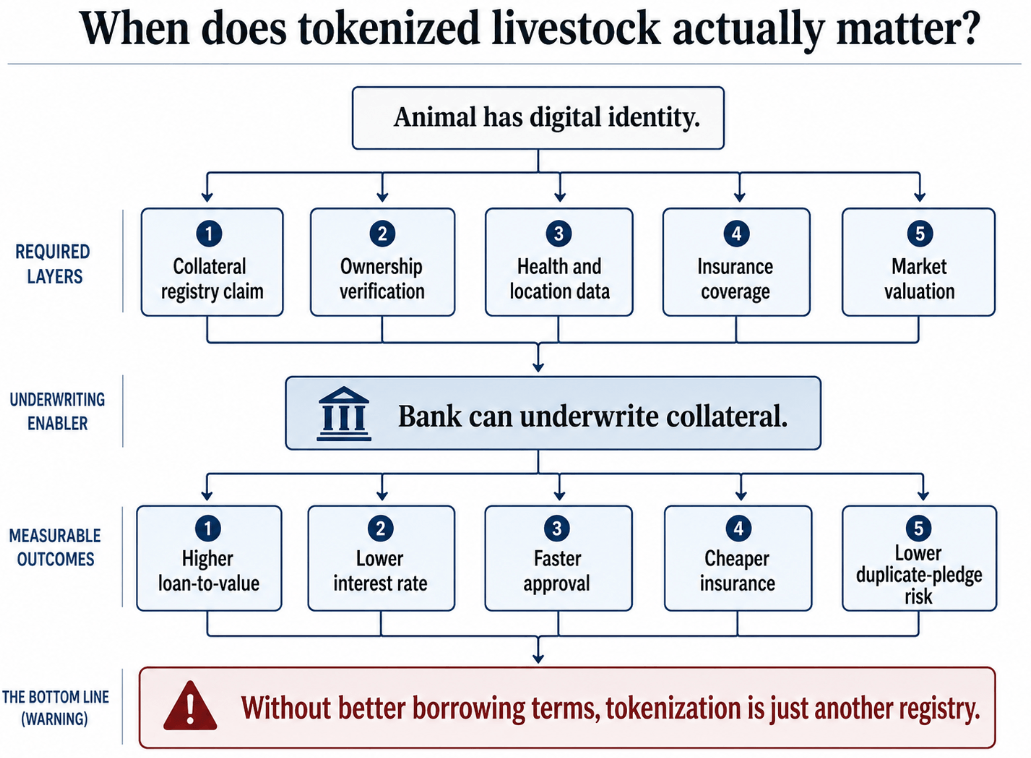
Flowchart shows tokenized livestock only matters when identity, collateral, insurance, and valuation data let banks offer better borrowing terms.

The real test asks whether Ethiopia, Nigeria, Kenya, and Pakistan can connect identity, insurance, and creditor claims into loans that did not exist before, at terms better than farmers get today.

Brazil’s ten cows proved the mechanics work at a small scale, and whether that mechanism becomes rural credit infrastructure for millions of farmers depends on insurance and registries.

Share. Facebook Twitter Pinterest LinkedIn Tumblr Email
NBTC

NBTC is the editorial account for NBTC News, covering Bitcoin, Ethereum, DeFi, blockchain infrastructure, exchanges, mining, regulation and digital asset markets. The editorial team focuses on clear sourcing, timely updates and practical context for crypto readers.

Related Posts

Michigan State Pension Fund Boosts Strategy Holdings by 141%

17/08/2026

Biotech company asks shareholders to dilute stock by 951% to hoard illiquid crypto token instead of funding its own drug

17/08/2026

India’s Gen Z Is Fueling Record Crypto Adoption; Here’s How They’re Investing

17/08/2026

Everyone has the perps convergence backwards

17/08/2026
Add A Comment

Comments are closed.

Top Posts
Get Informed

Subscribe to Updates

Get the latest news from NBTC regarding crypto, blockchains and web3 related topics.

Your source for the serious news. This website is crafted specifically to for crazy and hot cryptonews. Visit our main page for more tons of news.

We're social. Connect with us:

Facebook X (Twitter) LinkedIn RSS
Top Insights

Michigan State Pension Fund Boosts Strategy Holdings by 141%

17/08/2026

Cardano hands core development to outside teams in decentralization push

17/08/2026

Bitcoin’s first institutional bear market is starting to take shape and draining liquidity

17/08/2026
Get Informed

Subscribe to Updates

Get the latest news from NBTC regarding crypto, blockchains and web3 related topics.

Type above and press Enter to search. Press Esc to cancel.