
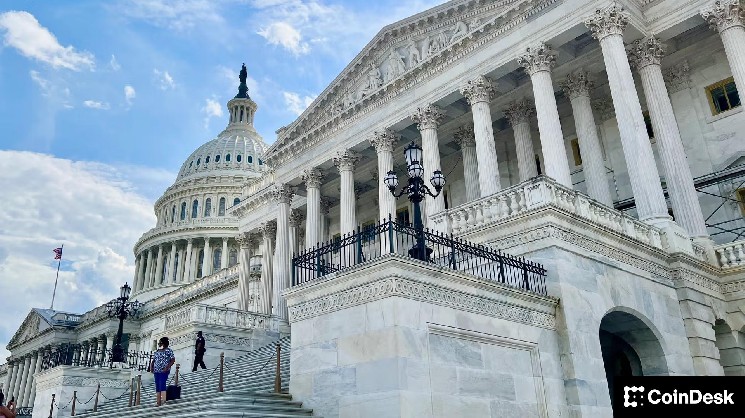

U.S. lawmakers were about to begin a hearing on a major crypto bill that aimed to define how federal regulators, such as the Securities and Exchange Commission (SEC) and the Commodity Futures Trading Commission (CFTC), can oversee crypto markets, but the night before the hearing was about to start, Coinbase, one of the biggest crypto exchanges that has been deeply involved in the bill’s negotiations and has spent millions lobbying for it, suddenly withdrew its support.
This sent the whole industry into chaos. Just hours later that same Wednesday evening, the U.S. Senate Banking Committee canceled the hearing on the crypto market structure bill — just over 12 hours before it was scheduled to kick off. Following the announcements, lawmakers relaunched talks on Friday, with Democrats and staffers holding a call with industry representatives.
However, Coinbase was not alone in having issues with the bill.
Let’s break down what the concerns about the original bill, based on CoinDesk interviews with six industry participants throughout the week, were before and after Wednesday evening’s cancellation.
The general concern was that different provisions in the bill would make it more difficult for crypto startups to launch tokens or operate anything resembling a decentralized project.
These concerns included issues with how decentralized finance (DeFi) would be regulated, stablecoin yield provisions, disclosure requirements for certain cryptos treated as securities, restrictions on tokenized securities and how the SEC would oversee those types of assets. Some provisions even risked forcing blockchains to become permissioned products, defeating the purpose of a decentralized ledger intended for public access.
People also cited the lack of time to review the text and proposed amendments among their concerns.
The bill was published just before midnight on Monday, with amendments from lawmakers due by 5:00 p.m. the next day — just 17 hours later. The hearing was originally scheduled to kick off at 10:00 a.m. Eastern on Thursday, leaving roughly 58 hours between the text dropping and the planned start. This did not give companies much time to read and digest the bill.
To be clear, the industry was not united in opposition to the bill. After Coinbase CEO Brian Armstrong posted on X that his company could not support the bill, executives from numerous other crypto companies and organizations shared statements in support of the bill and the markup hearing.
DeFi conundrum
The provisions for DeFi, particularly, became alarming for some industry participants because they weren’t included in previous drafts of the bill and hadn’t been circulated by the individuals drafting the text prior to the bill’s release near midnight on Monday.
These provisions, which address DeFi and apply anti-money laundering and know-your-customer regulations to the sector, were a surprise to the industry.
Among other issues, the bill proposed expanding the Bank Secrecy Act to address certain aspects of DeFi, potentially blocking these projects from actually operating decentralized platforms. In other words, centralized companies would still be required to operate these platforms and address compliance concerns.
“There should be a path toward decentralization, and it shouldn’t be some impossible-to-achieve dream, because then it’s not really a blockchain,” one person said.
The bill also gave the U.S. Treasury Department the ability to sanction and otherwise “restrict how self-hosted wallets might interact with exchanges,” according to another person’s complaint.
Blockchain Association CEO Summer Mersinger said in a post on X on Thursday that the bill risked “sweeping in core DeFi infrastructure” into regulatory regimes set up by the SEC and the Treasury Department.
She similarly pointed to concerns about how DeFi projects might have to abide by rules meant to prevent money laundering by tracking customers, calling the provision “broad.”
Stablecoin’s rewards problem
Stablecoin yield may be the most controversial area for the industry, at least in public discussions.
The banking lobby secured a number of wins, restricting digital asset platforms from directly offering yield rewards except as part of user activity, such as transactions and staking.
While one individual characterized that loophole as significant enough to render the broader restrictions useless, others called it a serious issue.
Proposed amendments to the stablecoin provision could have made these restrictions even tighter. In fact, multiple senators from both parties had concerns about allowing yield through activities, and people familiar with the negotiations said it was likely an amendment would further restrict crypto companies’ ability to offer yields of any sort on stablecoin deposits.
And this brought an intense debate of banks versus crypto.
While banks have to secure Federal Deposit Insurance Corporation backing and submit to intensive disclosures and government supervision due to financial industry regulations, stablecoin companies might not have the same requirements or protections. Treating stablecoin deposits like bank deposits could similarly further restrict issuers and exchanges’ ability to offer rewards.
Securities restrictions
The bill also granted the SEC the authority to force “a huge amount of disclosures and restrictions on sale” of network tokens.
It defines the tokens as any token whose value depends on “the entrepreneurial or managerial efforts” of the parties building the token and other assets, one individual said. In other words, a network token or ancillary asset is just how this bill defines which cryptocurrencies may be securities within the SEC’s remit.
The bill would essentially have the SEC act as the regulator for every project that launches a token and requires those projects to convince the SEC that these tokens are not securities.
Despite granting these authorities, critics also said that the bill would simultaneously constrain both the SEC and the CFTC’s ability to be flexible in how they approached digital assets.
Armstrong also cited similar concerns about how the bill treated the CFTC, saying that it eroded “the CFTC’s authority, stifling innovation and making it subservient to the SEC.”
Despite giving the SEC this sort of authority over every new crypto project, the bill still restricted the regulator’s ability to create exemptions from its disclosure and registration requirements for digital asset products specifically.
Even the definition of “common control,” which governs how regulators can determine whether a distributed ledger system is controlled by “related persons,” was overly broad and could cause trouble for certain companies.
Tokenized assets might also be treated under more restrictive rules than traditional securities, which would be a problem for crypto firms, two individuals said. Coinbase’s Armstrong said that the bill would create a “de facto ban” on tokenized equities.
However, representatives of the tokenization sector pushed back against this claim, telling CoinDesk they were not concerned by the bill’s provisions around tokenized equities. Representatives from Superstate, Uniform Labs, Securitize and Dinari said the bill essentially treated tokenized securities like any other security and placed them clearly under the SEC’s remit.
Other issues
While the three issues above were the big ones, there were more.
Take, for example, the proposed amendments to the bill’s original text. Lawmakers were set to debate several amendments that would modify the bill’s text. They had pitched more than 70 by Tuesday alone.
Some of these amendments raised alarms among industry stakeholders.
One amendment, attributed to Senator Angela Alsobrooks, included language calling for rulemakings, studies on deposit outflows and anti-evasion regulations. This amendment was widely believed to have sufficient support that it would have been attached to the bill if it had passed, and it would have been more prohibitive to the industry than the base text.
Her proposed changes, specifically mandating a rulemaking, were problematic because they would have nudged regulators to conclude that something was wrong with existing statutes. The anti-evasion provisions would have called for strict punishments, even for minor infractions, if companies were not able to meet all of the requirements, critics noted.
The bill also still faced headwinds from lawmakers. Senators from both parties had concerns about the stablecoin provisions, particularly those representing states with large numbers of community banks.
Democrats have also been seeking provisions or assurances that the bill would require the federal regulators to be helmed by a bipartisan slate of commissioners.
And, of course, there is the ongoing debate over an ethics provision that would prevent President Donald Trump from profiting from his crypto ventures while serving as president.
Senator Ruben Gallego, who is said to be leading the Democrats’ negotiations on this with Republican Senator Cynthia Lummis, told reporters on Wednesday that White House crypto adviser Patrick Witt was a no-show at a scheduled meeting to negotiate a compromise. A White House spokesperson did not return a request for comment.
Lawmakers, after a quiet Thursday, already relaunched talks on Friday, with Democrats and staffers holding a call with industry representatives. The markup hearing has not yet been rescheduled, and the bill is expected to change, but the process is not dead—at least not as of press time.
