Ethereum's “store-of-value” narrative is picking up traction lately.
Taking a wider view, several factors are driving higher risk sentiment in the U.S. market.
Whether driven by fears of an AI bubble, high interest rates, CPI data, or the aftermath of the midterm elections, Bitcoin is heading for its weakest annual performance since the 2022 bear market, with year-to-date losses approaching 17% in 2026.
Against that backdrop, Ethereum has suffered nearly twice Bitcoin's losses and is on track for its worst year since 2022, yet co-founder Joseph Lubin remains bullish on Ethereum's potential as an inflation hedge.
Pointing to several key on-chain trends, he argues that Ethereum has the long-term potential to outperform both Bitcoin and gold as a store of value.
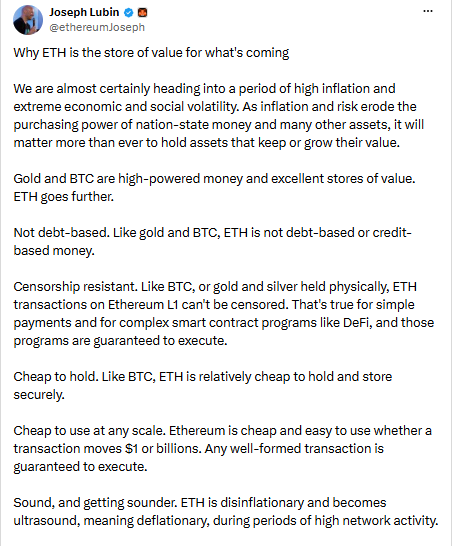
A central part of his argument is the DeFi ecosystem, stablecoins, and smart contracts on Ethereum, which he says give $ETH a stronger utility base than Bitcoin or gold.
Additionally, as AI adoption accelerates, Ethereum could see rising demand for its network infrastructure.
Ethereum’s macro hedge thesis faces a crucial market test
Ethereum's inflation-hedge narrative faces a key test.
As noted earlier, the U.S. market faces a range of risks, making this one of the most volatile periods for investors. So far, Ethereum has struggled to attract risk capital, falling nearly 30% during Q4 compared with Bitcoin's decline of just 17%.
This puts pressure on Joseph Lubin's thesis, as Bitcoin continues to lead the store-of-value narrative while Ethereum struggles to keep pace.
Gold, meanwhile, is also losing momentum. The metal is in a technical downtrend, down more than 5% so far in Q4, after failing to move above $4,000. Its most recent drop below that level erased roughly $480 billion in market value within just 10 hours.
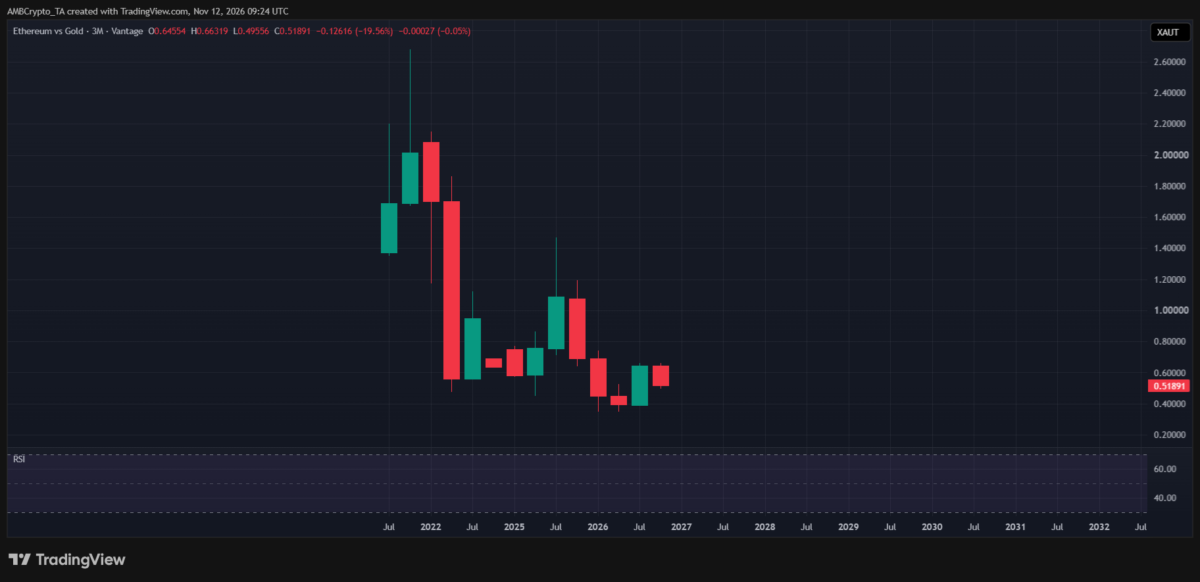
That said, gold still holds a clear “relative-strength” advantage over crypto.
As the chart above shows, the $ETH/XAU ratio has fallen more than 19% in Q4, indicating that Ethereum has made no progress relative to gold. This is a key level to watch, as a breakout could provide better technical support for Lubin's long-term thesis.
For now, Ethereum is struggling to outperform both Bitcoin and gold. Despite rising staking participation and stronger network security, $ETH has yet to translate these fundamentals into stronger capital inflows or relative price performance.
Final Summary
-
Ethereum is showing growing network participation, supporting Lubin’s store-of-value thesis.
-
Despite this, $ETH continues to lag Bitcoin and gold, with the $ETH/XAU ratio down over 19% in Q4.