A key shift is taking shape in the market, and traders should watch it closely.
On a macro level, the stablecoin market is currently at one of its lowest levels since the 2022 bear market. The total supply of Tether ($USDT) has fallen by almost $15 billion from its peak of $310 billion in mid-May. This indicates that liquidity has been flowing out of the crypto market, which is why demand has been fairly low even though Bitcoin is now trading almost 30% below its $126K high.
As the largest stablecoin hub, Ethereum has also taken a significant hit.
According to DeFiLlama, the total amount of stablecoins on Ethereum fell by over $20 billion. This was compounded by Tether, as in the last 30 days alone, the total supply of $USDT on Ethereum fell by nearly 9% to just over $66 billion. The key takeaway, however, may be Tron's $USDT supply.
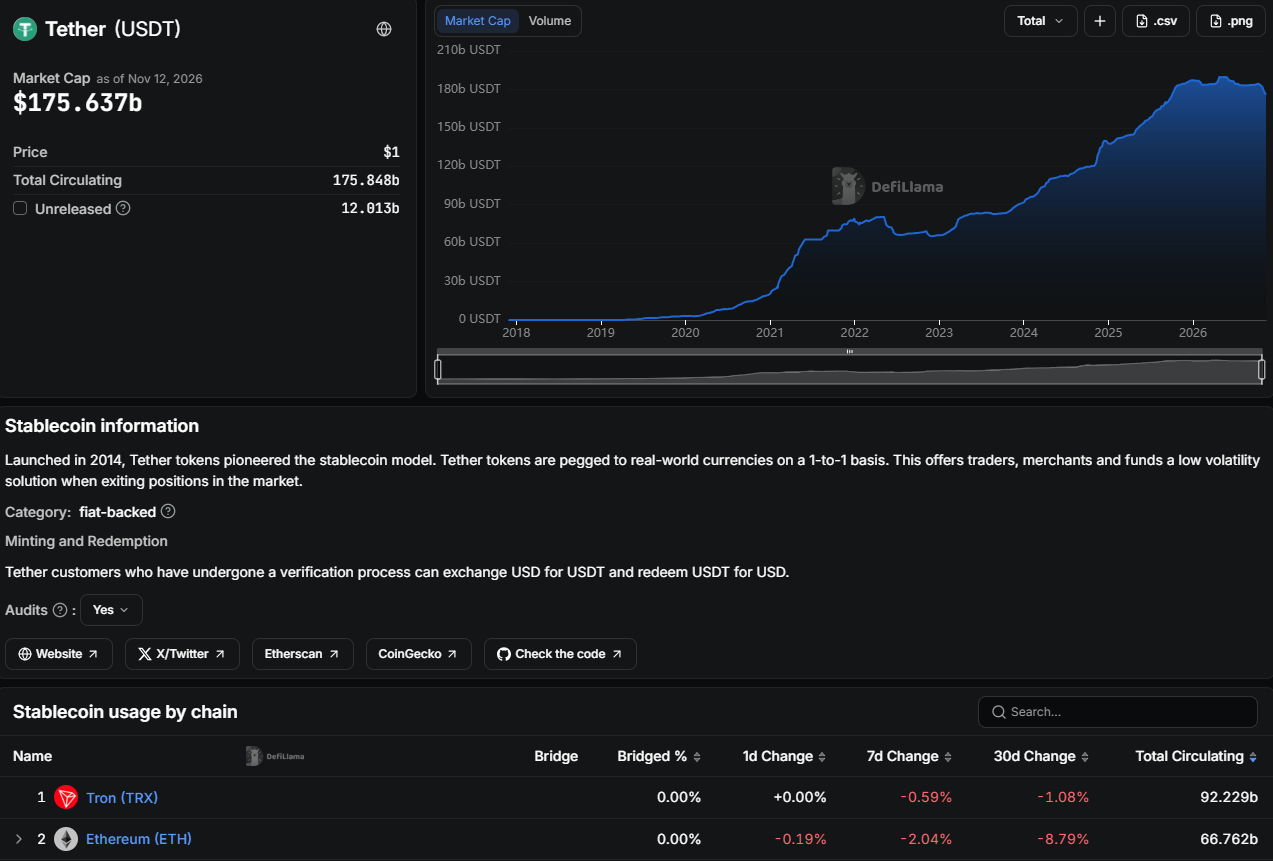
As shown in the chart above, $USDT supply on the Tron blockchain was down by only just over 1% at press time. This was much lower than the 9% decrease seen on Ethereum, hinting at a clear divergence in stablecoin liquidity between the two networks.
With Ethereum seeing heavier $USDT outflows, Tron's share of total $USDT supply climbed above 52%, reinforcing its position as the dominant network for $USDT liquidity.
Tron founder Justin Sun also pointed to this trend in a recent X post, citing data from Token Terminal. In the past 12 months, TRON recorded a $16.1 billion increase in stablecoin supply, the highest among 45 tracked blockchains. HyperEVM came second. Arc also rose by $1.3 billion, while Arbitrum decreased by $4.3 billion. By contrast, Ethereum saw a larger $30.6 billion decline.
In short, Tron's TRX stablecoin dominance may be coming at Ethereum's expense. It is also making inroads into other major Layer 1 networks. According to AMBCrypto, with growing liquidity advantages, $TRX is an altcoin to watch when the market moves back into a risk-on environment.
Tron's stablecoin inflows challenge Ethereum as $TRX/$ETH gains 23%
The real impact of this divergence becomes clearer when looking at on-chain activity.
Data from the Tron network also appears to support the stablecoin trend. Within a 24-hour period, Tron processed 12,990,075 transactions, the highest daily total in the past 7 days, averaging around 150 transactions per second (TPS). This suggests there may be steady demand on the network, with the increase in stablecoins on Tron potentially driven by real usage.
The result? The $TRX/$ETH ratio has risen by over 23% so far in Q4 and is only 15% away from recovering all of its Q3 losses. With stablecoin liquidity and on-chain activity on the two networks both increasing, this trend may be accelerating.
If this continues, a break above the 0.002 resistance level could become more likely, opening the door to further $TRX outperformance against $ETH.
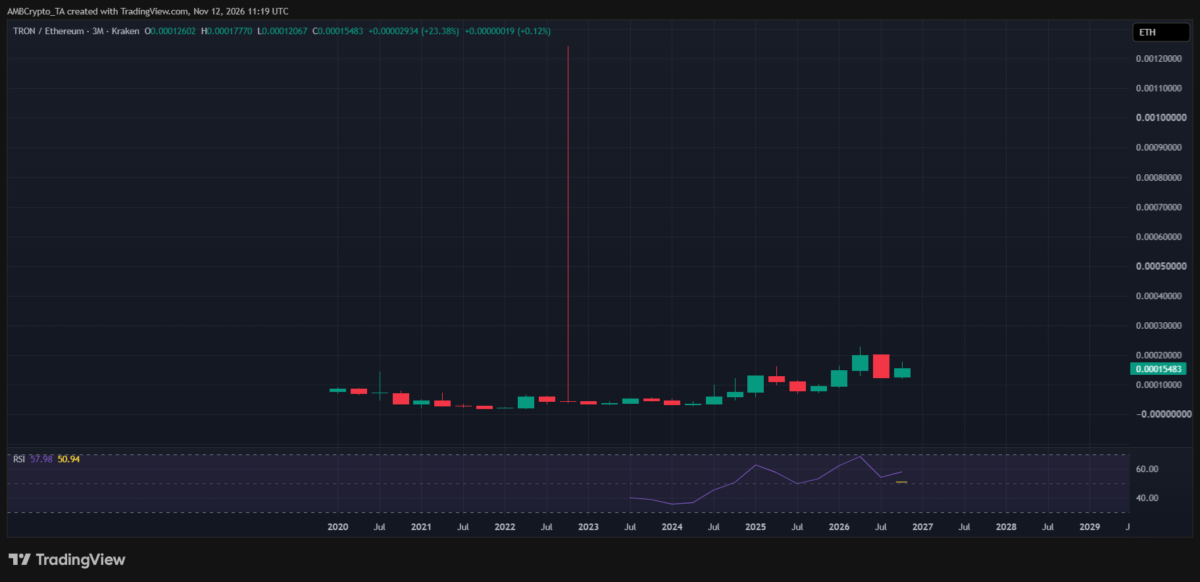
Taken together, with rising stablecoin dominance, high volume, and the 23% rally in the $TRX/$ETH ratio, 0.002 is a key level. A breakout above it could signal strength for $TRX, while a failure to clear resistance may leave the pair trading within its current range.
As it stands, the combination of stablecoin inflows and growing network activity suggests TRON is well positioned to outperform Ethereum ETH this quarter.
Final Summary
-
Tron gained significant stablecoin share as Ethereum saw heavier outflows and weaker on-chain activity.
-
At press time, $TRX/$ETH was up 23% in Q4, with 0.002 as the next key resistance level.