


More than 36 million ETH is now staked in Ethereum’s proof-of-stake system, close to 30% of the circulating supply and worth over $118 billion at recent prices.
That headline number sounds like a clean vote of confidence: holders are locking up their ETH to secure the network, collect yield, and signal they’re in no rush to sell. The trouble with using “confidence” as a metric is that it counts coins, not motivations, and it treats one whale the same as a million retail users.
Ethereum’s staking record is also a very large and complicated composition show, and the cast list is getting more concentrated, more corporate, and more strategic.
A very unsophisticated way to understand this is to imagine Ethereum as a nightclub with a strict door policy. The room is fuller than it’s ever been, a line has formed outside to get in, and almost nobody is leaving. That looks bullish, until you check who’s cutting the line and who owns the building.
The question mark behind the new staking milestone
You can think of staking as Ethereum’s security deposit system. Validators lock up ETH, run software that proposes and attests to blocks, and earn rewards for doing the job correctly. The incentives here are simple: behave and get paid, or misbehave and get penalized.
At today’s scale, the most useful datapoints aren’t the round numbers (like the 30% of staked supply) people quote in tweets. They’re the mechanics that decide who can join, how quickly they can join, and how fast the staking crowd can change its mind.
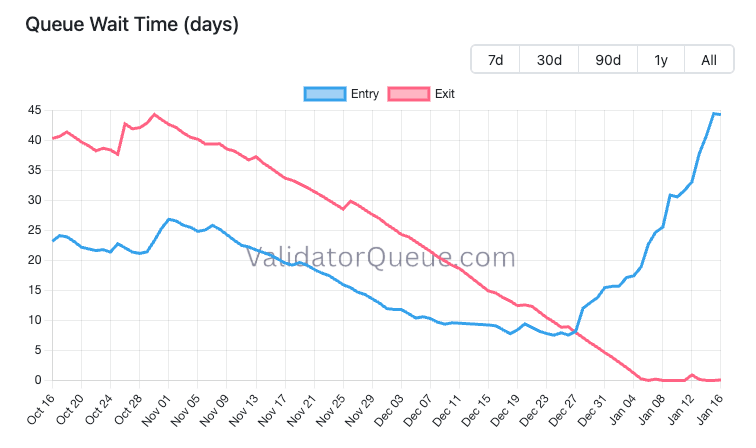
Right now, the network’s running close to a million active validators, and the entry queue has swollen enough that new stake can face activation delays measured in weeks. Exits, by contrast, have been thin in recent snapshots, with some trackers showing tiny withdrawal lines and short wait times.
That gap is important because it turns staking into a kind of slow-moving indicator. Demand can surge today and still take weeks to show up as active validators.
This is where the 30% figure starts to mislead. A record can come from a broad base of long-term believers, or from a smaller number of large holders with a plan. Both push the number up, but only one tells you much about the average investor’s conviction.
Even the “community” path can concentrate influence. Liquid staking protocols pool deposits and hand users a tradable token representing a claim on staked ETH. That’s convenient, but it also routes a big slice of Ethereum’s security through a few major pipes. It’s very efficient, but it creates obvious chokepoints.
Staking participation is rising, and so is the share of staking that runs through a handful of channels. These channels don’t have to fail to become important, they just have to become big enough.
The thing about liquidity
Locking up 36 million ETH sounds like supply leaving the market, because in one sense, it does. Staked ETH isn’t sitting on exchanges waiting to be sold, and withdrawals are governed by protocol rules and queue dynamics.
But “locked” is a slippery word in Ethereum because staking can be and frequently is packaged into something that trades.
Liquid staking is the main reason. Instead of staking directly and waiting for withdrawals, investors stake through a protocol or platform that issues a token representing their claim. That token can be used elsewhere: collateral in lending, liquidity in trading pools, or building blocks for structured products. The pure uncut ETH is committed to staking, yet the holder still ends up with something they can sell, borrow against, or loop.
That creates a liquidity mirage that can fool both bulls and bears.
Bulls look at a rising staking ratio and see scarcity: less liquid ETH, thinner float, sharper moves when demand returns. Bears look at liquid staking and see leverage: claims on staked ETH get used as collateral, and a risk-off move can force unwinds that show up far from staking dashboards. Both can be true at the same time, depending on where the positions sit.
A clean way to map the ecosystem is to split it into three camps.
First are direct stakers who run validators or stake through custodians and don’t turn their position into a tradable token. Their ETH is genuinely less liquid, and exiting takes time.
Second are liquid stakers who hold staking derivative tokens and treat them as a yield position. Their exposure stays flexible as long as derivative markets behave.
Third are yield stackers who use those derivative tokens to borrow and repackage exposure. They can create liquidity on the way up and fragility on the way down. That’s where margin calls live, so that’s where the drama arrives during stress.
So what does a staking record imply? It suggests a larger share of ETH is being routed through staking, and a meaningful portion of that staked ETH is being wrapped into tokens that circulate. The net effect isn’t just having less of the supply in the market. It’s a genuine shift in market structure: ETH is increasingly treated as productive collateral, and the liquidity of that collateral depends on the plumbing.
But the plumbing here is getting more and more institutional. Institutions like staking because it looks like yield you can operationalize: custody, controls, audits, predictable rules. They also tend to accept lower yields in exchange for scale and perceived safety. That matters because reward rates compress as more ETH is staked, and the reward pie gets split more ways.
Bit by bit, Ethereum starts to resemble a large interest-bearing system where the marginal buyer isn’t a retail yield-chaser anymore, but a treasury manager who wants a baseline return with a compliance wrapper.
Then there’s the detail that makes the staking record feel less like a crowd and more like a few heavyweight patrons rearranging the room.
BitMine and the rise of the corporate validator class
If Ethereum staking is a nightclub, BitMine is the group that shows up with a reservation, a security detail, and a plan to buy the place next door.
BitMine has been marketing itself as an aggressive ETH treasury vehicle, and its recent disclosures are huge even by crypto standards. As of Jan. 11, the company said it held roughly 4.168 million ETH, with about 1,256,083 ETH staked.
It also said its staked ETH increased by nearly 600,000 in a single week, a burst large enough to show up in queue data and spark the obvious question: how much of this network confidence everyone is talking about is actually a single strategy playing out?
Put it next to the record: roughly 36 million ETH staked across the whole network. A single entity staking north of 1.25 million ETH doesn’t explain the milestone, but it does change how you should read it.
When a handful of entities can move participation by meaningful fractions, the fact that staking is up stops being a clean proxy for broad sentiment. It becomes a question of who’s executing what plan, and why now.
BitMine has also described plans to launch a commercial staking solution branded as the Made in America Validator Network, targeting 2026. The name sounds like a policy memo decided to become a product, which is exactly why it matters.
As staking scales, geography, regulation, and identity start to creep into what used to be a purely technical job.
None of this is automatically bad for Ethereum. Large professional operators can improve uptime, diversify infrastructure, and make staking accessible to holders who’d never run a validator. Institutional participation can broaden ETH’s investor base and tighten the link between protocol economics and traditional capital markets.
But it introduces trade-offs that don’t show up in that celebratory percentage.
One is the concentration of influence. Ethereum’s governance is social and technical, but validators still shape outcomes through software choices, upgrades, and crisis responses. A network secured by many independent operators is resilient in one way. A network secured by fewer large operators is resilient in another, until a shared failure mode appears.
Another is correlated behavior. If a large staker changes strategy, rebalances, or faces constraints, the effects can ripple through queues and liquidity. A long entry queue and a thin exit queue look stable, but stability can depend on a few big players staying content.
The subtle issue is the market signal itself. Crypto loves simple indicators: staking up, exchange balances down, inflows up. These can still be useful, but Ethereum’s staking record now blends retail conviction, liquid staking design, and corporate treasury choices. The signal carries more noise because the incentives are more varied.
Staking is becoming the default endgame for a growing share of ETH, which supports the view of ETH as productive collateral rather than a purely speculative token. Liquidity isn’t disappearing so much as migrating into wrappers and venues with different rules. And composition matters: a record can be driven by the crowd, by the pipes, by corporate treasuries, or by all three at once.
Ethereum’s staking milestone is real. The story underneath it is where the edge sits, and where the surprises tend to live.
