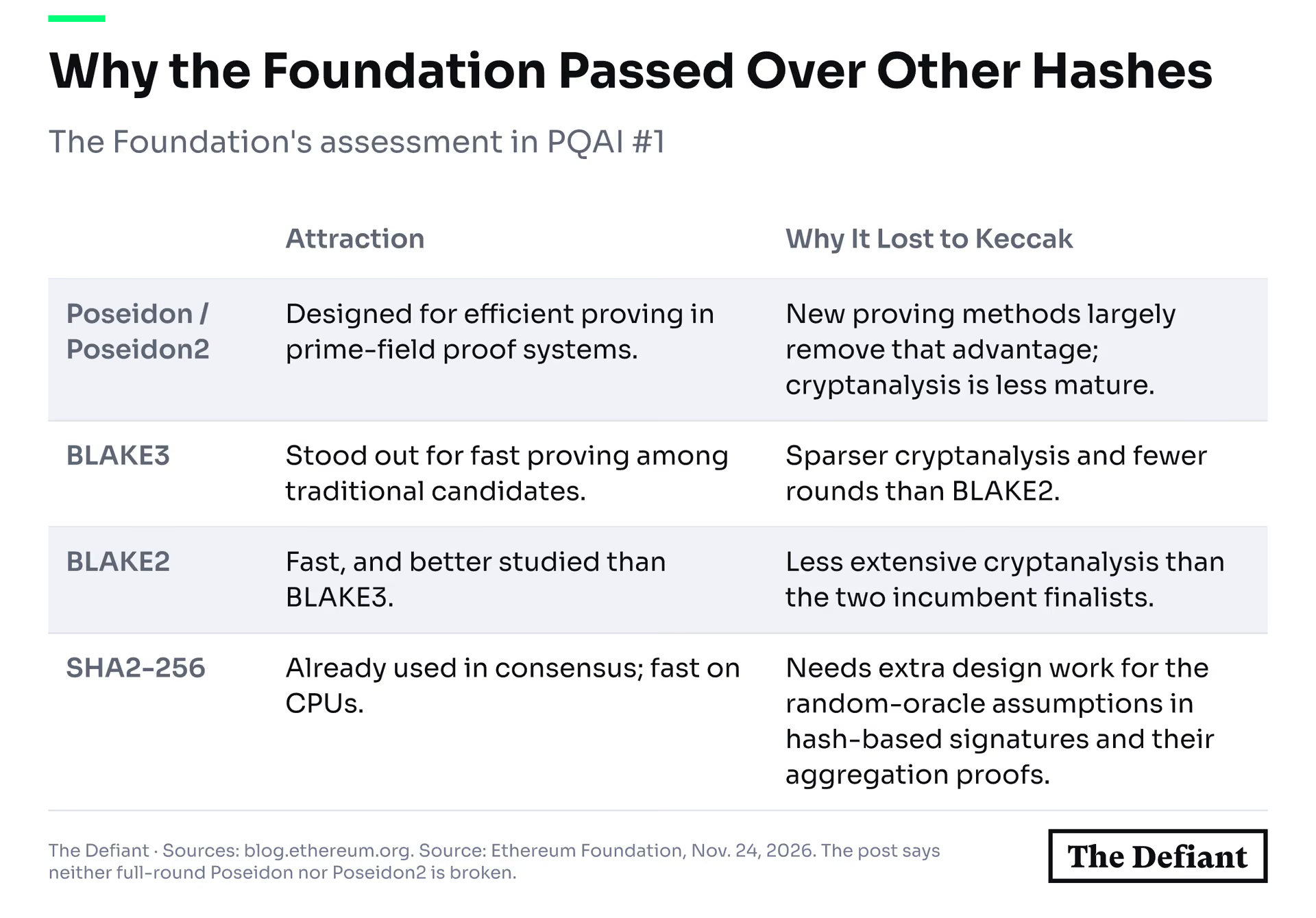
The Ethereum Foundation recommended Keccak-256 for Ethereum's planned move to hash-based cryptography on Nov. 24, favoring an existing network component over newer alternatives designed for fast proof generation. The post is a Foundation research and engineering recommendation, not an accepted Ethereum Improvement Proposal or a scheduled fork change. The Foundation's post-quantum team says final protocol decisions belong to Ethereum's open governance processes.
The broader PQAI plan, published Nov. 23, calls for hash-based validator and user signatures and hash-based commitments for blob data. The Foundation frames that migration as preparation for quantum computing and possible AI-assisted advances against cryptography. Its first recommendation, PQAI #1, covers the Keccak family across signatures, blob data and recursive aggregation in leanVM, the proof-generating virtual machine planned for the protocol.
The Foundation reports that leanVM can prove more than 500,000 Keccak permutations per second on EIP-7870 reference hardware. The Foundation says this is enough for its required aggregation throughput, while noting the software is not yet production ready. Keccak remains slower to prove than BLAKE3 and slower to run natively than SHA2-256. Post author Kev Wedderburn wrote: "We accept that relative performance cost for the security margin and historical cryptanalysis."
The recommendation also includes moving consensus-layer SSZ data-tree hashing from SHA2-256 to Keccak-256 over the longer term. For execution-client developers, the recommendation means reusing existing Keccak implementations for signature verification.
Why Keccak Was Chosen
Ethereum already uses Keccak-256 for addresses and execution-layer state, so reusing it avoids adding another general-purpose hash alongside SHA2-256. The Foundation also said choosing Keccak-256 over SHA3-256 avoids adding a near-identical function, since the two differ only in padding, and Ethereum already exposes Keccak-256 directly to smart contracts.