The following analysis is a guest post by James Delmore, a blockchain and crypto market analyst for Breadcrumbs. The report’s figures are based on federal donations only.
Drawing on Federal Election Commission (FEC) records and comprehensive campaign finance data, Delmore’s research identifies the industry’s biggest corporate and individual donors, examines the political action committees (PACs) that deployed millions of dollars, and assesses their influence in pivotal congressional races. Republicans received the vast majority of financial support, as crypto-aligned PACs committed substantial resources to shaping Congress.
Yet the results reveal a striking contradiction: despite an impressive string of electoral wins, some of the industry’s costliest political bets ended in defeat. This report explores the financial machinery behind cryptocurrency’s growing influence in Washington, the winners and losers of the 2026 election cycle, and the industry’s broader push for favorable digital asset legislation.
Crypto-Linked Donors Poured $471 Million Into the 2026 Midterms
Companies and individuals connected to the cryptocurrency industry contributed a record total of at least $471 million in the 2026 US election cycle, nearly twice the $250 million spent in 2024, according to an analysis of FEC records.
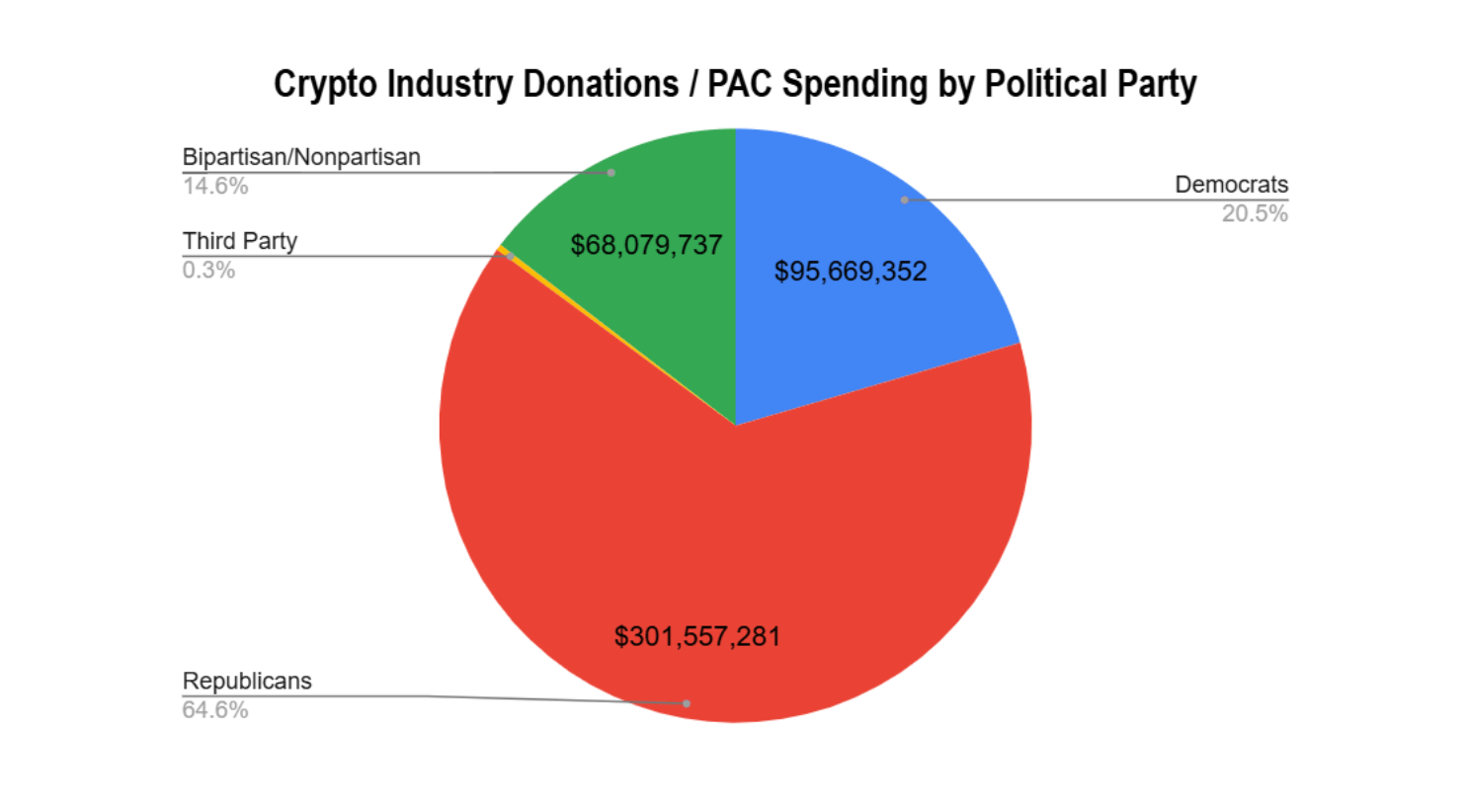
Republicans received the overwhelming majority of contributions and spending support from the crypto industry. Of the $471 million, $302 million (65%) went to or was spent on Republican-aligned candidates, while $96 million (21%) went to Democratic-aligned candidates.
WHO GOT THE MONEY?
Non-crypto PACs and committees received more than $250 million in contributions from the crypto industry.
| CONTRIBUTIONS to NON-CRYPTO PACS | ||
| PAC Name | Amount | Description of PAC |
| MAGA, Inc. | $94 million | Supports Trump-endorsed Republicans. |
| Leading the Future | $50 million | Super PAC supporting AI |
| Lone Star Rising | $18 million | Supports James Talarico (D) for Senate in Texas |
| HMP | $17 million | Supports Democrats in House races |
| Congressional Leadership Fund | $15 million | Aligned with Congressional GOP leadership |
| Senate Leadership Fund | $8 million | Aligned with Senate Republican leadership |
| V-PAC: Victors, Not Victims | $6 million | Supports Vivek Ramaswamy for Ohio governor |
| Invest in Tomorrow Coalition | $6 million | Supports Democrat candidates for clean energy |
Crypto PACs: $163 Million in Spending
Most of the crypto industry’s remaining contributions went to Fairshake, a crypto PAC that then transferred most of its funds to its affiliate PACs, Protect Progress and Defend American Jobs.
These crypto-focused PACs reported spending approximately $163 million. 82% of that spending supported Republicans or opposed Democrats, compared with 18% that supported Democrats or opposed Republicans.
| Name of Crypto PAC | Political Affiliation | Amount Spent |
| Fairshake | Bipartisan | $18.4 million |
| Protect Progress | Democrat | $29 million |
| Defend American Jobs | Republican | $102 million |
| Digital Freedom Fund | Republican | $8.3 million |
| Fellowship | (Mostly) Republican | $4.8 million |
| Jump PAC | Bipartisan | None Reported |
| First Principles Digital | Republican | $900,000 |
Where Crypto PACs Spent Their Money
| Senate Race | Crypto PAC Spending | Support | Result |
| Ohio Senate | $64M | Backed Jon Husted/opposed Sherrod Brown | Lost |
| Nebraska Senate | $14M | Backed Pete Ricketts/opposed Dan Osborn | Won |
| Alabama Senate | $13M | Backed Barry Moore | Won |
| Illinois (primary) | $10M | Opposed Juliana Stratton | Lost |
| Kentucky Senate | $8M | Backed Andy Barr | Won |
Overall, candidates backed by crypto PAC spending performed very well. Of the 90 candidates supported by crypto super PACs, 73 won their races and were elected to Congress, while only 14 lost (with three races still to be determined). That is a winning rate above 80%.
But the financial commitments proved costly. More than half of the $163 million spent went to losing candidates ($88 million). In the Ohio Senate race alone, $64 million—or 39% of crypto PAC spending—went toward an unsuccessful effort to defeat anti-crypto candidate Sherrod Brown.
Crypto PACs did better in Nebraska, Alabama, and Kentucky, where $34 million was spent on candidates who won.
WHO ARE THE CRYPTO INDUSTRY DONORS
| Companies and investment entities | Contributed | Individuals | Contributed |
| Andreessen Horowitz / a16z | $117M | Reid Hoffman | $28M |
| Coinbase | $61M | Cameron Winklevoss | $18M |
| Ripple | $50M | Tyler Winklevoss | $18M |
| Crypto.com | $39M | Chris Larsen | $17M |
| Winklevoss Capital Fund | $21M | Ross Stevens | $6M |
The top five entities account for $288 million, or about 61% of the total donations.
The totals include crypto-native and crypto-affiliated businesses and individuals.
Crypto-native and affiliated businesses and other entities accounted for approximately $346 million, while individuals in the crypto space accounted for 125.4 million.
Contributions from Crypto-Native and Crypto-Affiliated Sources
| Donor group | Contributions |
| Crypto-native entities | $276 million |
| Crypto-native individuals | $82 million |
| Crypto-affiliated entities | $70 million |
| Crypto-affiliated individuals | $43million |
| Total | $471 million |
Donors by Political Party
Largest Donors to Republicans
| Foris Dax (Crypto.com) | $38 million |
| Winklevoss Capital Fund | $21 million |
| Tyler Winklevoss | $17 million |
| Cameron Winklevoss | $17 million |
| Andreessen Horowitz / a16z | $10.6 million |
| Cantor Fitzgerald | $10 million |
| Ross Stevens | $6.3 million |
| Blockchain.com | $5 million |
| Solana Institute | $3.6 million |
| Bijan Tehrani | $3 million |
| Matt Huang | $2.6 million |
Largest Donors to Democrats
| Reid Hoffman | $28 million |
| Chris Larsen | $16.7 million |
| Ron Conway | $7.5 million |
| Michael Novogratz | $1.9 million |
| Brian Armstrong | $494,000 |
Methodology: Figures come from James Delmore’s compilation of political contribution and PAC spending records for the 2025–26 cycle, reported here as of November 6, 2026. “Crypto-native” refers to businesses primarily engaged in digital assets and associated individuals; “crypto-affiliated” includes diversified firms, investors, and individuals with substantial crypto ties. Donations from affiliated donors are not necessarily intended to advance crypto policy.
The $471 million figure is a tally of contributions. PAC expenditures are reported separately and should not be added to it. PAC fundraising totals may include transfers between committees. Race totals are rounded, and election results remain subject to certification.
Add A Comment
Comments are closed.