Could Q4 turn out to be the strongest quarter yet for decentralized AI?
The broader AI market has faced growing scrutiny lately. Earnings reports from major tech firms such as Amazon highlight how costly it can be to expand into AI. Their shares fell nearly 8% within a short period, erasing more than $200 billion in market value.
Although the stock has since recovered most of those losses, gaining more than 11% so far in November, the sell-off still served as a serious wake-up call for investors.
This prompts a key question: Might mounting concerns over Big Tech's AI spending act as a catalyst for decentralized AI networks?
Bittensor has recently gained momentum after Tencent selected one of its subnets, Chutes, as a launch partner for its new flagship AI model HY4.
What does Tencent’s launch mean for Bittensor?
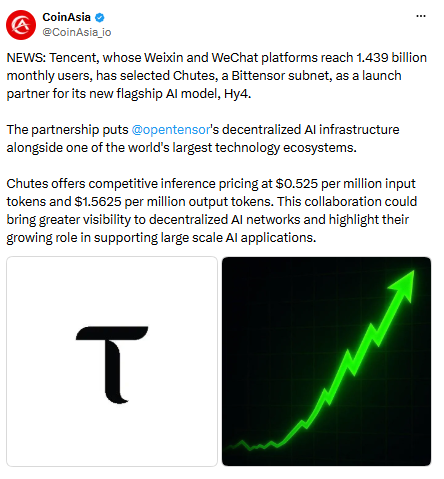
The main takeaway: Tencent reportedly has a combined 1.439 billion monthly active users across its Weixin and WeChat platforms.
Chutes charges $0.525 per million input tokens and $1.5625 per million output tokens, illustrating how decentralized AI providers are competing on price while aiming for larger markets.
The effect also appears in the market.
Bittensor's [$TAO] price has climbed by more than 3% to trade at $220. The rise follows the Tencent partnership and comes amid growing concerns over rising AI costs at Big Tech firms. This raises a key question: Could AI be emerging as a major driver of crypto's growing divergence from the broader market?
Bittensor turns AI hype into revenue as subnet buybacks pick up
Strategically, Bittensor is positioning itself at the heart of the growing AI trend.
Its affordable services are becoming more appealing, particularly with the new Tencent partnership, which provides access to an ecosystem of close to 1.5 billion monthly active users.
This could expand Bittensor's reach and support wider decentralized AI adoption. To gauge how this trend might affect the wider AI crypto sector, $TAO will be a key token to watch.
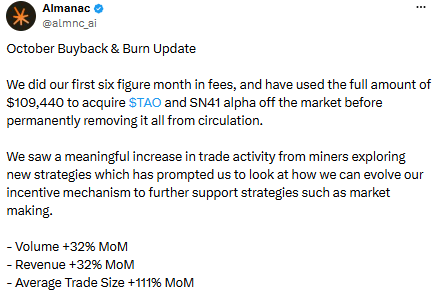
Notably, this momentum is also beginning to appear on-chain. The Bittensor-based decentralized AI platform Almanac (SN41) generated $109,440 in fees during October, the first time it has surpassed $100k in fees.
Interestingly, Almanac burned 100% of these fees to buy back $TAO and SN41 alpha.
Meanwhile, Engy (SN53), a Bittensor subnet focused on verifiable AI inference for open-source models, has already spent $63,000 on buybacks and token burns.
Taken together, these developments show how rising subnet revenue is translating into direct buying pressure for $TAO.
The key test, however, will be whether this momentum turns into genuine market demand. $TAO's recent 3% rally suggests investor interest may already be picking up.
So, if more subnets keep generating revenue and channel it into buybacks and burns, Bittensor could build a stronger fundamental case and potentially become one of the leading plays in the decentralized AI sector heading into 2027.
Final Summary
-
Tencent’s partnership with Chutes puts Bittensor in front of nearly 1.5 billion users, boosting its exposure to the AI market.
-
Growing subnet revenue and token buybacks are supporting $TAO demand, while its 3% rally signals rising interest in decentralized AI.
Source: ambcrypto.com. Adapted by NBTC.
Add A Comment
Comments are closed.