


Bitcoin miners entered early 2026 in a familiar but increasingly unforgiving setup: network hashrate is slipping from late-2025 highs, difficulty is adjusting on a delay, and power costs remain the hard constraint that decides which fleets stay online and which go dark.
The result is a market that can look resilient on the surface, especially when Bitcoin bounces, but remains fragile at the margin, where a single difficulty uptick or a regional power spike can turn “operating” into “curtailing” quickly.
Hashrate is cooling after a late-2025 high
Bitcoin’s network hashrate has cooled from its late-2025 peak pace and has not consistently returned to that level even during periods of spot strength.
JPMorgan estimated Bitcoin’s monthly average network hashrate rose 5% in October to 1,082 EH/s, a record monthly average in its series. November followed with an estimated 1,074 EH/s, a modest month-over-month pullback rather than a straight continuation.
Daily estimates since late December have been choppy, with prints swinging above and below the 1,000 EH/s threshold, consistent with miners cycling uptime instead of expanding smoothly.
YCharts’ network series sourced from Blockchain.com showed both sub-1,000 EH/s readings and rebounds above that level around the mid-January rebound.
Hashprice, not Bitcoin price alone, is driving shutdown decisions
Miner behavior hinges less on spot Bitcoin and more on hashprice, the expected daily revenue earned per unit of hashrate. That’s the metric that determines whether the least efficient rigs can run without bleeding cash.
In Luxor’s weekly update dated Jan. 12, USD hashprice slipped week over week from $40.23 to $39.53 per PH/s/day, a level described as “close to, or at, breakeven for many miners.”
In other words: the network can stay volatile even during a spot rebound because miner profitability can remain compressed.
Luxor also reported Bitcoin fell 2.9% last week to about $91,132 as hashprice tightened, increasing stress on miners whose cost base does not move with spot BTC.
In the same update, Luxor’s 7-day simple moving average for hashrate fell 2.8% from 1,054 EH/s to 1,024 EH/s.
Late-2025 context matters. Luxor’s research arm previously recorded difficulty hitting an all-time high after an Oct. 29 positive adjustment of 6.31% that lifted difficulty to 155.97T.
Hashprice then weakened in November as fees and price failed to offset the higher difficulty, with Hashrate Index data showing hashprice falling to an all-time low near $36 per PH/day.
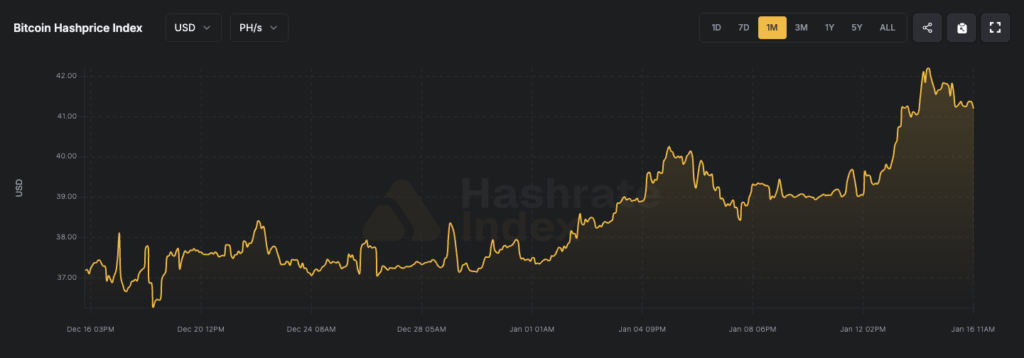
The market has moved above that trough into early 2026, but not by much. That’s why the hashrate recovery since October has been uneven: many operators are hovering around the point where “on” and “off” are separated by a thin power-cost spread.
A quick reality check at the machine level
The sensitivity becomes clearer when you translate hashprice into per-rig revenue and compare it with electricity cost.
Bitmain lists the Antminer S19j Pro at 92 TH/s and 2,714 watts, while its S21 listing shows 200 TH/s and 3,500 watts.
The table below uses a hashprice input of $38.2 per PH/s/day, roughly in line with Luxor’s cited six-month forward average.
For power, it uses the U.S. Energy Information Administration’s September 2025 industrial average electricity price of 9.02 cents/kWh as a delivered-price benchmark. Wholesale prices can be lower (or higher), but miners’ all-in cost depends on contracts, congestion, fees, and curtailment terms.
The implication isn’t that every miner is unprofitable, many have far better power rates, demand response revenue, and operational efficiency.
The point is that the marginal miner drives churn, and at these hashprice levels, marginal fleets increasingly behave like flexible load rather than “always on” infrastructure.
Difficulty is the lagging lever that can blindside miners
Difficulty adjusts only every 2,016 blocks (roughly every two weeks), which means it doesn’t respond instantly to spot BTC or hashrate swings.
That lag can force miners to absorb weak hashprice conditions for an entire epoch before the protocol recalibrates, compressing margins during drawdowns and delaying the profitability rebound some operators expect to arrive immediately.
That timing risk is why miners can get blindsided by difficulty: a fleet can look viable on a BTC rally, only to be squeezed when difficulty rises into the next window and the expected per-hash revenue fails to follow.
Early January difficulty data has also been reported down 1.20% to 146.4T in the first adjustment of 2026. Projections point to a Jan. 22 adjustment potentially rising toward ~148.20T.
Forward pricing suggests limited relief unless something changes.
Luxor said the forward market is pricing an average hashprice of $38.19 over the next six months. With spot hashprice around $39.53, that curve implies limited near-term relief unless one of the major drivers shifts: higher BTC, higher fees, easing difficulty, or cheaper power.
The emerging pattern is a kind of network whiplash: hashrate softens when hashprice compresses, difficulty lags the change, and miners are forced to eat weaker economics for a full epoch before protocol-level relief arrives.
A spot rally, such as the recent climb to $97,000, can mask stress temporarily, but if the next difficulty window lands higher than operators modeled, the squeeze can return quickly.
Power costs are where the squeeze concentrates
If hashprice tells miners what the network is paying, electricity determines what the real-world operator can keep.
Luxor’s roundup translated compute revenue into implied revenue per MWh across fleet-efficiency tiers:
That ladder matters because electricity pricing does not clear evenly across regions or contract types.
The International Energy Agency cited U.S. wholesale electricity prices averaging around $48/MWh in the first half of 2025, while the European Union averaged about $90/MWh.
The IEA also cited EU 2026 electricity futures around $80/MWh.
Wholesale benchmarks don’t map 1:1 to delivered industrial rates, but they help frame direction and volatility by region.
For miners operating in Luxor’s 25–38 J/TH tier, implied compute revenue near $51/MWh means many sites can be pushed to curtailment quickly if delivered energy costs rise, if hedges are unfavorable, or if local congestion and fees widen the all-in price.
Negative pricing adds another layer: it can reward flexible load and punish rigid procurement.
The IEA said negative prices are becoming more common in Europe, with the share of negative-price hours reaching 8–9% in H1 2025 in countries such as Germany, the Netherlands, and Spain.
That environment favors miners that can ramp up and down rapidly, capture demand response payments, or run behind-the-meter generation.
Operators without that flexibility can face higher effective costs in tight periods even if headline wholesale prices soften.
Texas remains a key mining jurisdiction, and a policy wildcard
Texas remains one of the most important jurisdictions to watch because grid policy and interconnection competition shape the economics of large mining loads.
Texas law Senate Bill 6 enables ERCOT to order certain large electricity users to shut down or use backup generation during emergencies.
Reporting on the bill said this applies to new large loads of 75 MW or more connecting after Dec. 31, 2025, while existing facilities are exempt.
Meanwhile, ERCOT’s load request pipeline exceeded 230 GW in 2025, with more than 70% tied to data centers, according to reporting on the queue.
The International Energy Agency has also flagged data centers as a major driver of electricity demand growth through 2026.
For Bitcoin miners, that combination raises the value of existing interconnections and stable contracts, and can make expansion meaningfully harder unless curtailment terms and grid access are negotiated early.
What to watch next
- The next one to two difficulty epochs: Difficulty’s lag can either relieve the squeeze (if it eases) or intensify it (if it rises while hashprice stays flat).
- Hashprice stability: Luxor’s $39–$40 per PH/s/day zone is near breakeven for many miners, and the forward curve near $38 suggests little margin for error.
- Power volatility: Fleets in the 25–38 J/TH tier are particularly exposed if delivered costs approach or exceed implied compute revenue per MWh, or if local basis risk widens all-in pricing.
- ERCOT curtailment risk: Emergency authority under SB 6 could translate into abrupt, event-driven hashrate dips independent of Bitcoin price.
- Data center competition: Continued grid demand growth may constrain miners’ access to the lowest-cost capacity and reinforce regional divergence in profitability.
For now, the measurable baseline is a spot hashprice Luxor placed at $39.53 per PH/s/day, alongside a weekly Bitcoin decline to around $91,132 and a 7-day hashrate average down to 1,024 EH/s.
That combination sets the reference point as the network approaches the next difficulty window, where miners will again decide whether to run, curtail, or wait for a recalibration that arrives only after the protocol’s built-in delay.
And with JPMorgan’s 1,082 EH/s October monthly benchmark still standing as a recent record in its series, the next key question is straightforward:
Can miner economics support enough sustained uptime to climb back toward that pace, or will difficulty lag and power constraints keep the network in stop-start mode even if BTC stays strong?
