
Close Menu
  • Coins
    • Bitcoin
    • Ethereum
    • Altcoins
    • NFT
  • Blockchain
  • DeFi
  • Metaverse
  • Regulation
  • Other
    • Exchanges
    • ICO
    • GameFi
    • Mining
    • Legal
  • MarketCap
What's Hot

How to Earn Stablecoin Yield on Payroll Funds in 2026

16/05/2026

SoFi stock drops 12% despite strong Q1 earnings as outlook disappoints

16/05/2026

Tether’s Paolo Ardoino Makes Case for Small On-Device Translation Models

16/05/2026
Facebook X (Twitter) Instagram
  • Back to NBTC homepage
  • Privacy Policy
  • Contact
X (Twitter) Telegram Facebook LinkedIn RSS
NBTC News
  • Coins
    1. Bitcoin
    2. Ethereum
    3. Altcoins
    4. NFT
    5. View All

    A “Rising Wedge” Formation is Beginning in Bitcoin! Here Are the Details

    16/05/2026

    This Was the Reason for the Recent Drop! Analyst Predicts What Might Happen Next for BTC!

    16/05/2026

    According to a report by onchain analytics company Santiment, Bitcoin whales made large-scale BTC purchases

    15/05/2026

    Is Your Bitcoin Really Bitcoin? The Truth About Wrapped and Staked BTC

    15/05/2026

    Ethereum Captures 71.9% of Tokenized Funds — BlackRock’s $7B Move Locks In the Lead

    16/05/2026

    Vitalik Buterin Donates Another $150K in ETH to Animal Welfare Fund

    16/05/2026

    can Glamsterdam news stop the selloff?

    16/05/2026

    Ethereum Price Prediction: ETH Tightens Below $3,000

    15/05/2026

    According to a famous CEO, XRP is not just an altcoin! It’s now being used in this field too!

    16/05/2026

    Hyperliquid’s HYPE token flips Cardano’s ADA in market cap

    16/05/2026

    Ripple Prime CEO Confirms XRP Use as Collateral for Institutional Trades

    16/05/2026

    Unusual Data in Solana (SOL) On-Chain Charts – Whales Have Changed Their Behavior

    15/05/2026

    OpenSea CMO sees tokenized Pokémon cards, Rolexes and tickets driving next NFT wave

    16/05/2026

    Will the NFT Craze That Swept the World Make a Comeback?

    15/05/2026

    Dapper Labs Pauses NFL ALL DAY NFT Minting to Develop Next-Gen Product

    14/05/2026

    Yuga Labs CEO defends Bored Ape price comeback

    12/05/2026

    How to Earn Stablecoin Yield on Payroll Funds in 2026

    16/05/2026

    SoFi stock drops 12% despite strong Q1 earnings as outlook disappoints

    16/05/2026

    Tether’s Paolo Ardoino Makes Case for Small On-Device Translation Models

    16/05/2026

    TradingRazor Integrates Manadia To Expand Secure, Verifiable Multi-Chain DeFi Trading

    16/05/2026
  • Blockchain

    Tether’s Paolo Ardoino Makes Case for Small On-Device Translation Models

    16/05/2026

    OP Succinct data confidentiality lets institutions hide transaction data on Ethereum

    16/05/2026

    Upbit to Launch Proprietary Wallet and Blockchain Chain, Signaling Shift to On-Chain Platform

    16/05/2026

    Animoca-backed NUVA connects Figure’s $19 billion of tokenized assets to Ethereum

    15/05/2026

    Solana’s ‘Alpenglow’ upgrade is live for testing

    15/05/2026
  • DeFi

    How to Earn Stablecoin Yield on Payroll Funds in 2026

    16/05/2026

    TradingRazor Integrates Manadia To Expand Secure, Verifiable Multi-Chain DeFi Trading

    16/05/2026

    TownSquare unveils $100 million USD1 liquidity initiative

    16/05/2026

    Byreal Launches USD1 Growth Push on Solana Backed by 1M $WLFI Rewards

    16/05/2026

    Aave Labs Proposes Major Bug Bounty Overhaul, Boosting Top Reward to $5 Million

    15/05/2026
  • Metaverse

    Why Animoca’s Yat Siu says the future is 100 billion AI agents

    07/05/2026

    ‘8,000 Jobs’—Polymarket Sees Tech Layoff Surge As Meta AI Push Bites

    18/04/2026

    Planet Hares Partners With Magne.AI To Bridge Web3 Metaverse With Smartphone Mobile-Ready Applications For Mass Adoption

    08/04/2026

    Mark Zuckerberg’s Meta launches new AI initiative after metaverse retreat

    25/03/2026

    Meta partners with Arm to develop new CPUs for AI deployments

    24/03/2026
  • Regulation

    SoFi stock drops 12% despite strong Q1 earnings as outlook disappoints

    16/05/2026

    Jack Mallers’ Twenty One Capital surges after majority holder Tether proposes 3-way merger

    16/05/2026

    AI Earnings From Four Tech Giants Land Tonight. Bitcoin Is Watching.

    16/05/2026

    Robinhood Can’t Shake Off Risky Crypto Image

    16/05/2026

    Trillion-dollar, lifetime CEO Musk emerges as early winner ahead of SpaceX IPO

    15/05/2026
  • Other
    1. Exchanges
    2. ICO
    3. GameFi
    4. Mining
    5. Legal
    6. View All

    GAEA Teams Up with GAT Bank to Expand AI-Powered Global Payments

    15/05/2026

    US Government Moves $33K in Seized UNI, CRO, and LINK to Coinbase Prime

    15/05/2026

    Hong Kong Exchange OSL Joins Mastercard’s Crypto Partner Program to Advance Stablecoin Payments

    15/05/2026

    Coinbase is Back in Service After an Outage Caused by Amazon Infrastructure! Here Are the Details

    15/05/2026

    ICO market slows sharply with only six completions in 2026

    30/04/2026

    South Korea Poised to Lift Ban on Domestic ICOs After 7 Years

    19/12/2025

    Why 2025’s Token Boom Looks Both Familiar and Dangerous

    31/10/2025

    ICO for bitcoin yield farming chain Corn screams we’re so back

    22/01/2025

    NUMINE Joins Outer Ring MMO for the Expansion of Web3 Gaming Experiences

    13/05/2026

    GMatrixs And MiniverseCore Join Forces To Unlock Web3 Gaming Experience With Cross-Chain DApp, DeFi Applications

    11/05/2026

    MetaOne Joins MetYa to Boost SocialFi Gaming with Exclusive Rewards

    10/05/2026

    Quantra and FishWar Unite to Advance AI-Powered Web3 Gaming on Sei

    10/05/2026

    Miner Weekly – The Great Bitcoin Mining Power Shift: Who Won Q1?

    15/05/2026

    Canaan Mined 90 BTC in April, Now Holds Over 1,800 Bitcoin

    15/05/2026

    Bitfufu Produces 145 BTC in April, Lifts Holdings to 1,812 Bitcoin

    15/05/2026

    Bitcoin Miner MARA Stock Under Pressure Following $1.5 Billion Bitcoin Sell-Off

    14/05/2026

    Trump Says World Becoming a ‘Casino’ as Soldier Charged Over Polymarket Maduro Bets

    14/05/2026

    Bermuda pushes stablecoin payments with USDC airdrop as it courts crypto firms, regulators

    14/05/2026

    Crypto bill won’t move without a ban on officials’ industry ties, says U.S. Senator Gillibrand

    14/05/2026

    the Senate must act on crypto market structure legislation

    14/05/2026

    How to Earn Stablecoin Yield on Payroll Funds in 2026

    16/05/2026

    SoFi stock drops 12% despite strong Q1 earnings as outlook disappoints

    16/05/2026

    Tether’s Paolo Ardoino Makes Case for Small On-Device Translation Models

    16/05/2026

    TradingRazor Integrates Manadia To Expand Secure, Verifiable Multi-Chain DeFi Trading

    16/05/2026
  • MarketCap
NBTC News
Home»Mining»Bitcoin’s 15% difficulty spike allows one on-chain metric to flip miners from sellers to hoarders in days
Mining

Bitcoin’s 15% difficulty spike allows one on-chain metric to flip miners from sellers to hoarders in days

NBTCBy NBTC02/03/2026No Comments7 Mins Read
Share
Facebook Twitter LinkedIn Pinterest Email


Bitcoin difficulty just reset about 15% higher to roughly 144.40T.

While this is neither the first nor the last, it is the largest since around 2021. The timing is important because the protocol tightened miner economics while Bitcoin has been chopping around the mid-$60,000s with repeated tests near $65,000.
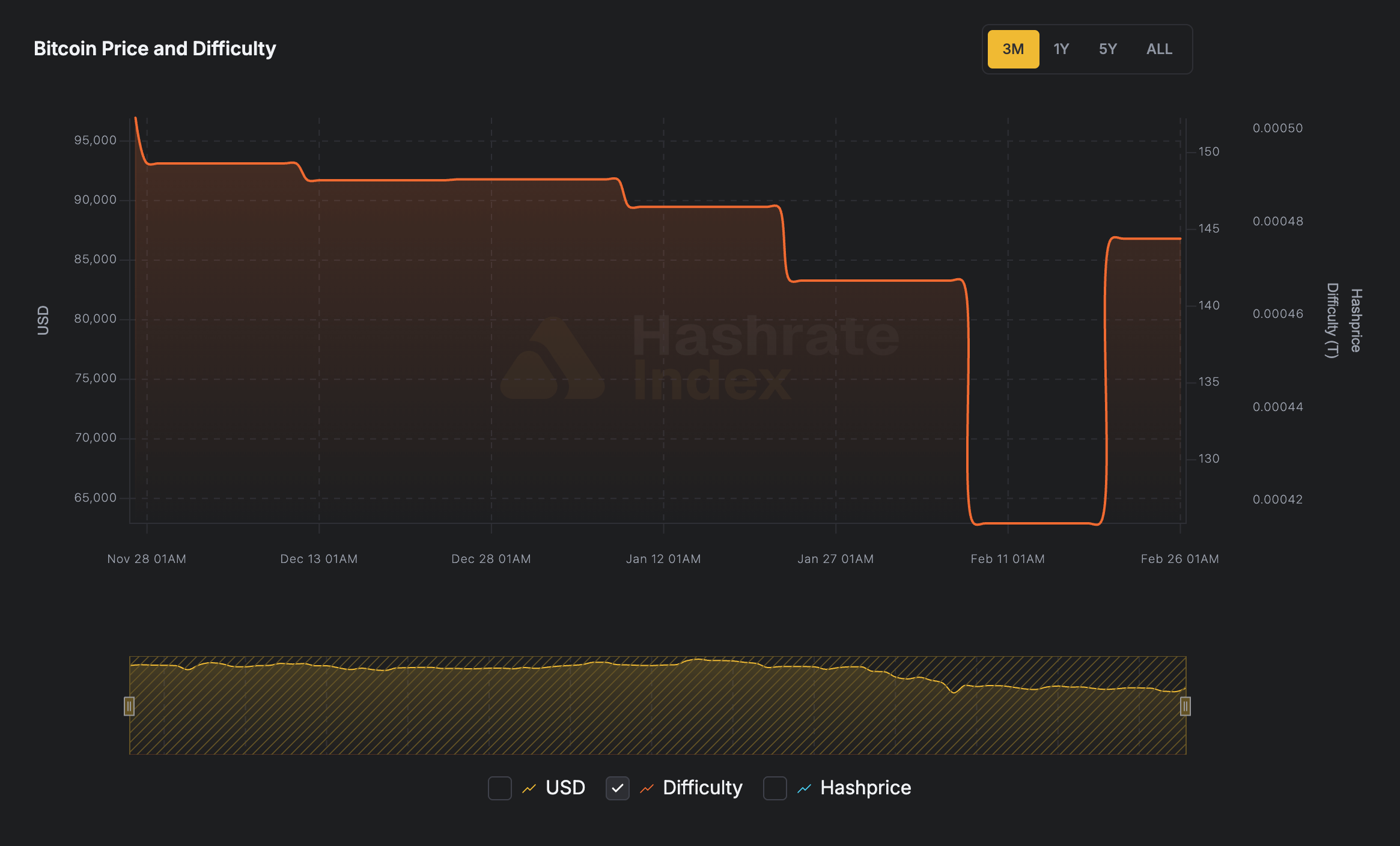
When blocks arrive faster than the ten-minute target, the network raises the work required per block to normalize issuance. That mechanism is working as designed, with security improved, block timing normalized, and production costs moved higher in one adjustment.

For markets, the key detail is what a difficulty increase does when price and fees don’t rise alongside it.

In that case, mining stops behaving like background infrastructure and starts behaving like a flow variable, because the fastest way to close a near-term cash gap often involves selling coins into spot markets. The setup is mechanical, but it can matter for short-run price behavior after an adjustment, especially when the weaker segment of the fleet reaches the same stress zone at the same time.

Why this matters now

Difficulty functions as a cost multiplier. A higher multiplier raises the work required to earn the same expected share of blocks, which translates into more electricity consumed and more wear per expected coin for a given machine, unless miners offset it through a higher Bitcoin price, higher transaction fees, lower power costs, or higher efficiency.

Hashprice is the clean shorthand for the combined result. It expresses revenue per unit of hashrate, typically quoted in dollars per petahash per second per day. Around the adjustment window, hashprice fell from roughly $33.5 to about $29.7 per PH/s/day, which puts a meaningful portion of the fleet in a band where outcomes depend heavily on power costs, machine efficiency, and debt service.
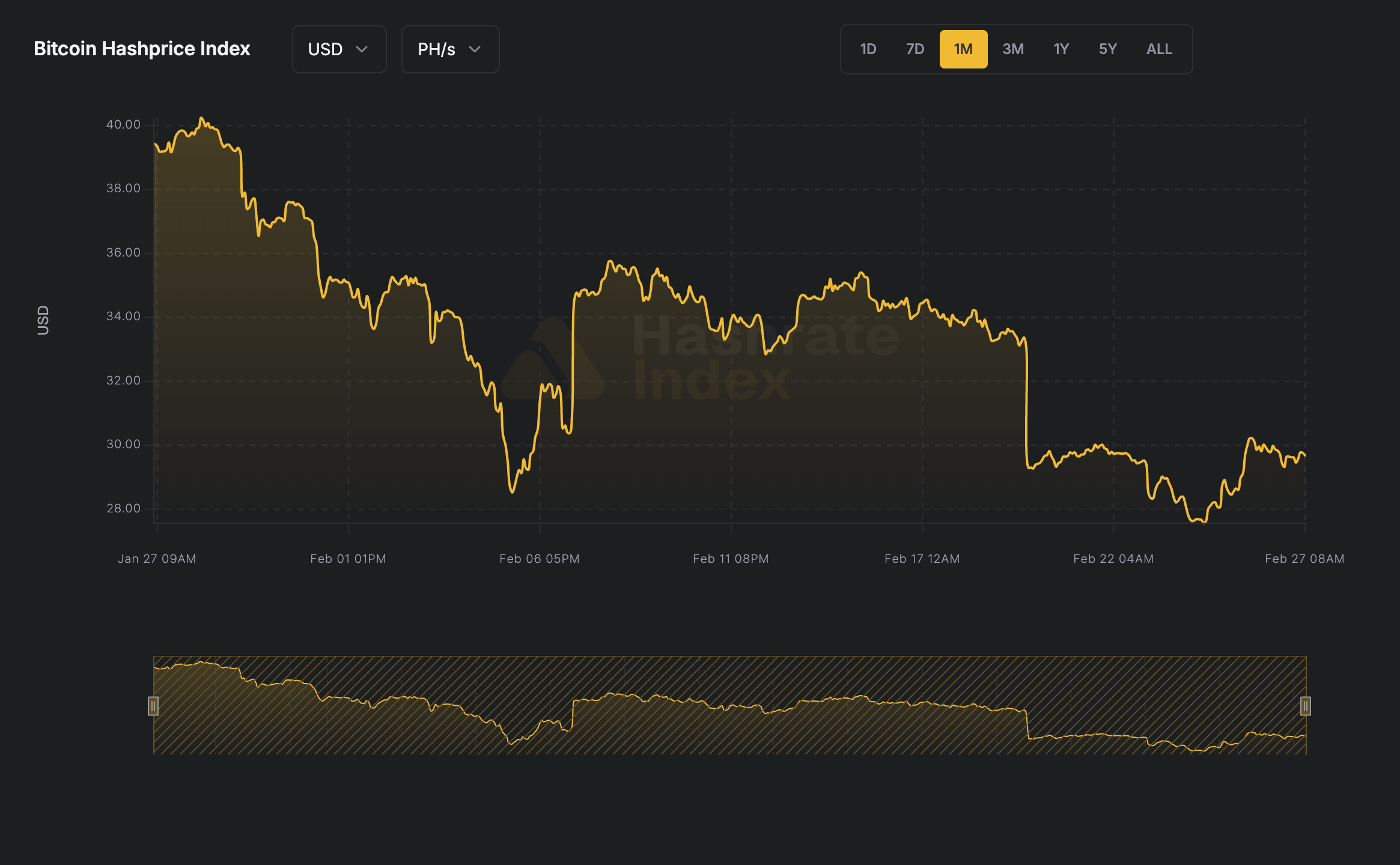
Nonetheless, that level doesn’t imply uniform distress.

The strongest operators pair low-cost power with modern fleets and financing that preserves flexibility, while less efficient miners operate closer to break-even. This is especially true in a post-halving environment where the block subsidy is smaller, and fees have to do more work during quiet periods.

The point is simpler: the margin for error shrank quickly, and tighter weekly math can translate into more price-facing supply when operators meet liquidity needs through inventory sales.

Why a difficulty jump into flat revenue compresses margins

Higher difficulty means more hashes are required to earn the same expected output, and the adjustment arrives all at once. Miners respond through efficiency upgrades, cost renegotiation, balance-sheet financing, or coin sales, yet those channels move on different clocks.

Treasury sales sit on the shortest clock. Power and hosting agreements often behave like fixed obligations. Hardware upgrades require capital and deployment time. Capital markets can tighten when Bitcoin and miner equities weaken together.

When difficulty rises while price stays range-bound, the stress shows up as a cash-flow constraint.

Revenue in fiat terms can compress immediately, while most operating costs stay denominated in currency and electricity. Profitability can deteriorate even as network security strengthens, and that combination tends to surface as miner-related sell pressure, especially among operators with scheduled payments.

How a miner squeeze turns into scheduled selling

When revenue per hash declines, miners typically work through cost reductions, efficiency improvements, capital raises, and coin sales, but the order in which they do it is shaped by time. The bills that arrive next week take priority over projects that pay back in six months.

Public miners carry payroll, site leases, hosting bills, and interest expense. Many also hold BTC on their balance sheets as a form of working capital. These treasury coins become the most direct liquidity source when other channels look expensive or slow. A miner that needs dollars on a schedule sells into that schedule, and the transaction turns a balance-sheet asset into spot market supply.

Markets pay attention to sellers who transact on obligation rather than preference, because the flow tends to arrive during indecisive price action, when financing windows narrow and reserves matter more. Selling can also cluster, since similar cost structures and similar fleet efficiencies can push multiple operators into the same stress zone at once.

The effect can persist for a while because a softer price reduces dollar revenue per block, which can increase the number of coins required to cover the same fiat bill.

This mechanism doesn’t require a network crisis. It emerges from a mismatch between a higher work requirement on the protocol side and a market that does not reprice bitcoin higher.

What ends the squeeze, and why the base case still skews constructive

A forced-seller window typically closes through price strength, fee strength, or difficulty relief, and each channel works through a different part of miner revenue.

Price strength is the fastest. Even a moderate move higher improves miner revenue in fiat terms immediately, while many costs remain relatively stable, which reduces the need to fund operations through coin sales.

Fee strength is a second relief valve. Transaction fees can rise with congestion, activity spikes, or volatility-driven on-chain demand. That top-up can turn a red week into a manageable one even if spot price stays range-bound.

Difficulty relief arrives through the protocol. If enough miners power down, block times slow, and the next adjustment can reduce difficulty. A large upward move, like 144.40T, can be followed by a downward move if the fleet contracts.

From here, the outlook splits into two coherent paths that follow from the same inputs.

In the weaker path, price continues hovering around $68,000 without follow-through, hashprice stays near the $30 per PH/s/day zone, and a portion of the fleet funds operations by selling treasury coins. That adds supply into moments when spot markets already lack momentum, which can keep price action heavy for longer than sentiment expects.

In the constructive path, a combination of modest price improvement, a sustained fee pickup, or incremental difficulty relief reduces cash-flow pressure, and the selling impulse cools.

The constructive bias rests on a straightforward observation: a large difficulty increase reflects a deep mining base that is adding hashrate and normalizing block times quickly, even in a post-halving margin environment.

Difficulty at 144.40T signals the network can absorb industrial-scale compute and preserve cadence, which tends to strengthen the security profile over time.

Squeezes also act as clearing events. Hashrate share migrates toward operators with durable power strategies, modern fleets, and flexible financing, while less efficient miners renegotiate costs, consolidate, or power down. The network emerges with a higher-quality production base.

A miner selling phase can also function as a distribution phase, where coins move from leveraged producers into the hands of buyers willing to hold through volatility. The market can dislike the flow in real time while still building a sturdier holder base under the surface.

The clean way to read this moment is to separate fundamentals from flow: fundamentals improved through higher difficulty and stronger security, while flow risk increased as a range-bound price meets tighter miner economics.

What to watch next week

If the market is going to feel this adjustment, it will show up through a small set of observable constraints.

Hashprice matters because it concentrates the revenue picture into a single number, and sustained prints around the $30 per PH/s/day region sharpen the difference between miners who can fund operations from current revenue and miners who need to monetize inventory.

Price behavior around $65,000 is relevant because range-bound action can amplify the effect of scheduled selling, while a cleaner move higher tends to relax the cash-flow constraint quickly.

Fees matter because a fee-heavy period can supplement the post-halving revenue base.

Difficulty is worth focusing on because the next adjustment will reflect whether enough operators powered down to slow blocks and trigger relief.

In practice, the question is arithmetic. Miners either pay the power bill from current revenue, or they convert bitcoin to do it, and that conversion becomes supply that can lean on spot markets for as long as the constraint stays binding.

Share. Facebook Twitter Pinterest LinkedIn Tumblr Email
NBTC

NBTC is the editorial account for NBTC News, covering Bitcoin, Ethereum, DeFi, blockchain infrastructure, exchanges, mining, regulation and digital asset markets. The editorial team focuses on clear sourcing, timely updates and practical context for crypto readers.

Related Posts

Miner Weekly – The Great Bitcoin Mining Power Shift: Who Won Q1?

15/05/2026

Canaan Mined 90 BTC in April, Now Holds Over 1,800 Bitcoin

15/05/2026

Bitfufu Produces 145 BTC in April, Lifts Holdings to 1,812 Bitcoin

15/05/2026

Bitcoin Miner MARA Stock Under Pressure Following $1.5 Billion Bitcoin Sell-Off

14/05/2026
Add A Comment

Comments are closed.

Top Posts
Get Informed

Subscribe to Updates

Get the latest news from NBTC regarding crypto, blockchains and web3 related topics.

Your source for the serious news. This website is crafted specifically to for crazy and hot cryptonews. Visit our main page for more tons of news.

We're social. Connect with us:

Facebook X (Twitter) LinkedIn RSS
Top Insights

How to Earn Stablecoin Yield on Payroll Funds in 2026

16/05/2026

SoFi stock drops 12% despite strong Q1 earnings as outlook disappoints

16/05/2026

Tether’s Paolo Ardoino Makes Case for Small On-Device Translation Models

16/05/2026
Get Informed

Subscribe to Updates

Get the latest news from NBTC regarding crypto, blockchains and web3 related topics.

Type above and press Enter to search. Press Esc to cancel.