
Crypto Fear Returns to Tariff Sell-Off Levels
Fear across digital assets recently neared levels seen during the March 2025 tariff sell-off, while further declines appeared increasingly limited unless equities fell sharply, Marc des Ligneris, senior portfolio manager at digital asset investment firm Coinshares, said in commentary sent to Bitcoin.com News on Nov. 17. He also described how an AI downturn could eventually support bitcoin through a Federal Reserve policy reversal.
Coinshares’ Crypto Sentiment Index, which tracks market mood, fell to fear levels comparable to March 2025. Funding rates, which determine payments between bullish and bearish futures traders, remained healthier than during February’s liquidation, or forced closure of leveraged positions, suggesting overall fear was less severe. However, options skew, which measures the relative cost of downside protection versus upside exposure, reached an extreme, as did the Fear & Greed Index.
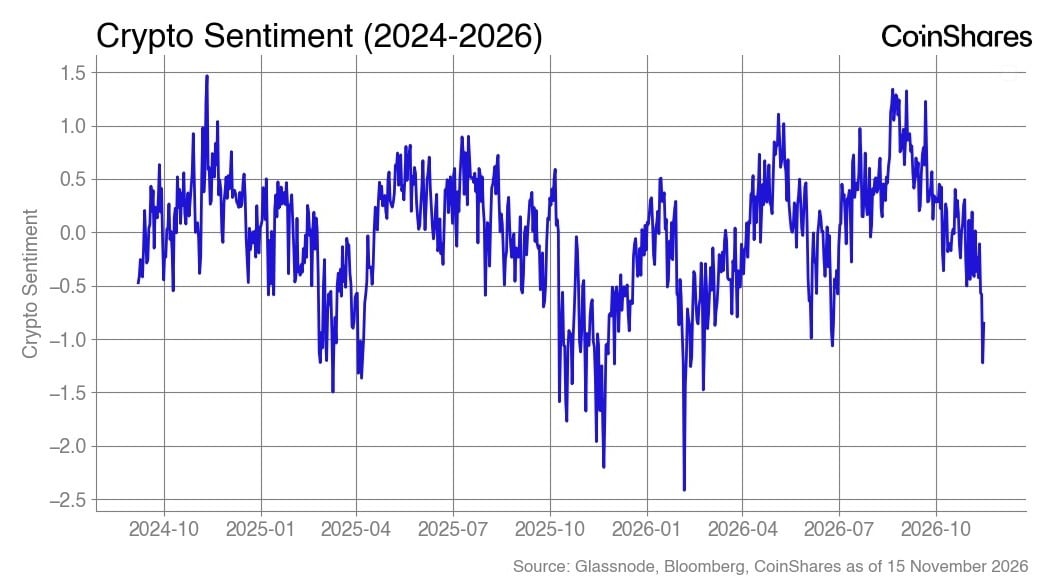
Capitulation Tempers the Case for Further Losses
Des Ligneris considered such readings unusual in a healthy bull market, reinforcing his view that August’s rally increasingly looked like a false start. He judged that crypto had not yet entered a bull market. Nevertheless, he saw advanced capitulation, or investors giving up after losses.
On the possibility of a broader retreat from riskier assets, he said:
“Unless there is a broader risk-off move, such as a sharp correction in equities, further downside looks increasingly limited from here.”
Extreme-fear readings across other crypto gauges reinforced that backdrop. Alternative.me’s zero-to-100 sentiment index rose to 12 on Nov. 17, from 10 the previous day, but still indicated extreme fear. Cryptoquant contributor Darkfost viewed the pessimism as a contrarian signal, suggesting a rebound could follow widespread bearishness.
In a bitcoin recovery outlook published on Nov. 13, Coinshares Head of Research James Butterfill set his base case at $60,000-$90,000. A sustained breakout would require changes in Fed expectations, institutional flows, meaning buying and selling by professional investors, or renewed purchases by large holders.
An AI Downturn Could Change the Fed’s Direction
Des Ligneris observed that monetary policy and the U.S. dollar heavily influenced bitcoin, while the previous week’s inflation figures added pressure. He suggested that leadership turmoil at chipmaker Nvidia (Nasdaq: NVDA) and the initial public offering (IPO) of Anthropic, the AI company behind Claude, might signal an AI bubble peak. Nvidia’s board accepted co-founder Jensen Huang’s resignation as CEO on Nov. 11.
He explained:
“If that bubble deflates, growth expectations would quickly come under pressure. That could push the Fed to reverse course on monetary policy, which would create a much more supportive environment for bitcoin.”
Federal Reserve Governor Christopher Waller made his case for further monetary tightening on Nov. 10. He said persistent inflation favored another increase and that a half-percentage-point December hike warranted consideration if core inflation remained elevated. His position contrasted with the potential policy reversal described by des Ligneris.
The scale of Anthropic’s proposed public offering underscored the amount of capital involved. Its Nov. 10 roadshow outlined 825 million shares priced at $70-$78 each, implying proceeds of up to $64.35 billion before fees.
Investor positioning also pointed to near-term optimism. Bitmex co-founder Arthur Hayes reported on Nov. 11 that he was adding crypto exposure ahead of Anthropic’s debut, keeping positions small to medium so he could close them quickly.