
Close Menu
  • Coins
    • Bitcoin
    • Ethereum
    • Altcoins
    • NFT
  • Blockchain
  • DeFi
  • Metaverse
  • Regulation
  • Other
    • Exchanges
    • ICO
    • GameFi
    • Mining
    • Legal
  • MarketCap
What's Hot

Ethereum Could Get Faster in January With Gas Limit Rise to 80M Following BPO2 Fork

18/12/2025

Blue Origin Marks First Ocean Landing of New Glenn Booster After Second Attempt

18/12/2025

Gavin Newsom Singles Out CZ, Ross Ulbricht, Arthur Hayes as Trump’s ‘Criminal Cronies’

18/12/2025
Facebook X (Twitter) Instagram
  • Back to NBTC homepage
  • Privacy Policy
  • Contact
X (Twitter) Telegram Facebook LinkedIn RSS
NBTC News
  • Coins
    1. Bitcoin
    2. Ethereum
    3. Altcoins
    4. NFT
    5. View All

    Price Breaks All-Time High Record Again – Here’s What We Know

    04/08/2025

    Bitcoin Switzerland? El Salvador to Host First Fully Native Bitcoin Capital Markets

    04/08/2025

    Bitcoin Breaks $119K, but XLM and HBAR Aren’t Impressed by Its Meager Percentage Gain

    04/08/2025

    High-Stakes Consolidation Could Define Q3 Trend

    04/08/2025

    Ethereum Could Get Faster in January With Gas Limit Rise to 80M Following BPO2 Fork

    18/12/2025

    Foundation Proposes 3 Key Solutions

    18/12/2025

    Ethereum’s (ETH) 19% Mini-Rally Faked Out: What’s Next for Price?

    17/12/2025

    Whales Are Going All-In on Ethereum — But Record Leverage Puts Their Longs at Risk

    17/12/2025

    The Sui Ecosystem’s Top 3 Altcoin Performers

    29/07/2025

    Floki Launches $69000 Guerrilla Marketing Challenge With FlokiUltras3

    28/07/2025

    Crypto Beast denies role in Altcoin (ALT) crash rug pull, blames snipers

    28/07/2025

    $1.6 Billion XRP Surge: Here’s What’s Unfolding

    28/07/2025

    Reddit Sunsets Digital Collectibles, Users Must Export Keys

    17/12/2025

    Assemble AI and Infiblue World Join Forces to Enhance Web3 Creator Economy

    17/12/2025

    A Game-Changer for Bitcoin NFTs

    16/12/2025

    RaveGods NFTs represent ultimate status symbol for the new digital elite

    15/12/2025

    Ethereum Could Get Faster in January With Gas Limit Rise to 80M Following BPO2 Fork

    18/12/2025

    Blue Origin Marks First Ocean Landing of New Glenn Booster After Second Attempt

    18/12/2025

    Gavin Newsom Singles Out CZ, Ross Ulbricht, Arthur Hayes as Trump’s ‘Criminal Cronies’

    18/12/2025

    Nordic Crypto Exchange Safello Partners With Fuels Capital for Bitcoin‑Collateral Custody

    18/12/2025
  • Blockchain

    Comprehensive startale usd guide for on-chain yields, liquidity and STAR Points

    18/12/2025

    JPMorgan just crossed a dangerous line with Solana that major banks have strictly avoided until now

    18/12/2025

    Here are the most popular 2025 blockchains

    18/12/2025

    Gold leads tokenized stocks and commodities to record valuation in December

    18/12/2025

    Neo Launches MainNet Message Bridge to Boost Next-Gen Cross-Chain Interoperability

    18/12/2025
  • DeFi

    How tokenized US Treasuries are replacing DeFi’s foundation

    18/12/2025

    SDEX Soars 160% After Smardex Unveils Unified DeFi Protocol

    18/12/2025

    JustLend DAO TVL Crosses $6.47B as TRON DeFi Gains Strong Momentum

    18/12/2025

    Bug that can drain all your tokens impacting ‘thousands’ of sites

    18/12/2025

    Who controls the money — and the brand?

    18/12/2025
  • Metaverse

    Meta CEO Mark Zuckerberg Made a Decision That Will Deeply Affect Metaverse Projects! Here Are the Details

    05/12/2025

    Meta Plans 30% Cut to Metaverse Budget as Reality Becomes Less Virtual: Bloomberg

    04/12/2025

    Cambridge Institute Joins InfblueNFT to Transform Digital Communication

    21/11/2025

    AGI Open Network Partners with MetaMars to Drive Marverse Economy

    15/11/2025

    Koda Nexus Opens in Otherside, Bored Ape Yacht Club Creator Debuts Social Hub

    13/11/2025
  • Regulation

    Blue Origin Marks First Ocean Landing of New Glenn Booster After Second Attempt

    18/12/2025

    Nearly 25% of Adults With Internet Access in Asia Might Own Crypto, Report Says

    18/12/2025

    Grayscale’s IPO filing reveals 20% revenue slump and $318.7M in losses

    18/12/2025

    Tether plans major expansion in commodities lending, deploys $1.5 billion capital

    18/12/2025

    Upexi CSO Explains Why the Next Wave of Corporate Finance Is Moving On-Chain

    18/12/2025
  • Other
    1. Exchanges
    2. ICO
    3. GameFi
    4. Mining
    5. Legal
    6. View All

    Nordic Crypto Exchange Safello Partners With Fuels Capital for Bitcoin‑Collateral Custody

    18/12/2025

    Stablecoins surpassed PayPal and Visa in terms of monthly transaction volumes

    18/12/2025

    Bitget Integrates Monad, Letting Users Trade Monad Assets Directly with USDC

    18/12/2025

    Liquidity pools into Binance as volatility returns

    18/12/2025

    Why 2025’s Token Boom Looks Both Familiar and Dangerous

    31/10/2025

    ICO for bitcoin yield farming chain Corn screams we’re so back

    22/01/2025

    Why 2025 Will See the Comeback of the ICO

    26/12/2024

    Sentism AI Brings AI Intelligence to GameFi With Anome Protocol

    17/12/2025

    Greedy World Partners with Qitmeer Network to Boost Web3 Decentralized Meme Gaming Platform with Advanced Scalability and Interoperability

    17/12/2025

    Market Cap Slides to $9.03B as Web3 Gaming Momentum Builds

    16/12/2025

    Moonbirds to launch BIRB token in early Q1 2026

    15/12/2025

    Crypto Miners Face Jail Time as Tajikistan Fights Winter Blackouts

    17/12/2025

    Hut 8 partners with Anthropic and Fluidstack on US AI data center buildout

    17/12/2025

    Why China’s Recent Mining Crackdown Triggered Bitcoin’s Latest Sell-Off

    17/12/2025

    Russia to impose year-round mining bans two new Siberian territories next year

    17/12/2025

    Gavin Newsom Singles Out CZ, Ross Ulbricht, Arthur Hayes as Trump’s ‘Criminal Cronies’

    18/12/2025

    Dubai’s DIFC removes red tape for crypto registration in its financial center

    18/12/2025

    Lawmakers pass key amendments to Armenia’s crypto act

    18/12/2025

    CFTC Acting Chair Caroline Pham joins MoonPay as chief legal and policy officer

    18/12/2025

    Ethereum Could Get Faster in January With Gas Limit Rise to 80M Following BPO2 Fork

    18/12/2025

    Blue Origin Marks First Ocean Landing of New Glenn Booster After Second Attempt

    18/12/2025

    Gavin Newsom Singles Out CZ, Ross Ulbricht, Arthur Hayes as Trump’s ‘Criminal Cronies’

    18/12/2025

    Nordic Crypto Exchange Safello Partners With Fuels Capital for Bitcoin‑Collateral Custody

    18/12/2025
  • MarketCap
NBTC News
Home»Regulation»Are Stablecoins the Hidden Blueprint for a US Digital Dollar?
Regulation

Are Stablecoins the Hidden Blueprint for a US Digital Dollar?

NBTCBy NBTC24/07/2025No Comments6 Mins Read
Share
Facebook Twitter LinkedIn Pinterest Email


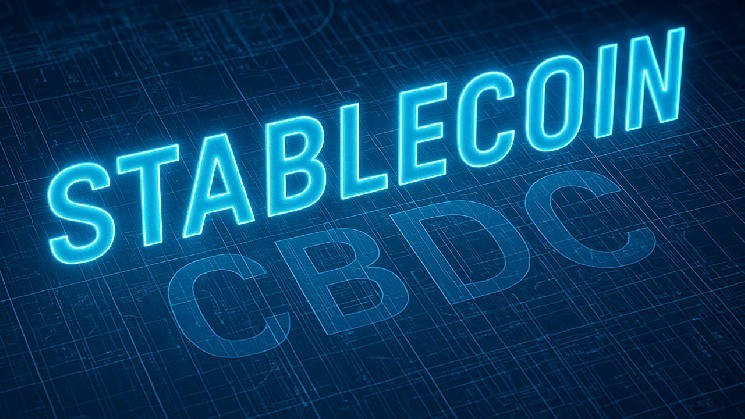
Stablecoins, digital currencies pegged to the U.S. dollar, have surged in popularity, but their quiet resilience under slim regulatory scrutiny may signal a deeper role as a testing ground for a central bank digital currency (CBDC).

Stablecoins and the Silent Rise of a Central Bank Digital Dollar

These blockchain-based tokens, designed to maintain a stable value, offer a glimpse into a future where governments could leverage their infrastructure to introduce a state-controlled digital dollar. As the U.S. grapples with the implications of a CBDC, stablecoins like Tether’s USDT and Circle’s USDC, which have thrived with fairly minimal government interference, raise questions about whether they are inadvertent prototypes for a broader, more centralized financial transformation.

Stablecoins operate on a simple premise: they are cryptocurrencies tied to a fiat currency, typically the U.S. dollar, to avoid the volatility plaguing assets like bitcoin or ethereum. Issued by private companies, they are backed by reserves of cash, bonds, or other assets, ensuring a 1:1 peg with the dollar. Tether’s USDT, the largest stablecoin, and USDC, issued by Circle, dominate the market, facilitating billions in daily transactions across decentralized finance (DeFi) platforms, remittances, and global trade.

Their utility lies in their ability to merge the speed and transparency of blockchain with the stability of traditional currency, making them a darling of crypto enthusiasts and a potential blueprint for central banks eyeing digital currencies. The U.S. government has long signaled interest in a CBDC, a digital version of the dollar issued and controlled by the Federal Reserve. Unlike stablecoins, a CBDC would be a direct liability of the central bank, offering unparalleled control over monetary policy, transaction tracking, and financial oversight.

Proponents argue it could streamline payments, reduce costs, and enhance financial inclusion. Critics, however, warn of privacy erosion, surveillance risks, and the potential for governments to exert unprecedented control over individual spending. The Biden administration’s 2022 executive order on digital assets tasked agencies with exploring CBDC feasibility, and the Federal Reserve has been studying its implications through initiatives like Project Hamilton. Yet, deploying a CBDC from scratch is a monumental task—unless the infrastructure already exists.

A few years after BTC was introduced, stablecoins became a prominent fixture. Yet in 2011, before stablecoins, Bernard von NotHaus, creator of the Liberty Dollar, was convicted on counterfeiting charges for making and distributing silver coins that resembled U.S. currency and for conspiracy against the United States.

Enter stablecoins, which have quietly built the scaffolding for a digital dollar. Their blockchain networks, wallet systems, and integration with global exchanges provide a ready-made ecosystem. Tether and USDC, for instance, operate on public blockchains like Ethereum, enabling seamless, near-instantaneous transactions across borders. They’ve also navigated regulatory gray zones since their inception. This resilience suggests a tacit acceptance by regulators, who could be observing how these coins function under real-world conditions—potentially as a dry run for a CBDC.

The parallels between stablecoins and a potential CBDC are striking. Both rely on digital ledgers to track transactions, both aim for dollar parity, and both require trust in the issuer’s backing. A CBDC could theoretically adopt a stablecoin’s architecture, swapping private issuers for the Federal Reserve. This transition would be a backdoor approach, bypassing the need to build a CBDC from the ground up. By leveraging existing stablecoin frameworks, the Fed could deploy a digital dollar with minimal disruption, using familiar technology to ease public and institutional adoption. The question is whether this is already happening in plain sight.
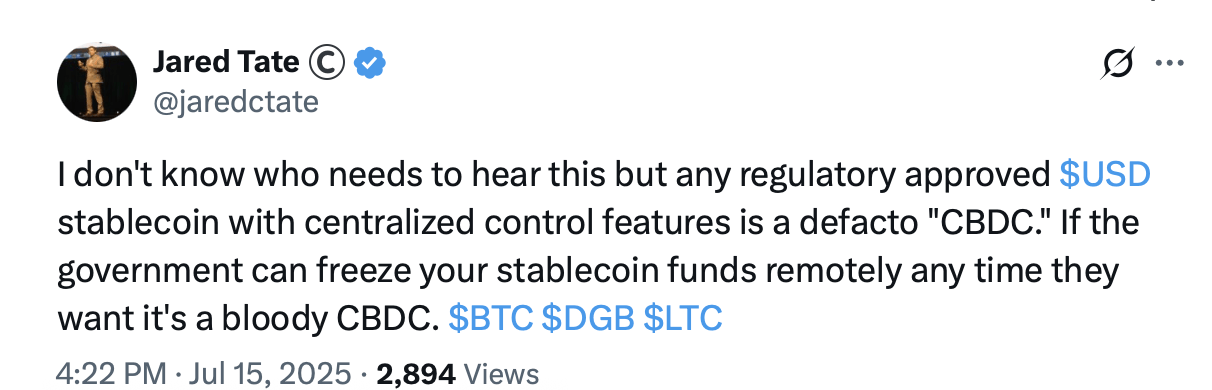
Some critics believe the GENIUS Act serves as a backdoor for a CBDC because it creates a framework for banks to issue dollar-pegged stablecoins that could function similarly to a state-controlled digital dollar, potentially enabling government oversight and control without direct Federal Reserve issuance. By allowing federally chartered banks to issue stablecoins under strict regulatory supervision, the Act could establish an interoperable network of private digital currencies that mirror CBDC capabilities.

Rep. Marjorie Taylor Greene said she voted NO on the GENIUS Act because it left out one key piece: a ban prohibiting a CBDC. The implications of such a move could be profound. A CBDC built on stablecoin rails could give the Federal Reserve unprecedented visibility into transactions, potentially requiring digital wallets linked to verified identities. Unlike cash, which is anonymous, a CBDC could track every dollar’s movement, raising privacy concerns. Stablecoins already collect user data through exchanges and wallet providers, a practice that could scale under a CBDC.
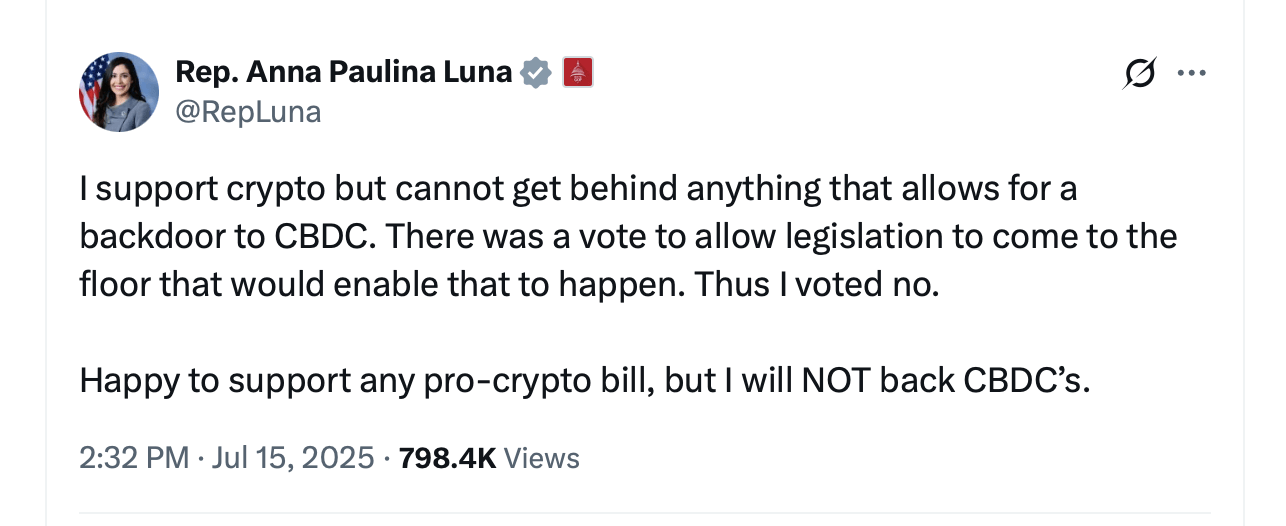
Moreover, a central bank could program a CBDC to enforce policies—like negative interest rates or spending restrictions—directly affecting how individuals use money. Stablecoins’ smart contract capabilities, which allow programmable transactions, could serve as a template for such controls. Skeptics might argue that stablecoins are too decentralized to serve as CBDC prototypes. After all, their blockchains are often permissionless, meaning anyone can participate without gatekeepers.

But this overlooks the centralized choke points: issuers control reserve management, and exchanges enforce KYC (know-your-customer) rules. A CBDC could retain the blockchain’s efficiency while replacing private issuers with the Fed, centralizing control. The government could also mandate interoperability between stablecoins and a future CBDC, creating a hybrid system where private tokens pave the way for state dominance.

The global context adds urgency to this theory. China’s digital yuan is already in trials, and countries like the Bahamas and Nigeria have launched their own CBDCs. The U.S. risks falling behind in the race to define the future of money, especially as stablecoins like Tether dominate cross-border payments in regions with unstable currencies. If the U.S. were to integrate stablecoin infrastructure into a CBDC, it could maintain the dollar’s global dominance while countering foreign digital currencies.
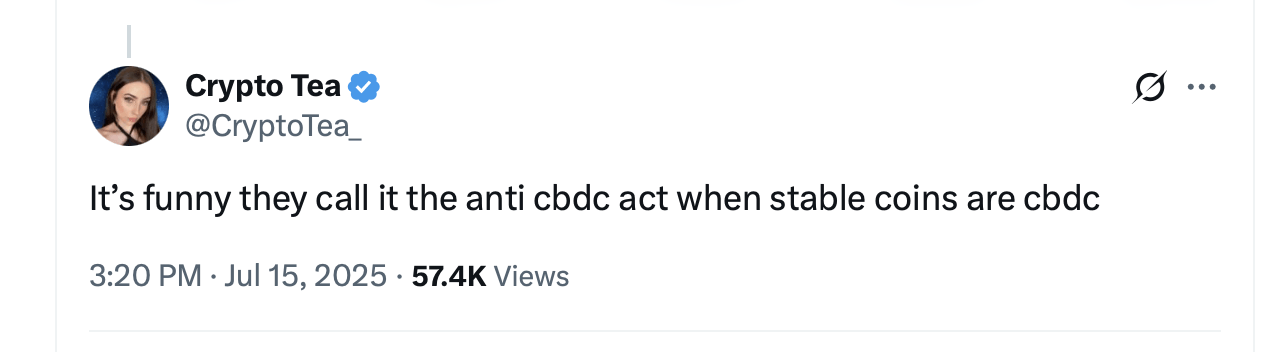
This strategic advantage might explain why regulators have allowed stablecoins to flourish despite their risks. Public perception remains a hurdle. Stablecoins enjoy trust among crypto users, but a CBDC could face backlash over surveillance fears. The government could mitigate this by framing a CBDC as an evolution of stablecoins, emphasizing familiarity and stability. For instance, a popular dollar coin’s transparency and reserve backing could serve as a model to reassure users that a digital dollar is just as reliable.

Meanwhile, stablecoin issuers might welcome integration, as it could cement their role in a government-sanctioned system, shielding them from future regulatory crackdowns. The road to a CBDC is fraught with technical and political challenges, but stablecoins offer a compelling shortcut. Their widespread adoption, battle-tested infrastructure, and regulatory resilience over the last decade make them ideal candidates for a backdoor transition.

Whether intentional or not, the survival of Tether and USDC amid regulatory As the Federal Reserve inches closer to a CBDC, the line between private stablecoins and state-controlled currency blurs, raising a critical question: Are we already using the prototype for the future of money?

Share. Facebook Twitter Pinterest LinkedIn Tumblr Email
NBTC

Related Posts

Blue Origin Marks First Ocean Landing of New Glenn Booster After Second Attempt

18/12/2025

Nearly 25% of Adults With Internet Access in Asia Might Own Crypto, Report Says

18/12/2025

Grayscale’s IPO filing reveals 20% revenue slump and $318.7M in losses

18/12/2025

Tether plans major expansion in commodities lending, deploys $1.5 billion capital

18/12/2025
Add A Comment

Comments are closed.

Top Posts
Get Informed

Subscribe to Updates

Get the latest news from NBTC regarding crypto, blockchains and web3 related topics.

Your source for the serious news. This website is crafted specifically to for crazy and hot cryptonews. Visit our main page for more tons of news.

We're social. Connect with us:

Facebook X (Twitter) LinkedIn RSS
Top Insights

Ethereum Could Get Faster in January With Gas Limit Rise to 80M Following BPO2 Fork

18/12/2025

Blue Origin Marks First Ocean Landing of New Glenn Booster After Second Attempt

18/12/2025

Gavin Newsom Singles Out CZ, Ross Ulbricht, Arthur Hayes as Trump’s ‘Criminal Cronies’

18/12/2025
Get Informed

Subscribe to Updates

Get the latest news from NBTC regarding crypto, blockchains and web3 related topics.

Type above and press Enter to search. Press Esc to cancel.