

Close Menu
  • Coins
    • Bitcoin
    • Ethereum
    • Altcoins
    • NFT
  • Blockchain
  • DeFi
  • Metaverse
  • Regulation
  • Other
    • Exchanges
    • ICO
    • GameFi
    • Mining
    • Legal
  • MarketCap
What's Hot

Nvidia to pay 2026’s first dividend next month; Here’s how much 100 NVDA shares will earn

28/04/2026

Israeli regulators approve shekel-pegged stablecoin

28/04/2026

Expert Explains What Strategy’s 89,599 BTC Buy In Q1 Means For The Bitcoin Price

28/04/2026
Facebook X (Twitter) Instagram
  • Back to NBTC homepage
  • Privacy Policy
  • Contact
X (Twitter) Telegram Facebook LinkedIn RSS
NBTC News
  • Coins
    1. Bitcoin
    2. Ethereum
    3. Altcoins
    4. NFT
    5. View All

    Expert Explains What Strategy’s 89,599 BTC Buy In Q1 Means For The Bitcoin Price

    28/04/2026

    Experienced Analyst Reveals the Level Bitcoin Must Surpass for an Altcoin Rally to Begin

    28/04/2026

    Bitcoin ETF inflows hit highest level since February

    28/04/2026

    “We Haven’t Seen the True Bottom in Bitcoin Yet; It Could Drop This Far”

    28/04/2026

    Whale Shorts Rise at Key Support

    27/04/2026

    Ethereum Faces ‘Moment Of Truth’ As Price Eyes $2,450 Resistance – Breakout Loading?

    27/04/2026

    ETH Coin Targets $2,500 as Bulls Defend a Strong Support

    27/04/2026

    Ethereum Near Key Zone After 36% Gain – What’s Next?

    26/04/2026

    Binance Founder CZ’s Posts Cause Another Price Boost! Two Altcoins See a Price Increase!

    28/04/2026

    XRP’s longest slump in a decade collides with Ripple’s $13 trillion institutional push

    28/04/2026

    SBI Ripple Asia and DSRV Plan to Revolutionize Japan & South Korea Payments via XRP Ledger

    28/04/2026

    Unifas Labs, ZenChain, and Perle Lead Token Sales in Q1 2026 Quarter Based on ATH ROI

    28/04/2026

    Are NFTs signaling a market shift? THESE indicators say yes

    28/04/2026

    Bored Ape NFT prices jump 81 percent as sales drop

    28/04/2026

    NFTs Attempt Another Comeback as Blue Chips Surge

    28/04/2026

    Pudgy Penguins, BAYC rally masks a shrinking NFT market as volumes and users fall

    27/04/2026

    Nvidia to pay 2026’s first dividend next month; Here’s how much 100 NVDA shares will earn

    28/04/2026

    Israeli regulators approve shekel-pegged stablecoin

    28/04/2026

    Expert Explains What Strategy’s 89,599 BTC Buy In Q1 Means For The Bitcoin Price

    28/04/2026

    Are NFTs signaling a market shift? THESE indicators say yes

    28/04/2026
  • Blockchain

    Mastercard joins the blockchain security push — why it matters now

    28/04/2026

    HashKey’s tokenization roadmap could reshape Web3 finance — and the agent economy

    27/04/2026

    Bondex Integrates World ID to Launch Human-Verified Talent Layer for Web3 Hiring

    27/04/2026

    PinGo Integrates With manadia to Power On-Chain Compute Tracking in Potion

    27/04/2026

    NodeOps Network Brings No-Code AI to the BNB Chain Ecosystem

    27/04/2026
  • DeFi

    Solana Prepares to Help Aave in Its Time of Need – They Have Made an Official Announcement

    27/04/2026

    Why DeFi isn’t dead despite massive exploits and $13 billion investor exodus

    27/04/2026

    Aave raises nearly 80% of the $200 million it needs to cover bad debt left by Kelp DAO exploit

    27/04/2026

    XPower Finance Partners With Blazpay To Unlock Cross-Chain Yield Access Across DeFi Applications

    27/04/2026

    Babylon Deposits $3M USDT Into Aave to Boost DeFi Recovery Push

    27/04/2026
  • Metaverse

    ‘8,000 Jobs’—Polymarket Sees Tech Layoff Surge As Meta AI Push Bites

    18/04/2026

    Planet Hares Partners With Magne.AI To Bridge Web3 Metaverse With Smartphone Mobile-Ready Applications For Mass Adoption

    08/04/2026

    Mark Zuckerberg’s Meta launches new AI initiative after metaverse retreat

    25/03/2026

    Meta partners with Arm to develop new CPUs for AI deployments

    24/03/2026

    Land values capitulate as $24M metaverse plot collapses to just $9,000

    20/03/2026
  • Regulation

    Nvidia to pay 2026’s first dividend next month; Here’s how much 100 NVDA shares will earn

    28/04/2026

    Stablecoins to replace old FX rails, but off-ramps remain a chokepoint

    28/04/2026

    Tether Partner Antalpha’s $8.5M XAUT Deposit to Cobo Signals Major Institutional Confidence

    28/04/2026

    Renowned Macro Strategist Henrik Zeberg Claims “Ethereum Has Entered Its Most Explosive Phase”

    28/04/2026

    Mastercard’s $1.8 billion deal ‘a clear answer’ to a massive shift in the global payment war

    28/04/2026
  • Other
    1. Exchanges
    2. ICO
    3. GameFi
    4. Mining
    5. Legal
    6. View All

    Bitcoin Exchange Binance Announces Delisting of Two Altcoin Pairs from its Futures Trading Platform! Here Are the Details

    28/04/2026

    Cryptocurrency Exchanges Upbit and Bithumb Announce They Will Delisting This Altcoin! Here Are the Details

    28/04/2026

    Lighter Unveils Multi-Asset Margin Starting With ETH

    28/04/2026

    Hyperliquid whales park $3.66B as long/short ratio hovers near neutral

    28/04/2026

    South Korea Poised to Lift Ban on Domestic ICOs After 7 Years

    19/12/2025

    Why 2025’s Token Boom Looks Both Familiar and Dangerous

    31/10/2025

    ICO for bitcoin yield farming chain Corn screams we’re so back

    22/01/2025

    Why 2025 Will See the Comeback of the ICO

    26/12/2024

    Tomoland Partners With Anome Protocol To Advance Web3 Gaming Engagement With DeFi Applications

    25/04/2026

    GameFi is effectively dead as 93% of projects collapse

    23/04/2026

    More than 90% of Web3 games failed after $15 billion boom as gamers never showed up: Caladan

    23/04/2026

    UXLINK Taps ANOME Protocol to Redefine Web3 Gaming, SocialFi, and NFTFi

    23/04/2026

    Bernstein sees IREN pivoting from Bitcoin mining to $3.7B AI cloud business

    28/04/2026

    Tether launches open-source mining framework to unify Bitcoin infrastructure

    28/04/2026

    Luxor expands MicroBT partnership with $100 million mining rig deal

    27/04/2026

    Miners Beat Bitcoin by 70% in 2026 as Terawulf Locks $12.8B in AI Contracts

    27/04/2026

    Israeli regulators approve shekel-pegged stablecoin

    28/04/2026

    SEC Chair Paul Atkins Tells Bitcoin Las Vegas 2026 a New Era Starts Now at the Agency

    28/04/2026

    Senate Democrats Warn SEC Crypto Exemptions May Undermine Investor Protections

    28/04/2026

    SEC Reviews 85% Proposal That Could Impact Bitcoin and XRP ETF Listings

    28/04/2026

    Nvidia to pay 2026’s first dividend next month; Here’s how much 100 NVDA shares will earn

    28/04/2026

    Israeli regulators approve shekel-pegged stablecoin

    28/04/2026

    Expert Explains What Strategy’s 89,599 BTC Buy In Q1 Means For The Bitcoin Price

    28/04/2026

    Are NFTs signaling a market shift? THESE indicators say yes

    28/04/2026
  • MarketCap
NBTC News
Home»DeFi»Aave DeFi lending monopoly reaches 51%, creating a systemic feedback loop with only a $460M backstop
DeFi

Aave DeFi lending monopoly reaches 51%, creating a systemic feedback loop with only a $460M backstop

NBTCBy NBTC29/01/2026No Comments6 Mins Read
Share
Facebook Twitter LinkedIn Pinterest Email


Aave now controls 51.5% of the DeFi lending market share, the first time any protocol has crossed the 50% threshold since 2020.

The milestone arrives not through competitor collapse but through steady accumulation: Aave’s $33.37 billion in total value locked sits atop a $64.83 billion lending category that has consolidated around a single liquidity hub.

The concentration raises a question DeFi has avoided for years: when one protocol becomes the ecosystem’s primary margin engine, does efficiency create fragility?

The answer depends on the metric used.

Aave’s total value locked (TVL) dominance reflects collateral custody, not credit exposure. DeFiLlama excludes borrowed funds from lending TVL calculations to prevent cycled lending from inflating figures.

As a result, Aave’s $24 billion in outstanding borrows translates to a 71% borrowed-to-TVL ratio, meaning the protocol runs meaningful leverage atop its collateral base.

That makes Aave less a passive vault and more an active leverage machine, where systemic risk manifests not through size but through the speed and violence of forced deleveraging when markets turn.

DeFi liquidation engine at scale

The Oct. 10 washout provided a preview.

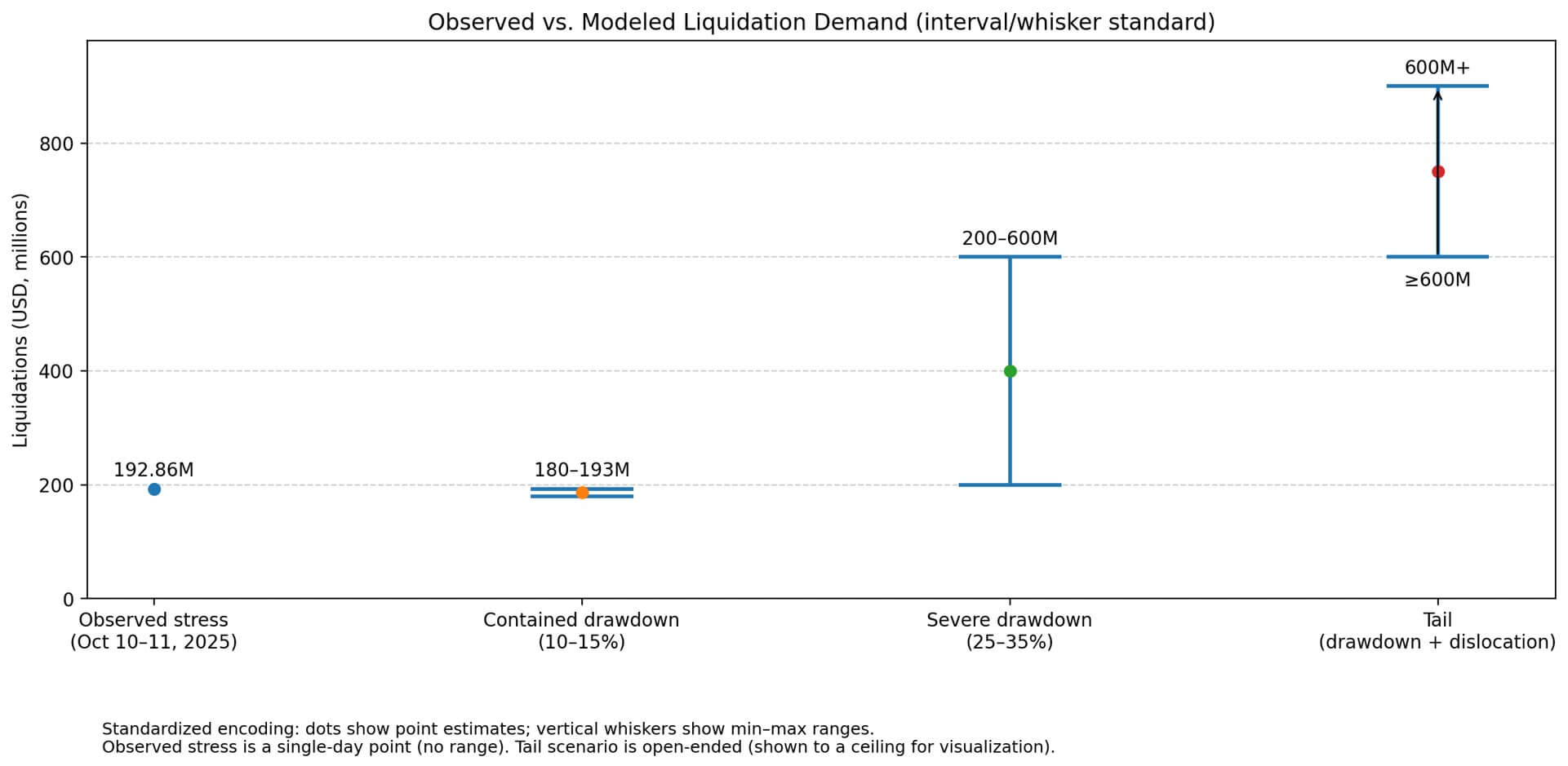
Over two days, Aave on Ethereum processed $192.86 million in liquidations, with wrapped Bitcoin accounting for $82.17 million of the total.

The episode marked the third-largest liquidation day in the protocol’s history. Liquidators collected roughly $10 million in bonuses, while Aave’s treasury captured $1 million in fees.

The system worked: collateral moved from underwater borrowers to liquidators without observable bad debt accumulation or oracle failures.

But October’s stress test occurred under favorable conditions: stablecoins held their pegs, on-chain liquidity remained deep, and the drawdown stayed contained to high-teens percentage moves in major assets.

The real systemic question arises when those assumptions break.

When a 25-35% drawdown coincides with stablecoin dislocations or liquidity-sensitive tokens like liquid staking derivatives trading wide of their theoretical value, the landscape changes quickly.

Aave governance documents acknowledge this tail risk explicitly: a January 2026 proposal reduced supply and borrow caps for USDtb while oracle adjustments finalized, citing the need to “increase liquidation profitability and reduce bad-debt likelihood” during potential depegs.

Aave’s concentration creates a feedback loop. As the dominant venue, it attracts more collateral, and as collateral grows, liquidation events scale proportionally. As the liquidation scale increases, the protocol’s ability to absorb stress without moving prices becomes the system’s primary shock absorber.

Traditional finance would classify this as a systemically important financial institution, but with automatic liquidations replacing human margin calls and no lender of last resort beyond a $460.5 million governance-controlled backstop.

Backstop arithmetic and asset-scoped coverage

The Safety Module’s $460.5 million represents roughly 2% of Aave’s outstanding borrows.

Governance is transitioning toward Umbrella modules, which provide asset-scoped deficit coverage rather than blanket guarantees. In this module, staked aUSDC covers $USDC shortfalls, for instance.

The design choice reflects a tradeoff: capital efficiency versus systemic coverage.

A blanket reserve large enough to cover tail losses across all borrowed assets would require immobilizing capital at scale. Instead, asset-scoped modules distribute coverage but leave cross-asset contagion scenarios partially unhedged.

The protocol’s risk controls operate through active parameter adjustment rather than static buffers.

Recent governance actions include interest rate changes on Base as liquidity mining incentives expire and oracle design choices that prioritize liquidation profitability during stress.

This approach mirrors how a prime broker manages margin in traditional markets, with continuous monitoring, dynamic risk limits, and proactive deleveraging before positions become unsalvageable.

However, prime brokers operate with credit teams, discretionary margin calls, and access to central bank facilities during liquidity crunches. Aave runs on immutable smart contracts, deterministic oracles, and liquidator incentives.

When those mechanisms work, the protocol deleverages smoothly. When they don’t, or when external liquidity evaporates faster than liquidators can execute, bad debt accumulates.

Modeling DeFi stress without wild assumptions

Three DeFi scenarios frame the range of plausible outcomes, each anchored to observed liquidation magnitudes rather than speculative projections.

In a contained drawdown of 10-15%, moves in major assets with stable stablecoin pegs and normal on-chain liquidity, liquidation volumes are likely to mirror October’s $180-193 million range.

In this case, Aave acts as a shock absorber, liquidators profit, and the system rebalances. Systemic risk remains low because the protocol is designed for exactly this scenario.

A severe drawdown of 25-35% moves with widening spreads and thinner liquidity could push liquidations to one-to-three times recent stress days, or roughly $200-600 million over the peak window.

Contagion depends on whether forced sales move collateral prices enough to trigger liquidations in other protocols. This is where concentration matters: if multiple venues use similar collateral sets and Aave processes the bulk of deleveraging, price impacts propagate faster than if liquidations were distributed across competing protocols.

The tail scenario pairs a major drawdown with collateral or borrow asset dislocation, such as a liquid staking derivative trading materially below its peg or a stablecoin breaking its dollar anchor during peak liquidation demand.

Here, liquidation volumes could exceed $600 million as oracle adjustments lag price moves and liquidity providers step back.

This is the case where Aave’s role as the primary margin engine creates genuine systemic exposure: correlated collateral, concentrated liquidation demand, and impaired execution infrastructure converging simultaneously.
What 51.5% actually means

Aave crossing the majority threshold likely signals that DeFi lending has entered a natural monopoly phase, where liquidity begets liquidity faster than competitors can match.

The systemic risk implications depend less on the static market share number and more on whether Aave’s liquidation machinery, oracle design, and backstop capacity scale proportionally with growing exposure.

Recent governance actions suggest risk management is keeping pace with growth. The protocol has processed multiple $180-193 million liquidation days without observable bad debt spirals.

Yet, those stress tests occurred under relatively benign conditions. The tail scenario in which systemic risk materializes involves correlated collateral shocks, liquidity dislocations, and forced deleveraging at speeds that exceed liquidator capacity or the oracle’s responsiveness.

Aave’s dominance makes it the primary margin engine in DeFi.

Whether that creates fragility or resilience will be determined not by market share but by the protocol’s ability to handle liquidations under conditions it hasn’t yet experienced, and whether the ecosystem has viable alternatives if it can’t.

Share. Facebook Twitter Pinterest LinkedIn Tumblr Email
NBTC

Related Posts

Solana Prepares to Help Aave in Its Time of Need – They Have Made an Official Announcement

27/04/2026

Why DeFi isn’t dead despite massive exploits and $13 billion investor exodus

27/04/2026

Aave raises nearly 80% of the $200 million it needs to cover bad debt left by Kelp DAO exploit

27/04/2026

XPower Finance Partners With Blazpay To Unlock Cross-Chain Yield Access Across DeFi Applications

27/04/2026
Add A Comment

Comments are closed.

Top Posts
Get Informed

Subscribe to Updates

Get the latest news from NBTC regarding crypto, blockchains and web3 related topics.

Your source for the serious news. This website is crafted specifically to for crazy and hot cryptonews. Visit our main page for more tons of news.

We're social. Connect with us:

Facebook X (Twitter) LinkedIn RSS
Top Insights

Nvidia to pay 2026’s first dividend next month; Here’s how much 100 NVDA shares will earn

28/04/2026

Israeli regulators approve shekel-pegged stablecoin

28/04/2026

Expert Explains What Strategy’s 89,599 BTC Buy In Q1 Means For The Bitcoin Price

28/04/2026
Get Informed

Subscribe to Updates

Get the latest news from NBTC regarding crypto, blockchains and web3 related topics.

Type above and press Enter to search. Press Esc to cancel.