
Close Menu
  • Coins
    • Bitcoin
    • Ethereum
    • Altcoins
    • NFT
  • Blockchain
  • DeFi
  • Metaverse
  • Regulation
  • Other
    • Exchanges
    • ICO
    • GameFi
    • Mining
    • Legal
  • MarketCap
What's Hot

Why an $88 billion bank reserve drop doesn’t prove a Bitcoin liquidity squeeze – yet

12/10/2026

Leopold Aschenbrenner is back to losing money in AI stocks

12/10/2026

Avalanche eyes South Korea’s $5T tokenization opportunity – Can AVAX benefit?

12/10/2026
Facebook X (Twitter) Instagram
  • Back to NBTC homepage
  • Privacy Policy
  • Contact
X (Twitter) Telegram Facebook LinkedIn RSS
NBTC News
  • Coins
    1. Bitcoin
    2. Ethereum
    3. Altcoins
    4. NFT
    5. View All

    Why an $88 billion bank reserve drop doesn’t prove a Bitcoin liquidity squeeze – yet

    12/10/2026

    Bitcoin survived 5% yields but crypto’s cheap-money era did not

    12/10/2026

    Bitcoin Price to Reach $90K in October? Polymarket Sets Odds at 60%

    12/10/2026

    Where Does BTC Go Next?

    12/10/2026

    Ethereum (ETH) Bloodbath: Largest Whales Get Liquidated

    11/10/2026

    How low can Ethereum go after losing $2,500 and wiping out $345M?

    11/10/2026

    Ethereum’s proposed safety checks could still let a bad trade through

    11/10/2026

    Ethereum price at $2,500 crossroads as Supertrend turns bearish

    11/10/2026

    Avalanche eyes South Korea’s $5T tokenization opportunity – Can AVAX benefit?

    12/10/2026

    Clearing House, Which Settles $2T Daily, Explains Why It Chose Quant (QNT)

    12/10/2026

    Two Key Dates in October

    12/10/2026

    XRP Whales Buy 1.6B Tokens in 2 Weeks, as Their Total Balance Hits New Record

    12/10/2026

    Pudgy Penguins gets support as billionaire buys 117 NFTs

    12/10/2026

    NFT sales rise to $39.85m as Pudgy Penguins jump 125%

    10/10/2026

    Flying Tulip’s NFT Options Market Tops $5 Million in Volume, Cronje Says

    06/10/2026

    NFT sales fall 23% to $40.9m as Panini jumps 557%

    03/10/2026

    Why an $88 billion bank reserve drop doesn’t prove a Bitcoin liquidity squeeze – yet

    12/10/2026

    Leopold Aschenbrenner is back to losing money in AI stocks

    12/10/2026

    Avalanche eyes South Korea’s $5T tokenization opportunity – Can AVAX benefit?

    12/10/2026

    Wisconsin Crypto ATM Law Targets Scams, But Is It Enough?

    12/10/2026
  • Blockchain

    Cardano Founder Accuses Ethereum Co-Founder Of ‘Bag-Holding’ Over AI Cryptography Warning

    12/10/2026

    XRP Ledger Might Be Vulnerable to AI, Avalanche Founder Warns

    12/10/2026

    Circle’s Tokenized Market Cap on BNB Chain Grows by $27.9M

    12/10/2026

    CircuitAI Launches Cross-Chain Swaps and Confidential Intents

    12/10/2026

    OpenAI, Google and Meta battle for AI internet domains as crypto firms target .bitcoin and .wallet

    12/10/2026
  • DeFi

    Some Aave loans sit near liquidation with collateral that can take hours to cash out

    12/10/2026

    Aave’s USDG rollover plan has a yield below most quoted borrowing rates

    12/10/2026

    Significant $500M Drop in DeFi Perpetual Open Interest

    10/10/2026

    Citrini Research Favors AAVE and Others as Tokenization

    10/10/2026

    Citrini Identifies Pendle as Key Player in Wall Street’s

    10/10/2026
  • Metaverse

    Is Solana Gaming Back? Kintara Activity Fuels Renewed Optimism in Onchain MMOs

    24/06/2026

    The Sandbox launches AI game engine ‘The Sandbox Studio’ for next-generation creators

    10/06/2026

    Meta commits $13M in funding for Oversight Board through 2028

    29/05/2026

    Why Animoca’s Yat Siu says the future is 100 billion AI agents

    07/05/2026

    ‘8,000 Jobs’—Polymarket Sees Tech Layoff Surge As Meta AI Push Bites

    18/04/2026
  • Regulation

    Leopold Aschenbrenner is back to losing money in AI stocks

    12/10/2026

    Bank of Korea warns AI chip leverage threatens markets

    12/10/2026

    ‘Big Short’ Michael Burry weighs in on AI extinction risks

    12/10/2026

    Another Bitcoin liquidity test arrives with Tuesday’s US tax deadline

    12/10/2026

    Public company insider sells outweighed buys 10-to-1 in August

    12/10/2026
  • Other
    1. Exchanges
    2. ICO
    3. GameFi
    4. Mining
    5. Legal
    6. View All

    What to Check Before Leaving an Exchange

    12/10/2026

    Citibank’s Coinbase stablecoin payments let institutional clients skip crypto setup

    11/10/2026

    Breez SDK Debuts New Stablecoin Feature

    11/10/2026

    Solana’s Weekly Memecoin DEX Volume Hits 80% Dominance

    11/10/2026

    ICO market slows sharply with only six completions in 2026

    30/04/2026

    South Korea Poised to Lift Ban on Domestic ICOs After 7 Years

    19/12/2025

    Why 2025’s Token Boom Looks Both Familiar and Dangerous

    31/10/2025

    ICO for bitcoin yield farming chain Corn screams we’re so back

    22/01/2025

    Top 12 NFT games every player should know about in August 2026

    19/08/2026

    GameShame Studios founder details Raijin Protocol’s roadmap in NeoPod’s sixth AMA

    13/08/2026

    How BC.GAME is turning players into stakeholders

    04/08/2026

    YGG Play Shuts Down Services as Yield Guild Pivots to AI Data

    01/08/2026

    SWI raises $894 million to repurpose former FTX bitcoin miner Genesis Digital to AI

    12/10/2026

    Can Bitcoin miners lose power?

    12/10/2026

    Luxor’s reported 6–13% annualized Bitcoin yield depends on mining delivery

    11/10/2026

    Bitcoin miners escape months of distress as daily revenue surges by 78%

    09/10/2026

    Wisconsin Crypto ATM Law Targets Scams, But Is It Enough?

    12/10/2026

    UK sanctions crypto platforms suspected of supporting Russian financial networks

    12/10/2026

    NFL joins pushback against prediction markets as U.S. Supreme Court asked to act

    12/10/2026

    Elizabeth Warren Calls for Legislation to Curb Presidential

    12/10/2026

    Why an $88 billion bank reserve drop doesn’t prove a Bitcoin liquidity squeeze – yet

    12/10/2026

    Leopold Aschenbrenner is back to losing money in AI stocks

    12/10/2026

    Avalanche eyes South Korea’s $5T tokenization opportunity – Can AVAX benefit?

    12/10/2026

    Wisconsin Crypto ATM Law Targets Scams, But Is It Enough?

    12/10/2026
  • MarketCap
NBTC News
Home»Bitcoin»Why an $88 billion bank reserve drop doesn’t prove a Bitcoin liquidity squeeze – yet
Bitcoin

Why an $88 billion bank reserve drop doesn’t prove a Bitcoin liquidity squeeze – yet

NBTCBy NBTC12/10/2026No Comments6 Mins Read
Share
Facebook Twitter LinkedIn Pinterest Email


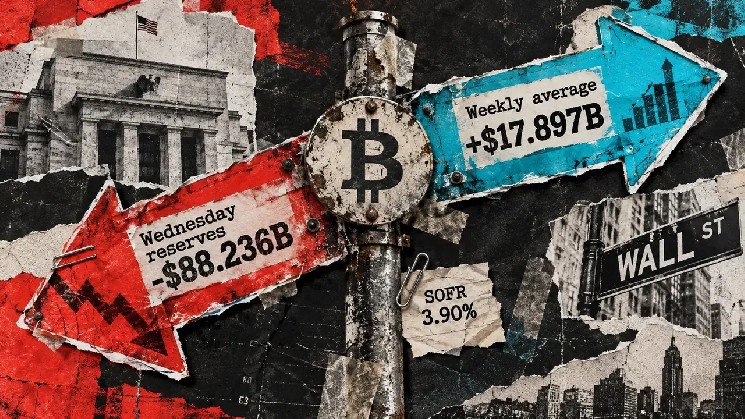
The Wednesday reserve series fell from $2.969922 trillion on Sept. 23 to $2.881686 trillion on Sept. 30. The weekly-average series rose from $2.930193 trillion to $2.948090 trillion for the weeks ending on those dates.

Both readings come from the Fed’s H.4.1 release. One compares balances on two Wednesdays; the other compares averages of daily figures across two weeks. A lower final observation can coexist with a higher average, because the readings cover different time windows.

The Treasury General Account, the government’s account at the Fed, illustrates the same problem. Its Wednesday balance rose $36.729 billion to $984.046 billion. Its weekly average fell $28.410 billion to $948.674 billion.

Mixing the Wednesday reserve decline with the average Treasury decline would combine observations from different windows. It could obscure the very cash movement an investor is trying to explain. A chart labeled “weekly” still needs a second question: is each point a weekly average or a balance observed once a week?

The endpoint captures the quarter-end position. The average describes the level across the week. Neither provides a complete daily path or proves how persistent the final-day position will be. For a Bitcoin liquidity argument, choosing the window changes the evidence before any price forecast enters the discussion.

Where the Wednesday reserve decline went

The Oct. 1 H.4.1 release and previous release provide an accounting bridge. Between the two Wednesday observations, factors supplying reserves fell $4.650 billion, while factors absorbing funds outside reserve balances rose $83.586 billion. Together, those changes reconcile the $88.236 billion reserve decline.

Treasury cash was a major part of the absorbing side. Total reverse repos were another: they rose $41.158 billion to $361.883 billion. But most of that reverse-repo balance belonged to foreign official and international accounts, which increased $30.080 billion to $350.344 billion. The remaining “others” category increased $11.078 billion to $11.539 billion.

Calling the whole $361.883 billion domestic overnight reverse-repo usage would misidentify both the counterparties and the size of that facility. The distinction also matters for comparisons with charts that subtract a domestic reverse-repo series from Fed assets: those charts do not represent every liability moving in this release.

Beyond Treasury cash and reverse repos, currency in circulation increased $373 million, other non-reserve deposits rose $3.001 billion, and other liabilities and capital increased $2.317 billion. A separate Treasury cash-holdings line rose $8 million. These smaller absorbing-side changes complete the $83.586 billion increase, with foreign official deposits and the remaining deposit categories unchanged.

The supplying side moved too. Outright securities declined $6.491 billion, partly offset by $1.199 billion more repo agreements and $2.493 billion more loans. Those selected changes sit inside the full accounting bridge; they are not its complete total. Treasury securities actually rose $5.829 billion while mortgage-backed securities fell $12.320 billion, so the holdings did not move uniformly. The separately presented consolidated balance sheet reported a $4.673 billion decline in total Fed assets, a different measure from the $4.650 billion fall in reserve-supplying factors.

The Fed’s explanation of its liabilities sets out the mechanism. Receipts into the Treasury account can drain bank reserves, while Treasury spending can return balances to banks, all else equal. Other Fed assets and liabilities can offset or reinforce those transfers. Gross bond issuance is therefore not an equal-sized withdrawal from reserves, and the observed TGA increase cannot all be assigned to a particular auction from these figures alone.

For the same reason, $88.236 billion less in bank reserves is not a measured $88.236 billion loss of money available to buy Bitcoin. The accounts establish where balances changed; a crypto-market effect requires evidence of a financing channel.

Funding prices give a different test

At the early Oct. 2 check, the New York Fed’s latest SOFR observation still covered Sept. 30. It was 3.90%, matching the Fed’s interest on reserve balances, or IORB. The five latest observed SOFR medians ranged from 3.88% to 3.90%.

September 30’s 99th-percentile rate was 3.99%, with $3.230 trillion of underlying transactions. SOFR rose from 3.88% the previous day, but the quarter-end median was also the same as on Sept. 25 and Sept. 28. That shows limited movement in the median, while leaving open strain in parts of the market or among borrowers with different access to cash.

SOFR measures overnight borrowing against Treasury securities and is calculated as a volume-weighted median. It describes the middle of the observed dollar volume, not the rate every borrower could obtain. A 99th percentile below 4% likewise does not establish that every transaction occurred below that level.

Nor were Fed lending operations absent. H.4.1 reported $1.2 billion of outstanding repo agreements on Sept. 30. The daily repo-purchase series separately recorded $1.2 billion that day and zero purchases on Oct. 1. An outstanding balance and a daily operation amount remain distinct measures, even when their values match.

Access is another reason to look beyond the median. The standing repo terms specify a 4.00% rate, two daily operation windows and a $40 billion proposition limit per eligible counterparty, per eligible security type, per operation. Access depends on counterparty and collateral eligibility, so the backstop’s terms cannot prove every market participant had ready access to cash.

October 1 supplied a narrower follow-up: domestic overnight reverse-repo usage fell from $11.539 billion to $350 million. That indicates the domestic facility increase unwound sharply. It does not measure an aggregate reserve rebound or show that the foreign official pool did the same. October 1 SOFR was not yet available in the early Oct. 2 snapshot.

What would establish pressure reaching Bitcoin?

CryptoSlate’s Sept. 28 settlement preview posed a conditional test of repo and Bitcoin funding after settlement, following its Sept. 21 tax-date coverage of falling bank balances alongside orderly repo. The new reserve comparison adds a reason to examine the measure itself before turning that test into a market conclusion.

Evidence of a dollar-funding squeeze would be stronger if borrowing costs remained elevated relative to the Fed’s settings across subsequent observations, with pressure visible beyond one median. Facility usage and access conditions would help distinguish a temporary quarter-end adjustment from continuing financing strain.

A Bitcoin transmission claim needs another link: dated exchange or instrument-level funding, futures-basis or liquidity observations over a comparable window. Changes in market depth, credit availability or positioning could corroborate that link. Even simultaneous Bitcoin weakness and higher repo rates would leave causation unresolved.

The current reserve and SOFR figures establish neither a Bitcoin financing shock nor its absence. They establish something more specific: the Wednesday reserve decline reconciles with changes elsewhere in the Fed’s accounts, the weekly average moved in the opposite direction, and the latest observed secured-cash median remained at IORB. Subsequent funding prices and direct Bitcoin financing data can strengthen or weaken the case that the quarter-end balance-sheet movement became a sustained squeeze.

Share. Facebook Twitter Pinterest LinkedIn Tumblr Email
NBTC

NBTC is the editorial account for NBTC News, covering Bitcoin, Ethereum, DeFi, blockchain infrastructure, exchanges, mining, regulation and digital asset markets. The editorial team focuses on clear sourcing, timely updates and practical context for crypto readers.

Related Posts

Bitcoin survived 5% yields but crypto’s cheap-money era did not

12/10/2026

Bitcoin Price to Reach $90K in October? Polymarket Sets Odds at 60%

12/10/2026

Where Does BTC Go Next?

12/10/2026

Bitcoin climbed past $85,000 as shorts closed. Will buyers stay after the jobs report?

12/10/2026
Add A Comment

Comments are closed.

Top Posts
Get Informed

Subscribe to Updates

Get the latest news from NBTC regarding crypto, blockchains and web3 related topics.

Your source for the serious news. This website is crafted specifically to for crazy and hot cryptonews. Visit our main page for more tons of news.

We're social. Connect with us:

Facebook X (Twitter) LinkedIn RSS
Top Insights

Why an $88 billion bank reserve drop doesn’t prove a Bitcoin liquidity squeeze – yet

12/10/2026

Leopold Aschenbrenner is back to losing money in AI stocks

12/10/2026

Avalanche eyes South Korea’s $5T tokenization opportunity – Can AVAX benefit?

12/10/2026
Get Informed

Subscribe to Updates

Get the latest news from NBTC regarding crypto, blockchains and web3 related topics.

Type above and press Enter to search. Press Esc to cancel.