


Circle, the company behind the USDC stablecoin, introduced a new international payments network in April 2025, aiming to make global payments faster, cheaper, and more transparent. This guide breaks down how the Circle Payments Network (CPN) works, its key features, real-world use cases, and where it stands in the broader cross-border payments space.
In this guide:
- CPN vs. traditional cross-border payments
- What is Circle Payments Network (CPN)?
- Key features and innovations of CPN
- Circle Payments Network: Real-world use cases
- How CPN works?
- Regulatory and compliance positioning across key regions
- Challenges and limitations of CPN
- Will CPN revolutionize cross-border payments?
- Frequently asked questions
CPN vs. traditional cross-border payments
What is Circle Payments Network (CPN)?
Sending money overseas shouldn’t ideally take days or cost a fortune. However, it almost always does if you use traditional cross-border banking routes.
International bank transfers can — and usually do — take more than a day to settle and often involve high fees due to intermediaries, currency conversions, and compliance layers. These inefficiencies hit developing economies hardest.
Circle’s new platform — the Circle Payments Network (CPN) — aims to offer a viable alternative to traditional banking routes. It is designed to connect financial institutions for near-instant cross-border payments using stablecoins like USDC and Euro Coin (EURC).
The result is fast, transparent, programmable payments that feel as instant as domestic transfers. For Circle, this is a step toward making money move as easily as an email.
“Since our founding, Circle’s vision has been to make moving money as simple and efficient as sending an email. CPN is a significant step in making that vision a reality for businesses worldwide.”
— Jeremy Allaire, co-founder, chairman, and CEO of Circle (via Circle press release)
Circle Payments Network overview: CPN whitepaper
Key features and innovations of CPN
CPN introduces several promising features that aim to transform cross-border payments:
➤ Stablecoin-powered transfers: CPN uses regulated stablecoins like USDC and EURC as the medium of exchange. These coins are fully backed by fiat reserves and maintain a 1:1 peg to their respective currencies. This helps eliminate currency volatility during transit and provides on-chain transparency.
➤ Integration with traditional finance: CPN connects banks, neobanks, payment processors, and wallets with local payment systems. It acts as a bridge between blockchain networks and traditional rails like ACH, SEPA, and others. Institutions can plug in via a single interface and avoid building multiple bilateral relationships.
➤ 24/7 real-time settlement: Transactions settle within seconds, regardless of weekends or banking hours. This reduces liquidity risk and improves cash flow by eliminating the need to pre-fund foreign accounts.
➤ Lower costs: CPN reduces fees and FX spreads by replacing multiple intermediaries and using blockchain. Transactions involving stablecoins can avoid double conversions, which further improves transparency while lowering per-transaction costs.
➤ Transparency and compliance: All transfers are recorded on public blockchains, which ensures auditability. Only vetted institutions participate, with strict rules on licensing, AML/CFT controls, and security protocols.
➤ Programmability: CPN is built on smart contract infrastructure, and it supports advanced features like escrow, auto-splitting payments, and condition-based transfers. Circle offers APIs to help fintechs and developers integrate with CPN.
➤ Security: Institutions retain control of their assets using their own wallets or trusted custodians. The system avoids centralized points of failure and incorporates bank-grade cybersecurity standards.
Circle Payments Network: Real-world use cases
The launch of Circle’s international payment network could significantly reshape how money moves globally, particularly for underserved regions.
If you’ve ever tried sending money abroad, you know the pain: delays, high fees, and unclear tracking. Circle’s CPN aims to solve those issues and improve access to financial services. Its likely impact includes:
Faster and cheaper remittances
Remittances often carry fees above 6%, draining income for families. With CPN, migrants could send money that arrives in minutes at much lower costs, even on weekends. This could help increase support to low-income households and meet UN goals of reducing remittance fees.
Wider access via mobile wallets
Many people without traditional bank accounts still use smartphones. CPN connects to mobile apps like Coins.ph (Philippines) and Flutterwave (Africa), to allow people to receive money directly in local currency without needing to handle crypto.
Boost for SMEs
Small businesses often face high friction in cross-border payments. With CPN, they could send or receive funds quickly, which significantly reduces delays, lowers costs, and eases access to global suppliers or customers.
Always-on payments
CPN operates 24/7. This means payments can be sent or received across time zones and weekends, helping people and businesses access funds when they need them most.
Emerging market integration
CPN’s partner network spans Africa, Latin America, Southeast Asia, and more. It could help connect local economies to global financial systems by improving payment corridors in these regions.
How CPN works?
Circle Payments Network (CPN) operates as a coordination protocol that allows licensed financial institutions to send, receive, and settle payments using stablecoins like USDC and EURC.
Instead of processing payments directly, CPN orchestrates how value moves between parties through blockchain settlement and offchain APIs. It connects Originating Financial Institutions (OFIs) and Beneficiary Financial Institutions (BFIs) while maintaining compliance and speed.
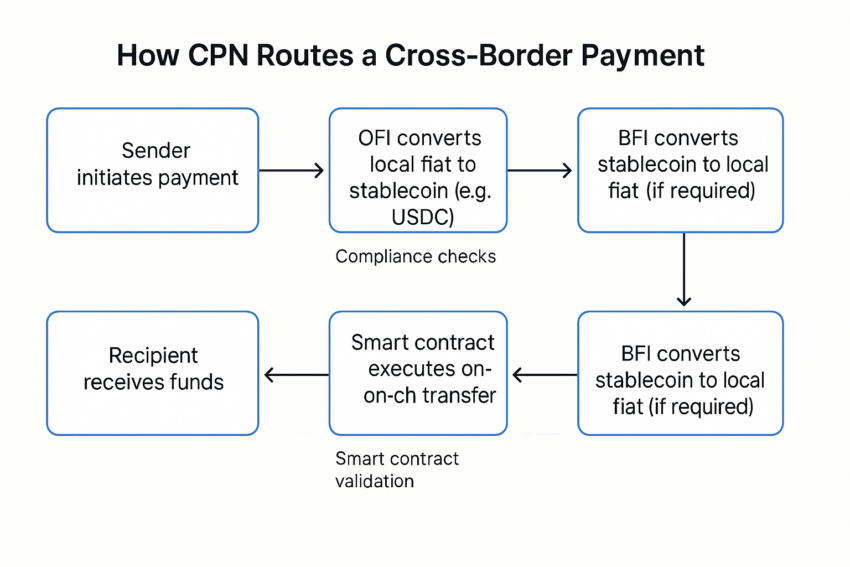
How Circle Payments Network functions: CPN
Off-chain orchestration meets on-chain settlement
CPN handles payments by splitting the process into two layers:
➤ Offchain layer: This includes APIs and SDKs that help OFIs discover available BFIs, query fiat and stablecoin pairings, obtain FX quotes, and initiate payment requests. All this occurs before the transaction moves to the blockchain.
Institutions use standard interfaces provided by Circle to perform these steps. Circle also facilitates service discovery by letting institutions broadcast their supported currencies and payout capabilities.
➤ Onchain layer: Once payment parameters are agreed upon, the system finalizes the transaction through smart contracts. These contracts validate the OFI’s credentials, match the transaction with a BFI, and confirm that settlement conditions are met.
The smart contract then executes the stablecoin transfer from sender to receiver on a supported blockchain. This hybrid model ensures flexibility while allowing programmable, auditable settlement.
Stablecoins and supported blockchains
CPN natively supports USDC and EURC for cross-border transactions. These tokens settle over public blockchains such as Ethereum and others for which Circle has issued USDC.
The system also integrates with Circle’s Cross-Chain Transfer Protocol (CCTP v2) to allow institutions to move stablecoins across different chains.
Matching OFIs and BFIs
CPN enables each OFI to find an appropriate BFI that can complete a payout in the desired fiat currency. The system matches participants based on liquidity, currency support, and service availability.
For instance, if an OFI wants to send USDC to pay out in Nigerian naira, CPN will route that payment to a BFI in Nigeria that can convert and disburse funds locally.
These capabilities turn CPN into a structured marketplace where institutions discover the best counterparty for a given payment corridor.
Compliance and eligibility enforcement
Only regulated financial institutions can access CPN. Every participant must meet minimum licensing and operational criteria defined in the CPN Rulebook and enforceable through Circle’s network contracts.
Each transaction undergoes checks such as:
- Sender/receiver KYC
- Travel Rule compliance
- Jurisdictional licensing verification
- Sanctions screening
CPN uses a combination of secure messaging and credential validation to coordinate this without exposing sensitive information.
Institutions exchange encrypted payloads for required disclosures and maintain audit trails to satisfy local and international laws. Circle does not touch funds or hold custody but acts as a coordinator and verifier.
Confidential payments and data handling
Some institutions may want to shield payment details from third parties. CPN supports confidential transactions by allowing payment metadata to remain private while still verifying settlement and credentials.
Participants can use zero-knowledge or threshold disclosure protocols (to be introduced in later versions) to share data only with required validators, such as regulators or auditors.
This architecture ensures compliance without leaking unnecessary information across the network.
Smart contract functionality
The on-chain portion of CPN uses smart contracts to coordinate final settlement.
These contracts confirm the sender’s and recipient’s credentials, check FX rates and fees and transfer stablecoins accordingly. The same infrastructure enables value-added logic, such as:
- Time-locked transfers
- Escrow payments
- Multi-party settlement (e.g., pay multiple suppliers from one stablecoin wallet)
- Fee automation (split between OFI, BFI, and Circle)
Institutions can also integrate their own smart contracts with CPN flows by building on Circle’s APIs and SDKs.
FX conversion and routing logic
CPN allows institutions to convert stablecoins into local fiat through whitelisted conversion venues. These venues include private liquidity providers and OTC desks during the early phases. Over time, CPN will route conversions through onchain protocols such as decentralized exchanges and automated market makers — subject to compliance approval.
Modular ecosystem integrations
While CPN focuses on core payment coordination, it is designed to support third-party integrations through modular APIs. Future add-ons may include:
- Lending and credit scoring
- Invoice automation
- Subscription billing
- Yield generation
- Digital identity integration
Put simply, Circle acts as the technical and governance layer while letting third parties build payment tools on top of the base protocol.
Regulatory and compliance positioning across key regions
Circle assures that CPN follows a strict “compliance-first” approach. Only licensed financial institutions can participate, and each partner must comply with local laws. This approach ensures every transaction is subject to oversight and aligned with evolving regulatory frameworks in the U.S., the E.U., and Asia.
United States
CPN aligns with the proposed STABLE Act, which enforces reserve transparency and prohibits interest on stablecoins. Circle already meets most requirements, with USDC backed 1:1 and issued via licensed money transmitters. AML and KYC compliance are built into the system.
European Union
Circle obtained an EMI license in France and complies with MiCA regulations. USDC and EURC are issued under full E.U. oversight. CPN works within E.U. laws, complements SEPA Instant, and supports full transparency and consumer protection.
Asia-Pacific
Circle already holds a Major Payment Institution license from MAS in Singapore. It can legally issue stablecoins and offer cross-border payment services. Circle is also engaging regulators in Japan and Hong Kong as those markets evolve.
Middle East, Africa, LATAM
Circle partners with regulated entities like Flutterwave and dLocal to ensure local compliance. Expansion in the UAE and Bahrain is expected via partnerships. All partners are licensed in their home markets.
Recent partnerships, announcements, and global expansion
Circle is actively building out the Circle Payments Network (CPN) through partnerships, geographic expansion, and infrastructure upgrades. Here’s a summary of key moves:
Global partners and design collaborators
Circle announced 20+ design partners across regions to support CPN’s launch and footprint:
- Africa: Flutterwave, Yellow Card, Onafriq — enabling payouts to mobile money and bank accounts.
- Asia: Coins.ph (Philippines remittances), FOMO Pay and dtcpay (Singapore).
- Latin America: dLocal (payouts in 30+ countries), Transfero (Brazil), Inswitch.
- Middle East & Europe: CoinMENA, BVNK, Triple-A, OpenPayd, Nilos.
- Remittances: Zepz (WorldRemit, Sendwave) gives CPN reach into 130+ countries and mobile wallet payout rails.
- Infrastructure: Fireblocks allows banks and fintechs to plug into CPN using their existing crypto custody stack.
Trusted banking advisors:
Circle has engaged Santander, Deutsche Bank, Société Générale, and Standard Chartered as advisors. While not yet active on CPN, they help shape compliance, data localization, and real-world banking requirements.
Standard Chartered’s past blockchain collaborations with Circle make it a likely early adopter.
Recent product developments:
- Refund Protocol (April 2025): Adds transaction reversibility to stablecoins, improving institutional confidence.
- EURC expansion: Euro Coin support on multiple blockchains adds flexibility for E.U. corridors.
- May 2025 soft launch: Limited beta launch will test remittance corridors like U.S.-Philippines or E.U.-Africa.
Physical and regulatory footprint:
- Singapore HQ for Asia, France for MiCA compliance, regional LATAM team now in place.
- Licenses in U.S., the E.U., and Singapore enable compliant operations across major markets.
Payment giant collaborations:
- Visa: Existing settlement partnership with USDC.
- MoneyGram: Uses USDC via Stellar and shows rising acceptance of stablecoins in traditional remittance models.
IPO and market credibility:
Circle plans to go public in 2025, adding investor confidence and enabling larger institutional adoption.
Competitive positioning:
- Aims to rival RippleNet and challenge Visa/Mastercard in cross-border settlement.
- Signals a stablecoin-driven alternative with real regulatory buy-in and global reach.
Challenges and limitations of CPN
While CPN introduces major improvements to cross-border payments, it still faces several practical and regulatory challenges.
The onboarding process is also complex, considering participants must pass stringent compliance checks, including AML, KYC, and sanctions screening.
To cut a long story short, CPN can reach its full potential only if Circle expands participation, improves developer tooling, and addresses jurisdictional concerns across different regulatory environments.
Will CPN revolutionize cross-border payments?
Circle is building infrastructure that could redefine cross-border payments. That said, the success of CPN — or the lack thereof — will ultimately depend on adoption, trust, and regulatory clarity.
If it pulls off doing what it has so far promised, sending money abroad might truly become as simple as sending an email. If that happens, it will definitely open up new doors to greater inclusion and opportunity worldwide.
Frequently asked questions
What is the Circle Payments Network (CPN)?
How does CPN work in practice?
What are the main benefits of CPN?
What are some current limitations or challenges facing CPN?
