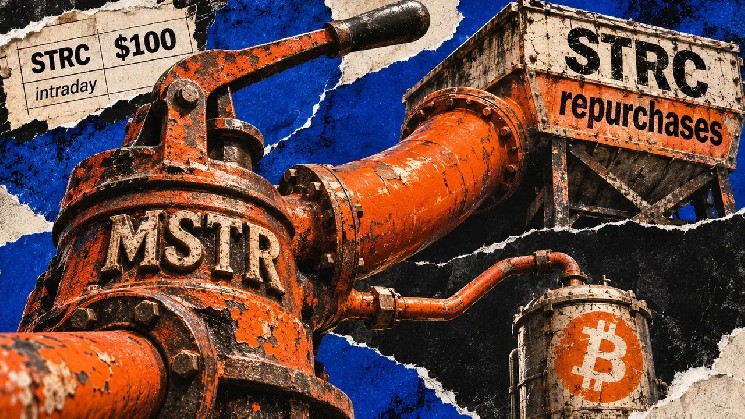
Strategy paid for its Bitcoin purchases with common-stock sales in November 2–8, even as STRC, its variable-rate preferred stock, reached $100. The company had said it would not issue STRC below that price, but its November 9 disclosure showed no STRC sales under its at-the-market program.
The breakdown shows where the week’s money went. Of $283.8 million in net proceeds from MSTR common shares, $188.3 million went to STRC repurchases, $81.9 million to Bitcoin purchases and $13.6 million to USD Cash, according to the weekly financing update.
That sent roughly two-thirds of the new common-stock money toward buying back preferred shares, with less than a third going into Bitcoin. STRC’s market-price recovery had not yet translated into reported STRC at-the-market financing that week.
STRC posted a historical intraday high of $100 on November 4 and an unadjusted close of $99.98. Its highs on November 5 and 6 were $99.97 and $99.84, respectively.
Strategy’s July 27 policy announcement said the company would not issue STRC below $100. It also described a long-term goal of healthy, sustained trading near that level. Those issuance and dividend policies are statements of intent and could change.
Strategy receives new equity capital only when it sells shares and collects the proceeds. In a secondary-market trade, a buyer instead pays another investor for an existing share, so the market price and the issuer’s financing proceeds describe separate transactions.
For November 2–8, the reported financing came from selling 2,051,348 MSTR shares. That figure includes shares sold but not yet settled as of November 6.
CryptoSlate’s November 5 coverage described renewed STRC financing as a possibility and cited an unconfirmed tracker estimate that issuance might have funded 191 $BTC. The later weekly disclosure reports no STRC at-the-market sales for the period including November 4.
Buying back preferred claims
During the week, Strategy bought 1,036 $BTC for $81.9 million, at an average of $79,012 per coin including fees and expenses. Its Bitcoin purchase disclosure explicitly names MSTR sale proceeds as the funding source.
Bitcoin purchases absorbed 28.9% of the common-stock proceeds. STRC repurchases took 66.3%, about 2.3 times the Bitcoin allocation, while USD Cash received 4.8%. That makes the buyback program a substantial competing use of newly raised capital.
The mix also shifts the company’s capital structure. Issuing MSTR expands the common-share base, while repurchasing STRC reduces preferred claims. Strategy bought back 1,887,464 STRC shares between November 2 and 8.
The July policy framed discounted repurchases as a way to reduce future preferred dividend requirements, giving the spending an economic purpose alongside its immediate cash cost. The eventual dividend savings depend on future rates and declarations.
The policy also anticipated a faster repurchase pace at deeper discounts, tapering as STRC approached $100. Decisions were left subject to liquidity, market conditions and capital-allocation priorities.
The preceding week also paired MSTR fundraising with STRC repurchases but disclosed a different funding route. In its November 2 filing, Strategy reported $164 million in MSTR proceeds, of which $65.5 million funded Bitcoin purchases and $98.5 million went to USD Cash. It separately used $208.2 million of USD Cash for STRC repurchases.
For November 2–8, the company explicitly assigned MSTR proceeds directly to the buybacks. The comparison shows a shift in the disclosed funding allocation, though common-stock sales financed Bitcoin purchases in both weeks.
As of November 8, USD Cash stood at $146.2 million, alongside a separate $4.77 billion reserve for dividends and interest. Strategy used $21.1 million of that reserve to pay preferred dividends during the week.
Future financing will depend on reported issuer sales and how their proceeds are used. STRC’s return to $100 marked a market-price milestone, while the November 2–8 allocation shows that MSTR issuance supplied the disclosed money for both Bitcoin accumulation and preferred-share repurchases.
Source: cryptoslate.com. Adapted by NBTC.
Add A Comment
Comments are closed.