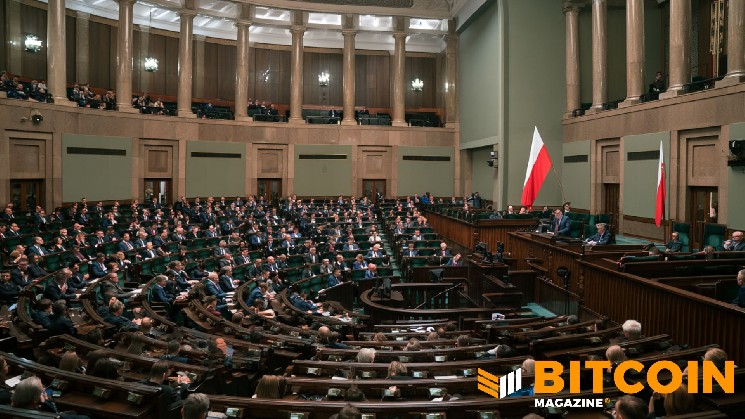
Poland’s lower house of parliament voted 240-202 on Friday to authorize the interior minister to freeze the crypto assets, bank accounts and other property of people placed on a national sanctions list before a court reviews the order.
The Sejm, Poland’s lower house, passed the Act on Restrictive Measures during its 68th sitting, with one member abstaining and 17 not voting. The Senate received the bill Monday and has 30 days under Article 121 of the Constitution to adopt, amend or reject it. It would then go to President Karol Nawrocki.
The government bill, which also implements European Union sanctions rules, classifies crypto assets as financial means that can be frozen, using the definition in the EU’s Markets in Crypto-Assets regulation. The text defines a freeze as a measure intended to prevent any movement, transfer, use or other change that would allow the holder to benefit from the assets.
The freeze applies only to people and entities added to a public national list by the interior minister, either on the minister’s initiative or at the request of agencies including the financial watchdog, the central bank, the financial intelligence unit and the internal security service. Grounds for listing include supporting a country already under EU sanctions, serious human rights abuses, or initiating or financing information manipulation that poses a serious threat to Poland’s national security.
To list someone on that last ground, authorities must show a real and serious threat to Poland’s interests, borders, security or elections. The bill exempts ordinary journalism, political speech and publishing, unless the activity constitutes a knowing campaign of the kind described in the law.
A freeze can take effect before a judge weighs in
The interior minister’s decision takes effect the day after it is published in the ministry’s Public Information Bulletin and is immediately enforceable. There is no procedure for asking the minister to reconsider. A listed person may file a complaint with an administrative court, but the law provides that the decision remains in force until a judgment becomes final and disapplies the usual rule allowing a court to suspend a challenged order.
The measures also prohibit making funds or property available to listed persons and may exclude them from public contracts. In some cases, the economy minister may appoint a temporary administrator to sell frozen assets or, under a separate order, transfer them to the State Treasury.
What the freeze would mean for bitcoin
The bill does not target ordinary bitcoin holders in Poland. It covers crypto assets owned, held or controlled by people and firms on the sanctions list. Banks, exchanges and other parties may face administrative fines for failing to freeze those assets or making them available. Compliance is monitored by the financial intelligence unit and, for firms it already oversees, the Polish Financial Supervision Authority.
The text does not set out a way for officials to obtain the keys to coins held in self-custody. In practice, enforcement in Poland would rely on exchanges, custodians and other obligated institutions capable of stopping a transfer.
What comes next for the bill
The bill must still pass the Senate and reach Nawrocki’s desk. The president refused to sign a separate crypto-assets market bill passed by the Sejm on May 15, and lawmakers failed to override that veto in September, voting 241-198. He had also vetoed earlier versions of that market bill, arguing that the rules went too far.
That earlier dispute concerned licensing and supervision under the EU’s crypto-assets rulebook, not a sanctions freeze. Whether the Senate will narrow the pre-court freeze, and whether Nawrocki will sign a sanctions law that reaches bitcoin, remain open questions.
This post, Poland’s Parliament Votes 240-202 to Allow Officials to Freeze Crypto Before Court Review, first appeared on Bitcoin Magazine and was written by Micah Zimmerman.
Source: bitcoinmagazine.com. Adapted by NBTC.
Add A Comment
Comments are closed.