
Close Menu
  • Coins
    • Bitcoin
    • Ethereum
    • Altcoins
    • NFT
  • Blockchain
  • DeFi
  • Metaverse
  • Regulation
  • Other
    • Exchanges
    • ICO
    • GameFi
    • Mining
    • Legal
  • MarketCap
What's Hot

Sentora’s OUSD Lending Vault Holds $42.5 Million on Tempo

20/10/2026

Bitcoin miners plunge up to 13% in Wall Street’s worst selloff since July

20/10/2026

Solana’s plan for fairer trades stalls as block producers still choose which orders get in

20/10/2026
Facebook X (Twitter) Instagram
  • Back to NBTC homepage
  • Privacy Policy
  • Contact
X (Twitter) Telegram Facebook LinkedIn RSS
NBTC News
  • Coins
    1. Bitcoin
    2. Ethereum
    3. Altcoins
    4. NFT
    5. View All

    Benjamin Cowen Reveals Bitcoin Level That Could Define Q4 2026

    20/10/2026

    Bitcoin could soon get Zcash-style ‘shielded’ privacy without changing its rules

    20/10/2026

    BTC Price Coils Near $84K as Volatility Squeeze Builds for Breakout

    20/10/2026

    Bitcoin is exiting exchanges, but why are ETFs still buying?

    20/10/2026

    Ethereum whale moves $57.88M as outflows deepen — Can ETH defend $2,400?

    19/10/2026

    Justin Sun Reduces ETH Exposure, Shifts Focus to US Stocks

    19/10/2026

    Ethereum Eyes Massive 3.3x Gas Limit Boost as Glamsterdam Approaches

    19/10/2026

    Claude unpicks an NSA mystery behind Ethereum passkey security

    19/10/2026

    Solana’s plan for fairer trades stalls as block producers still choose which orders get in

    20/10/2026

    Dynamic Resharding Could Enhance NEAR Protocol’s Market

    20/10/2026

    Can institutional demand absorb $100M in whale selling?

    20/10/2026

    XRP Generates Just $1,027 in 24-Hour Chain Revenue

    20/10/2026

    Yuga Labs Launches Mudwater TCG on Solana, Featuring BAYC Art

    18/10/2026

    Alex Fong counts losses as Blur folds

    14/10/2026

    Collector Crypt Logs $151 Million in Monthly Pack Sales

    14/10/2026

    Pudgy Penguins gets support as billionaire buys 117 NFTs

    12/10/2026

    Sentora’s OUSD Lending Vault Holds $42.5 Million on Tempo

    20/10/2026

    Bitcoin miners plunge up to 13% in Wall Street’s worst selloff since July

    20/10/2026

    Solana’s plan for fairer trades stalls as block producers still choose which orders get in

    20/10/2026

    Big Tech’s AI auditors will only see what they’re shown

    20/10/2026
  • Blockchain

    Verifying The Contract Before You Approve

    19/10/2026

    Why MemeToro Targets BSC For Its Launchpad

    19/10/2026

    Best Crypto Presales on BNB Chain vs Solana Memecoin Launches

    19/10/2026

    How MemeToro Adds AI Rules to Fair Launches

    19/10/2026

    Base Financing Markets Offer 4-5% Cheaper Stock Borrowing

    19/10/2026
  • DeFi

    Sentora’s OUSD Lending Vault Holds $42.5 Million on Tempo

    20/10/2026

    Two Aave stablecoin backstops shrank $12.4 million as reward rates rose

    19/10/2026

    Crypto vault deposits top $10 billion as lending risks draw regulatory scrutiny

    19/10/2026

    Ripple’s David Schwartz Predicts Major DeFi Breakthrough

    19/10/2026

    Cardano Founder Teases Something Special if RealFi Stablecoin Reaches $1,000,000 on Strike Finance

    19/10/2026
  • Metaverse

    Exploring the Future of the Metaverse

    19/10/2026

    Is Solana Gaming Back? Kintara Activity Fuels Renewed Optimism in Onchain MMOs

    24/06/2026

    The Sandbox launches AI game engine ‘The Sandbox Studio’ for next-generation creators

    10/06/2026

    Meta commits $13M in funding for Oversight Board through 2028

    29/05/2026

    Why Animoca’s Yat Siu says the future is 100 billion AI agents

    07/05/2026
  • Regulation

    Bitcoin miners plunge up to 13% in Wall Street’s worst selloff since July

    20/10/2026

    Anthropic revenue surges to about $16.8 billion in Q3

    20/10/2026

    BlackRock’s Fink names a U.S. recession trigger, sounds alarm over $40 trillion national debt

    20/10/2026

    Ondo Leads $686.5M Tokenized ETF Market with $325.7M Issued

    20/10/2026

    FED Member Goolsbee Assesses the Current Situation and Issues a Warning!

    20/10/2026
  • Other
    1. Exchanges
    2. ICO
    3. GameFi
    4. Mining
    5. Legal
    6. View All

    Big Tech’s AI auditors will only see what they’re shown

    20/10/2026

    Binance’s net equity inflows climb for a fourth straight week to $163M

    20/10/2026

    TradeXYZ and Variational compete for top spot as RWA perps volume expand on DEXs

    20/10/2026

    Tether backs Saber Money’s payment expansion across Asia and the Gulf

    20/10/2026

    ICO market slows sharply with only six completions in 2026

    30/04/2026

    South Korea Poised to Lift Ban on Domestic ICOs After 7 Years

    19/12/2025

    Why 2025’s Token Boom Looks Both Familiar and Dangerous

    31/10/2025

    ICO for bitcoin yield farming chain Corn screams we’re so back

    22/01/2025

    Top 12 NFT games every player should know about in August 2026

    19/08/2026

    GameShame Studios founder details Raijin Protocol’s roadmap in NeoPod’s sixth AMA

    13/08/2026

    How BC.GAME is turning players into stakeholders

    04/08/2026

    YGG Play Shuts Down Services as Yield Guild Pivots to AI Data

    01/08/2026

    Bitcoin mining offshoot Nscale loses Microsoft AI deal as power delay stretches into 2030s

    19/10/2026

    Binance Pool shuts on November 10, with record access ending two weeks later

    17/10/2026

    Bitcoin Mining Difficulty Jumps 5.92% in Third-Largest Hike of 2026

    17/10/2026

    Fortitude sold $8.3 million in borrowed Zcash to fund its mining expansion

    17/10/2026

    The crypto privacy rule Trump’s Treasury proposed, and Trump’s Treasury buried

    19/10/2026

    SEC Chair Atkins Reaffirms Push for Comprehensive Crypto Rules

    19/10/2026

    France’s stablecoin tax proposal could tax crypto-to-stablecoin conversions

    19/10/2026

    This Week in Crypto Law (October 18, 2026)

    19/10/2026

    Sentora’s OUSD Lending Vault Holds $42.5 Million on Tempo

    20/10/2026

    Bitcoin miners plunge up to 13% in Wall Street’s worst selloff since July

    20/10/2026

    Solana’s plan for fairer trades stalls as block producers still choose which orders get in

    20/10/2026

    Big Tech’s AI auditors will only see what they’re shown

    20/10/2026
  • MarketCap
NBTC News
Home»DeFi»Narrowing price cushions leave Bitcoin loans vulnerable to 4.7% price dips as Aave weighs higher leverage
DeFi

Narrowing price cushions leave Bitcoin loans vulnerable to 4.7% price dips as Aave weighs higher leverage

NBTCBy NBTC23/09/2026No Comments7 Mins Read
Share
Facebook Twitter LinkedIn Pinterest Email


Aave governance has advanced a proposal that would give Bitcoin-backed borrowers materially more leverage while leaving less room before liquidation.

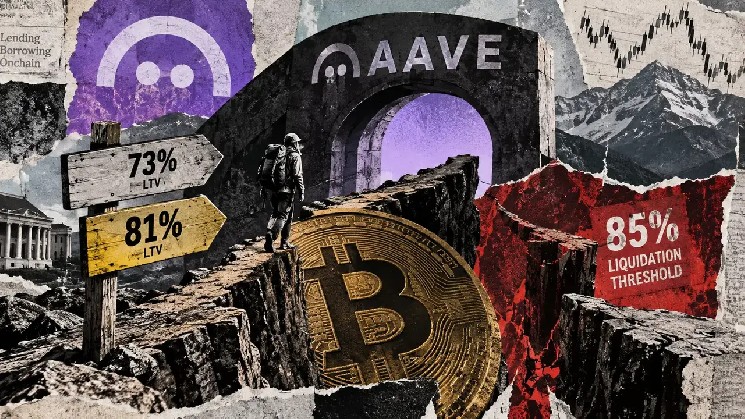
The proposal from risk service provider LlamaRisk would let users on Aave V3 Ethereum Core borrow as much as $0.81 against each $1 of WBTC or cbBTC collateral, up from $0.73. The liquidation threshold would rise from 78% to 85%.

LlamaRisk said on Sept. 21 that the proposal had advanced to Snapshot and voting would begin in less than 24 hours. The vote result and any implementation remained unverified at the reporting cutoff, so the higher limits are proposed parameters rather than live settings.

The case rests on one year of liquidation data showing that economically meaningful positions generally cleared within minutes. That history was recorded under existing parameters. It supports an argument for greater capital efficiency but cannot establish how the proposed settings would perform during the next extreme move.

Eight more cents of Bitcoin borrowing power

Loan-to-value, or LTV, sets the maximum debt that collateral can support. At 73% LTV, $100 of WBTC or cbBTC can support up to $73 of debt before reserve caps, available liquidity, asset eligibility and account-level constraints. At 81%, the same collateral could support up to $81.

The liquidation threshold marks the point where a position becomes eligible for liquidation. On Ethereum Core, the proposal would raise that threshold for WBTC and cbBTC from 78% to 85%.

The raw distance between LTV and the liquidation threshold would fall from five percentage points to four. The last table row expresses that distance as a collateral-price decline relative to the threshold, assuming debt remains unchanged and Bitcoin is the moving leg. Raising both parameters still narrows the borrower’s price cushion because the borrowing limit moves closer to the new liquidation line.

The changes extend beyond Ethereum Core. The proposal would raise Arbitrum WBTC’s ordinary LTV by five percentage points and Base cbBTC’s by eight points. Ethereum Core WETH, wstETH and weETH would each receive a 0.5-point LTV increase. Selected liquidation thresholds would also rise, while Base cbBTC’s liquidation bonus would fall from 7.5% to 6%. A separate Base cbBTC stablecoin E-Mode would move to 82% LTV and an 85% liquidation threshold.

These figures describe maximum capacity per dollar of eligible collateral. They do not quantify how much debt users would add. The proposal does not disclose a complete current dataset of collateral-enabled balances, debt attributed to each affected asset and account health factors. Total reserve supply would overstate usable collateral because some supplied tokens may be ineligible, disabled as collateral or unconnected to debt. Historical seized volume likewise does not reveal the live distribution of positions.

Minutes of liquidation history meet an hour-long tail model

LlamaRisk studied liquidation behavior from August 2025 through August 2026 across Ethereum Core, Arbitrum and Base.

On Ethereum Core, the analysis counted 7,206 $ETH liquidations that seized $618 million and 2,621 $BTC liquidations that seized $358 million. For both collateral families, the value-weighted 99th-percentile time a liquidation call spent at or below its execution price was five minutes.

That statistic measures a liquidation work-off window. It is different from saying that 99% of transactions executed within five minutes of an oracle update. Large positions can require several calls because a single liquidation generally repays only part of the debt.

The study separately measured processing after price-feed publications during the February and October 2025 stress windows. Its table reports that 100% of seized volume cleared within five minutes of the feed publication that made liquidation profitable in every listed market during those two events.

February produced no recognized deficit. October produced $0.39 million of event-level bad debt against roughly $128 million, although LlamaRisk said none affected the $ETH– or $BTC-family collateral analyzed for this proposal. The result suggests that liquidator response was not the binding constraint in those episodes; it does not recreate those events under the proposed higher leverage.

The model then combines a one-hour price excursion with each reserve’s liquidation bonus to derive a ceiling for the liquidation threshold. In the detailed table, the 99.9th-percentile adverse one-hour move was 11.85% for $ETH and about 5% for $BTC.

That percentile omits the most extreme 0.1% of one-hour observations in the two-year sample. The same record contained much larger moves: a worst one-hour $ETH decline of 24.27% and a worst $BTC decline of 10.72% in the detailed table. The proposal’s summary gives 11.15% for the $BTC worst hour, an internal discrepancy, but either $BTC figure is more than twice the roughly 5% percentile input.

The gap defines the residual risk. LlamaRisk’s framework assumes that regular oracle publications and responsive liquidators prevent a maximally leveraged position from sitting untouched for a full hour. A move beyond the percentile can become more damaging if price feeds stall, liquidation activity slows or market depth deteriorates at the same time.

The percentile therefore calibrates a protocol bad-debt buffer rather than a borrower protection level. A maximally borrowing $BTC position could reach the proposed liquidation threshold after an approximately 4.7% collateral-price decline under the simplified single-asset calculation, even though the protocol model uses a roughly 5% $BTC excursion plus the liquidation bonus to assess post-liquidation coverage.

The proposal leaves $BTC thresholds below the model ceiling to account for depth, caps and concentration risks that price history does not capture. $ETH receives less room: WETH is set at the model ceiling, while wstETH and weETH sit one point inside their ceilings.

The Bitcoin LTV vote weighs speed against leverage

Aave’s governance choice is whether observed liquidation performance under current parameters justifies allowing future positions to run closer to liquidation.

For Bitcoin collateral on Ethereum Core, the exchange is clear at the borrower level. Maximum LTV would rise eight percentage points, while the simplified collateral-price cushion at maximum leverage would shrink from about 6.4% to 4.7%. Existing borrowers would not automatically add debt, but the new limits would permit new or adjusted positions to carry more.

The protocol-level case is more favorable than the borrower-level cushion alone suggests. In LlamaRisk’s sample, economically meaningful liquidations were processed quickly, and the two studied stress windows left no bad debt on the reviewed $ETH– and $BTC-family collateral. The model also incorporates the liquidation bonus and keeps recommended $BTC thresholds below its calculated ceiling.

Its limits are equally specific. Historical execution does not measure an outage that coincides with an exceptional price move. The worst one-hour declines in the same dataset exceeded the percentile inputs by a wide margin, and the model cannot remove liquidity, concentration or oracle risk.

The aggregate credit effect also remains unknown. Calculating it would require current collateral-enabled balances for every affected asset and market, the debt those positions already carry, their collateral settings and their health-factor distribution. The published proposal supplies the parameter change, not that full position-level dataset.

The forum says an implementation AIP would follow only after a positive Snapshot result. Until a vote and AIP establish the final values, the 81% Bitcoin LTV remains a governance proposal.

LlamaRisk’s study makes a measurable case that fast liquidation work-off can support greater collateral efficiency. The unresolved question is how much confidence Aave should place in that history when the danger lies in the hour that combines an unusually large market move with impaired pricing, liquidation or market depth.

Share. Facebook Twitter Pinterest LinkedIn Tumblr Email
NBTC

NBTC is the editorial account for NBTC News, covering Bitcoin, Ethereum, DeFi, blockchain infrastructure, exchanges, mining, regulation and digital asset markets. The editorial team focuses on clear sourcing, timely updates and practical context for crypto readers.

Related Posts

Sentora’s OUSD Lending Vault Holds $42.5 Million on Tempo

20/10/2026

Two Aave stablecoin backstops shrank $12.4 million as reward rates rose

19/10/2026

Crypto vault deposits top $10 billion as lending risks draw regulatory scrutiny

19/10/2026

Ripple’s David Schwartz Predicts Major DeFi Breakthrough

19/10/2026
Add A Comment

Comments are closed.

Top Posts
Get Informed

Subscribe to Updates

Get the latest news from NBTC regarding crypto, blockchains and web3 related topics.

Your source for the serious news. This website is crafted specifically to for crazy and hot cryptonews. Visit our main page for more tons of news.

We're social. Connect with us:

Facebook X (Twitter) LinkedIn RSS
Top Insights

Sentora’s OUSD Lending Vault Holds $42.5 Million on Tempo

20/10/2026

Bitcoin miners plunge up to 13% in Wall Street’s worst selloff since July

20/10/2026

Solana’s plan for fairer trades stalls as block producers still choose which orders get in

20/10/2026
Get Informed

Subscribe to Updates

Get the latest news from NBTC regarding crypto, blockchains and web3 related topics.

Type above and press Enter to search. Press Esc to cancel.