


Bitcoin’s 4th halving event is scheduled to occur on April 22nd, at event block height 840,000. As each block, containing executed transactions, is mined, it is stamped with a block height, noting how many blocks have been generated before the latest one.
This way, block heights create a chronologically ordered digital ledger, granting Bitcoin its mantle of decentralized transparency and security against double-spending. This also makes it instrumental in imposing the embedded halving logic on the entire Bitcoin network, occurring every 210,000 blocks.
Bitcoin halving is there as an algorithmic monetary policy. Unlike the arbitrary central banking, halving predictably controls the inflow (inflation) of new bitcoins by cutting in half the miner BTC rewards. The very first Genesis block in 2009 delivered 50 BTC to miners. After the fourth halving, miners will receive 3.125 BTC per block mined.
The stark difference in these rewards translates to Bitcoin’s inflation rate. From over 1,000% to present 1.7%, Bitcoin’s inflation rate will once again be cut in half. And as less BTC is available in the supply, each Bitcoin becomes more valuable.
Yet, Bitcoin halvings are just one of many factors impacting BTC price. One of the most severe halving impacts revolves around Bitcoin mining profitability. If BTC rewards become so low, would this force BTC selloffs from struggling mining companies? And if that is the case, wouldn’t the selloff pressure suppress BTC price?
Understanding the Halving and Its Impact on Miners
To understand the importance of something, it is best to imagine its absence. In the case of Bitcoin halving, its absence would mean that all 21 million BTC would have been immediately available upon the launch of the Bitcoin mainnet.
Conversely, that would greatly diminish BTC scarcity, especially given its initial unproven, novel proof of concept as a digital asset. After three halvings, Bitcoin scarcity has proven a successful foil against fiat currency debasement, as central banks tamper with their respective money supplies. In other words, halvings paced out the Bitcoin supply and demand dynamic, allowing for adoption to unfold.
And as Bitcoin adoption increased, the Bitcoin mining network became more secure. That’s because more Bitcoin miners elevate Bitcoin mining difficulty, which is auto-adjusted every two weeks. Following the reshuffling of the supply and demand dynamic, Bitcoin halvings typically result in multiple gains pre and post halvings.
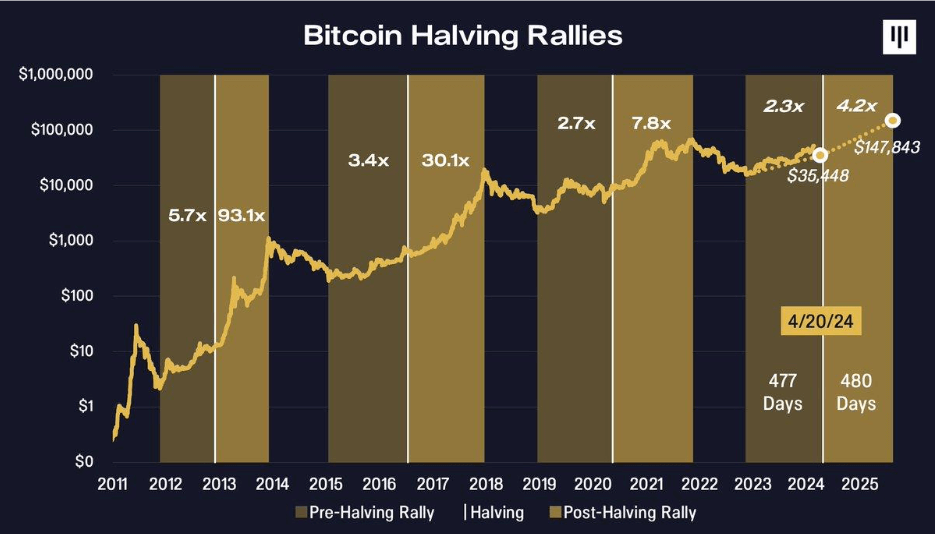
Likewise, the very purpose of Bitcoin mining difficulty is to regulate the rate at which new transaction blocks are added to the network (~10 min), after every 2016 blocks. Without this mechanism, Bitcoin mainnet would be less secure because miners could be disincentivized from participating.
With the Bitcoin mining difficulty, their profitability is auto-corrected. If too many miners unplug, the difficulty lowers, making it more profitable to mine regardless of cut rewards. If more miners onboard the network, the difficulty elevates, making it less profitable to secure the network (its computing power expressed in hash rate).
However, this is offset with BTC price rising over time, owing to its supply scarcity. When BTC mining rewards are cut in half, miners suffer a profitability hit. If the mining difficulty is not lowered, they must increase their cost-efficiency by reinvesting in operations’ upgrades. Accordingly, these miner cycles are called periods of accumulation and capitulation.
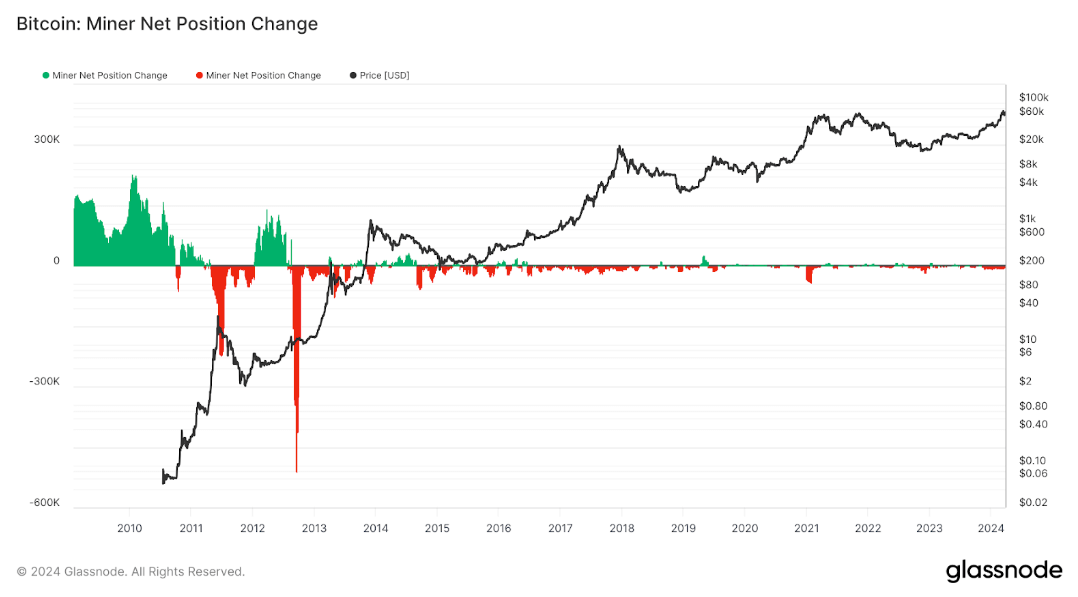
In the end, Bitcoin miners must carefully think ahead. Without overextending themselves in the expansion/debt department, they rely on BTC price boost to carry them through the halvings.
Challenges for Bitcoin Miners Post-2024 Halving
As of March 26th, the total hash rate of the Bitcoin network is 614.6 million TH/s, or 614.6 EH/s. Bitcoin miner revenue per TH/s is $0.10. To put this into context, Bitmain’s latest mining rig, Antminer S21 priced around $4,500, yields a hash rate of 188 TH/s while consuming 3500 Watts worth of electricity.
Some machines are even more powerful and expensive, such as the Antminer S21 Hyd 335T. Against the cost of these machines, miners must account for electricity costs, cooling, maintenance, debt interest payments and the cost of facilities themselves. Those companies unable to perform this balancing act will go bankrupt, as it happened to Core Scientific in 2022.
For individuals using ordinary PCs and laptops, Bitcoin mining long ceased to be profitable. They would have to invest in specialized ASIC machines to go against the rising Bitcoin mining difficulty and subsequent increase in energy costs. The USG, reliant on central banking and currency debasement, is well aware of this fact.
At the end of January, the Energy Information Administration (EIA) began to explore how to cripple miners’ operations. By requesting mandatory survey data on their energy consumption, EIA would then relay findings to the Department of Energy (DoE) to enact restrictive policies.
Owing to the swift legal action of Texas Blockchain Council (TBC) and Riot, this action has been halted as of March 2 filing.
Technological Advancements and Efficiency Improvements
Bitcoin’s proof-of-work is the critical component of BTC value. It makes it possible for a digital asset to be anchored into physical reality via energy consumption and hardware assets. Otherwise, a multitude of cryptocurrencies could be created at low-cost, introducing noise in their valuation.
But just as energy consumption is Bitcoin’s strength, it is also its weakness from a political standpoint. Case in point, Elon Musk revoked Bitcoin payment from Tesla in May 2021, triggering a major crash. Since those days, Bitcoin mining has gone green, having drawn 54.5% of energy from sustainable sources.
In addition to using regenerative hydropower, such as Norwegian Kryptovault, Bitcoin miners can put excess heat to good use. For instance, Kryptovault funnels this hot air to dry out chopped logs for the lumber industry. Many smaller mining operations took this approach to heat their homes.
Heating an entire home with #bitcoin mining pic.twitter.com/470jJ7PSGW
— Documenting ₿itcoin 📄 (@DocumentingBTC) December 28, 2022
Other miners, such as Crusoe Energy Systems, attached their operations to oil and natural drill wells, using the excess gas instead of setting it wastefully on fire. On a larger scale, Bitcoin miners even help to balance the electrical grid, as noted by now deceased ERCOT CEO Brad Jones.
The #bitcoin energy debate is over.
Head of the Texas electrical grid, Brad Jones explains, “#Bitcoin mining is helping balance our grid and is driving more renewables into our system”pic.twitter.com/kGYwAkOVv8
— Documenting ₿itcoin 📄 (@DocumentingBTC) March 5, 2023
At the high end, Bitcoin miners are turning to the densest and greenest form of energy – nuclear. TeraWulf began its construction of the Nautilus Cryptomine facility as the first nuclear-power Bitcoin mining operation. At 2 cents per KW/h, TeraWulf is looking to become the most cost-effective miner in the world.
Within the next halving cycle, much is expected of hydrogen infrastructure as the next best solution to nuclear power. However, the most common path to cost-effectiveness remains the pooling of resources in mining pools.
What to Expect In the Post-Halving Landscape
Serving as a currency debasement foil, Bitcoin provides an out for miners as well. They buy time with debt to upgrade, in the hopes of boosted BTC price repaying that debt down the line. The problem is, only the prepared miners, with the up-to-date rigs and favorable energy costs will survive.
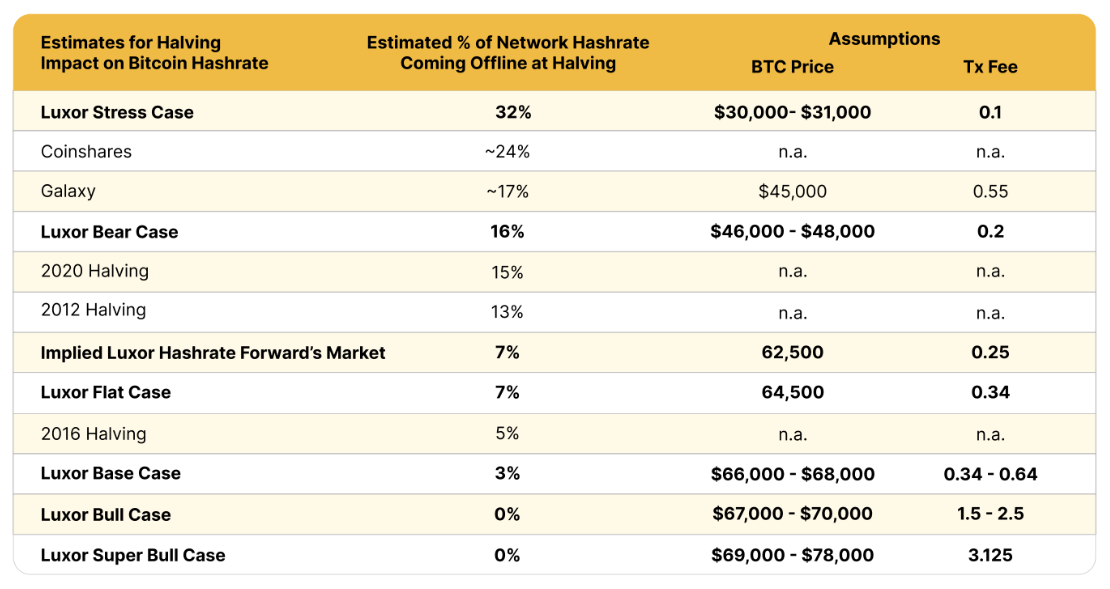
After all, it is they who will keep the Bitcoin mining difficulty elevated. Those who can’t compete will leave the network, making the job easier for competitors as network difficulty is auto-adjusted. According to Luxor’s base case, in the scenario of BTC price remaining within the $66k – $66k range, 3% Bitcoin miners could leave the network.
Furthermore, Luxor projects Bitcoin difficulty to reach 725 EH/s by the end of the year. This would level the post-halving hashprice at $53/PH/day, aligning with the flat case hashprice projection.
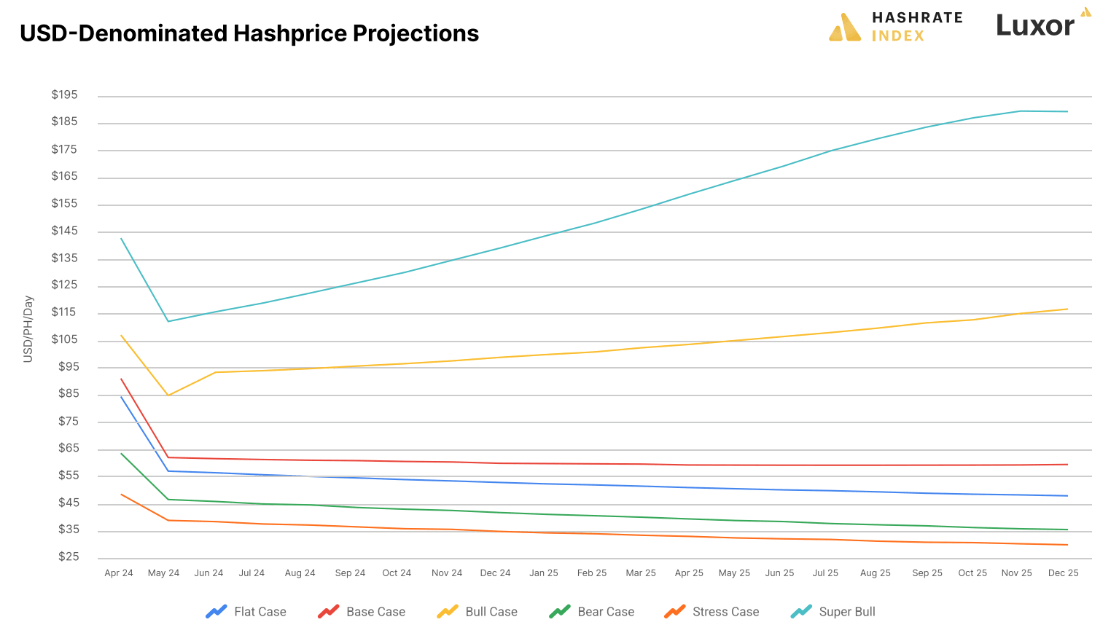
Presently, the breakeven hashprice stands at $37.20/PH/day, without accounting for firmware upgrades. Other companies, like Blockware Solutions, expect hashrate to reach ~670 EH/s by the end of the year, using the 2020 halving as benchmark when the hashrate increased by 30% by the end of the year.
Keeping this in mind, Bitcoin miners should plan for long-term scalability, such as TerraWulf’s investment in nuclear power. In the meantime, to hedge against uncertainty, miners could take advantage of Bitcoin derivatives products.
Case in point, several trading platforms currently exist which provide exchange traded futures as the mechanism to sell forward their mining productivity. Just as in traditional markets with commodities, miners could use this strategy to safeguard against BTC price fluctuations.
And with recurrent revenue streams, the spike in operational costs could be lessened. Likewise, Bitcoin mining companies can diversify and offer cloud mining services with enhanced cloud security.
Conclusion
Taking all of its elements into account, Bitcoin is a marvel of both software engineering and economic theory. It turns out, it is possible to enact monetary policy and incentives without resorting to direct centralized tampering.
Bitcoin miners play a key role in this digital enactment. Although they have to resort to the Darwinian play of the survival of the fittest, the unknowns are less prevalent. With three halvings behind, data for projections is there to take advantage of.
The only question remains, which Bitcoin miners aligned their financial modeling with the worst bear case?
