

[ad_1]
Infura, a blockchain infrastructure firm owned by Consensys, is expanding its API data marketplace, the Decentralized Infrastructure Network (DIN), to run on EigenLayer, a protocol that lets Ethereum stakers reuse their staked ETH to secure external services.
In a press release shared with The Defiant, Infura said this marks the first large-scale RPC and API marketplace to run as an EigenLayer Autonomous Verifiable Service. That means the service is now backed by stakers who can earn rewards if it performs well, or lose part of their stake if it fails, encouraging operators to stay online.
E.G. Galano, co-founder of Infura, said that using EigenLayer allows the team to realize its vision on a “proven restaking standard backed by the strongest asset in crypto: restaked ETH.”
DIN has been handling real user requests since February 2024, routing more than 13 billion requests per month across more than 30 networks and platforms, including Ethereum mainnet, Layer 2 network Linea, and web3 wallet MetaMask, per the release.
DIN links blockchain apps to multiple node providers, so if one goes down, the requests automatically switch to another without breaking anything. With the EigenLayer integration, Infura adds economic accountability on top of this existing traffic, making reliability costly to ignore.
Fighting Centralization
With the new service, the Consensys-owned blockchain infrastructure firm wants to address a major weakness in web3 infrastructure, as it says “70-80% of RPC traffic today still flows through a handful of centralized providers.”
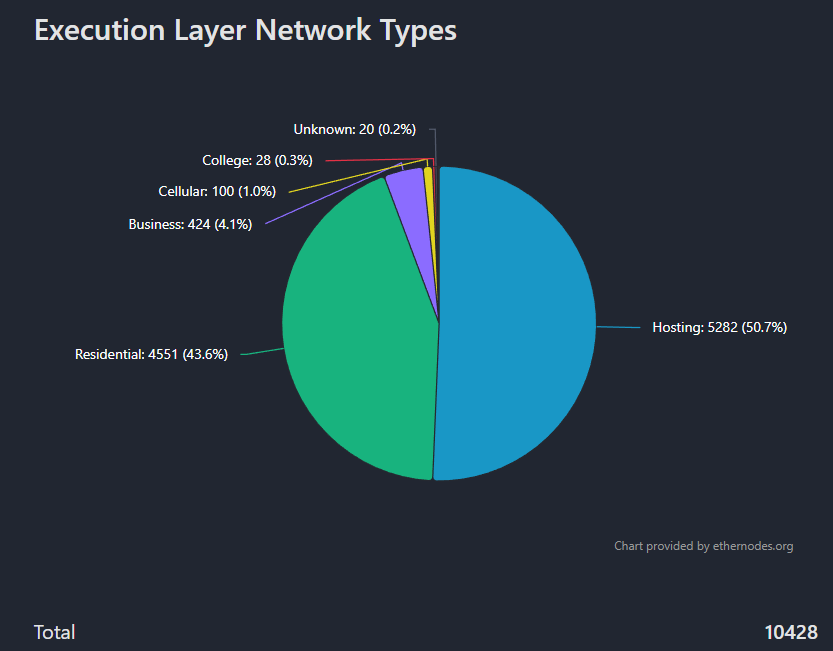
Execution layer network types. Source: Ethernodes
Data from Ethernodes, a website that tracks Ethereum’s data statistics, shows that more than half of Ethereum’s so-called “execution nodes,” which process blockchain data, are hosted by cloud providers.
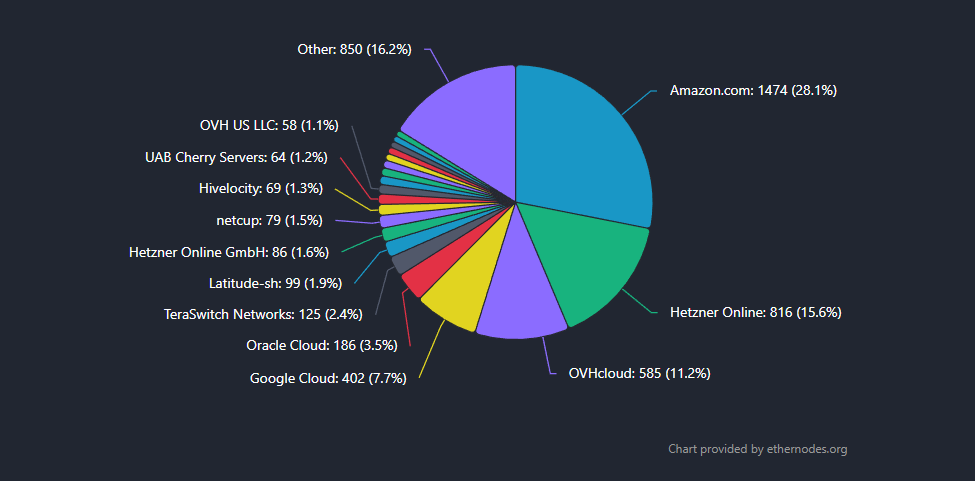
Ethereum execution node cloud providers. Source: Ethernodes
About 28% of these nodes run on Amazon’s cloud services, while 15.6% run on the European data center Hetzner.
Although blockchains are designed to be decentralized, much of their traffic still depends on a few centralized cloud platforms, especially Amazon Web Services (AWS). And the industry has already seen the consequences of this concentration.
In late October, AWS suffered an outage lasting several hours that disrupted major websites and apps, including Coinbase, its Layer 2 network Base, cross-chain stablecoin USDT0, and even Infura, which reported a “widespread outage” affecting multiple Infura networks and services. The AWS incident followed a similar outage in April.
[ad_2]
