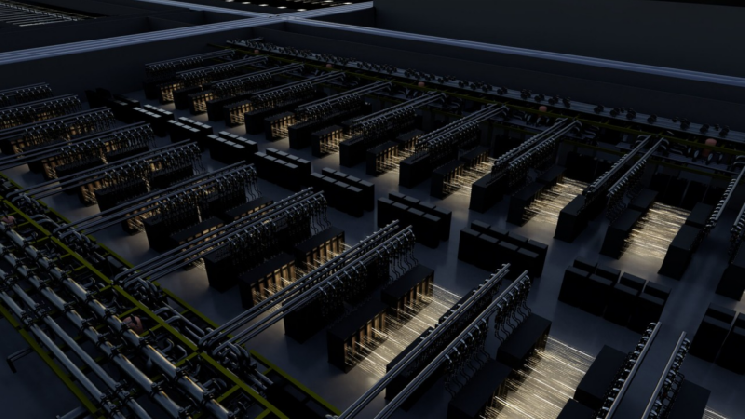
Hut 8 made its name mining Bitcoin. Its latest earnings call suggests it would prefer to be known as a landlord.
On November 4, 2026, Hut 8 Corp. (NASDAQ: HUT) used its third-quarter 2026 call to describe a strategy for turning its power assets into long-term AI data center leases. Management outlined a “power-first” energy infrastructure model centered on gigawatt-scale campuses. Mining is no longer the main focus.
The headline figure is hard to overlook. The company says it has contracted 949 megawatts of IT capacity, with those contracts expected to generate approximately $27 billion in base-term revenue from leases lasting 15 to 17 years.
Two campuses, one very large bet
The contracted capacity is spread across two sites: River Bend in Louisiana and Beacon Point in Texas. Beacon Point reached full commercialization in the third quarter. In other words, all of its capacity now has a signed customer.
The leases are intended for AI and high-performance computing (HPC) tenants.
The timeline will require patience. Hut 8 is targeting the first data-hall deliveries at River Bend in Q2 2027, followed by Beacon Point Phase 1 in Q3 2027.
The broader development pipeline now totals 7,859 MW, including 1,330 MW currently under construction. The company also highlighted the projects’ cost-efficient designs.
How Hut 8 is paying for it
AI campuses are expensive to build, and Hut 8 is relying on structured financing to fund them. The company has secured $7.5 billion in bonds tied to projects including River Bend and Beacon Point’s first phase.
The debt is structured as non-recourse, project-level financing. In general, lenders look to the individual project for repayment rather than the company as a whole.
Hut 8 also closed a new $1.07 billion senior secured revolving credit facility.
Bitcoin also factors into the strategy. Hut 8 bought back around $250 million of shares, partly funded by selling about 3,100 Bitcoin. It also increased its buyback authorization to $1 billion.
The quarterly numbers
The transition is evident in the income statement. Revenue in Q3 2026 was $71.1 million, down from $83.5 million in Q3 2025.
Adjusted EBITDA increased to $33 million from $30.5 million a year earlier.
What this means
The risks are real, however. The approximately $27 billion figure represents expected revenue from contracts lasting well over a decade, while first deliveries are still targeted for 2027. Construction delays, cost overruns or tenant issues could all affect that timeline. The $7.5 billion in bonds also adds substantial leverage, even though it is ring-fenced at the project level.
Another gap bears watching: the 1,330 MW under construction already exceeds the 949 MW under contract, while the 7,859 MW pipeline is much larger still.
Key milestones to watch include the Q2 2027 River Bend delivery, the Q3 2027 handoff of Beacon Point Phase 1, new lease announcements, and how much of its remaining Bitcoin treasury the company decides to retain.
Add A Comment
Comments are closed.