
Close Menu
  • Coins
    • Bitcoin
    • Ethereum
    • Altcoins
    • NFT
  • Blockchain
  • DeFi
  • Metaverse
  • Regulation
  • Other
    • Exchanges
    • ICO
    • GameFi
    • Mining
    • Legal
  • MarketCap
What's Hot

what the White House crypto summit means for regulation

24/08/2026

BC Card completes South Korea’s first stablecoin payment proof of concept with Coinbase

24/08/2026

How 8 Crypto Networks Reach Consensus

24/08/2026
Facebook X (Twitter) Instagram
  • Back to NBTC homepage
  • Privacy Policy
  • Contact
X (Twitter) Telegram Facebook LinkedIn RSS
NBTC News
  • Coins
    1. Bitcoin
    2. Ethereum
    3. Altcoins
    4. NFT
    5. View All

    ‘We’ll Get Through This Bear Market,’ Says CEO of Bitcoin Treasury Company Strategy

    24/08/2026

    Dogecoin’s Billy Markus Drops a One‑Word Reaction to Fresh Bitcoin Bear Calls

    24/08/2026

    Bitcoin’s next bottom may not arrive until late 2026

    24/08/2026

    US Interest in Bitcoin Sinks to Near 5-Year Low

    24/08/2026

    Besu Patches 5 Node Vulnerabilities: What Operators Must Know

    24/08/2026

    Ethereum Price Today Hits $2,468 as Overbought RSI Signals Pullback Risk

    24/08/2026

    Tom Lee’s Bitmine buys $81 million of ETH in largest weekly haul since early July

    24/08/2026

    Ethereum price rises 29% as Tom Lee says rotation has begun

    24/08/2026

    Binance BNB Chain’s TxStream Kills the Public Mempool, Here’s Why Memetoro $MT Will Benefit Most

    24/08/2026

    Where Memetoro $MT Stands as Binance (BNB) Chain Goes Machine-Native

    24/08/2026

    Listings, Staking and the Binance BNB AI Agentic Roadmap

    24/08/2026

    vault rotation frozen after 20% TVL drain

    24/08/2026

    A 2026 Filing Guide for Creators

    24/08/2026

    NFT sales surge 170% to $95.5M on $55M Pandora trade

    22/08/2026

    How StonkBrokers Turned a JPEG Into a Brokerage Account

    18/08/2026

    OpenSea founder pivoted to AI — and won

    17/08/2026

    what the White House crypto summit means for regulation

    24/08/2026

    BC Card completes South Korea’s first stablecoin payment proof of concept with Coinbase

    24/08/2026

    How 8 Crypto Networks Reach Consensus

    24/08/2026

    ‘We’ll Get Through This Bear Market,’ Says CEO of Bitcoin Treasury Company Strategy

    24/08/2026
  • Blockchain

    How 8 Crypto Networks Reach Consensus

    24/08/2026

    EVM network halts block production after supply exploit as TON connection remains dark

    24/08/2026

    HyperEVM Daily Fees Hit Record $538K as HYPE Buyback Mechanism Gains Traction

    24/08/2026

    How Could XDC Network’s x402 Integration Enable AI Agent Payments?

    24/08/2026

    India to Pilot Tokenized Corporate Bonds Next Month in Blockchain Test

    24/08/2026
  • DeFi

    Avalon Labs adds market-neutral yield pool to Super Earn, targeting 15% APY

    24/08/2026

    Uniswap Hits Record Daily UNI Burn of $590K as Ethereum Leads the Way

    22/08/2026

    BTCS used Ethereum to repay Aave debt and ended Q2 with just $317,000 in cash

    22/08/2026

    DeFi Roars Back as $10B DEX Boom Sends TVL Flying Above $83B

    21/08/2026

    Maple Finance crypto lending grows to $1.9B, ranks second only to Tether

    20/08/2026
  • Metaverse

    Is Solana Gaming Back? Kintara Activity Fuels Renewed Optimism in Onchain MMOs

    24/06/2026

    The Sandbox launches AI game engine ‘The Sandbox Studio’ for next-generation creators

    10/06/2026

    Meta commits $13M in funding for Oversight Board through 2028

    29/05/2026

    Why Animoca’s Yat Siu says the future is 100 billion AI agents

    07/05/2026

    ‘8,000 Jobs’—Polymarket Sees Tech Layoff Surge As Meta AI Push Bites

    18/04/2026
  • Regulation

    Fairmint CEO warns tokenized stocks risk market fragmentation

    24/08/2026

    A $1 billion meme coin purchase puts a huge 167% share dilution down to a single vote for ZeroStack

    24/08/2026

    Inside transfer wipes out $1M executive debt as crypto firm offloads payments business without independent valuation

    24/08/2026

    Bitcoin ETFs Add $1.92 Billion in 5 Days as Wall Street Buying Surges

    24/08/2026

    Bitcoin and Ethereum ETFs Add $492 Million as Inflow Streak Reaches Five Days

    24/08/2026
  • Other
    1. Exchanges
    2. ICO
    3. GameFi
    4. Mining
    5. Legal
    6. View All

    BC Card completes South Korea’s first stablecoin payment proof of concept with Coinbase

    24/08/2026

    Polymarket Bolsters Leadership with Industry Veterans Ahead of NFL Season and Midterms

    24/08/2026

    Binance, RedotPay clash over fate of Singapore lawsuit

    24/08/2026

    Kalshi launches institutional grade market data feed on DoubleZero Edge

    24/08/2026

    ICO market slows sharply with only six completions in 2026

    30/04/2026

    South Korea Poised to Lift Ban on Domestic ICOs After 7 Years

    19/12/2025

    Why 2025’s Token Boom Looks Both Familiar and Dangerous

    31/10/2025

    ICO for bitcoin yield farming chain Corn screams we’re so back

    22/01/2025

    Top 12 NFT games every player should know about in August 2026

    19/08/2026

    GameShame Studios founder details Raijin Protocol’s roadmap in NeoPod’s sixth AMA

    13/08/2026

    How BC.GAME is turning players into stakeholders

    04/08/2026

    YGG Play Shuts Down Services as Yield Guild Pivots to AI Data

    01/08/2026

    Bitcoin miner IPO demands 99.8% of funds from public buyers while handing them just 10% equity

    24/08/2026

    Bitcoin Miners Get a Lifeline as Hashprice Explodes 20% Higher

    24/08/2026

    EU Carbon Taxes Push Bitcoin Mining to Russia, Study Claims

    24/08/2026

    Bitcoin Mining Hits a Crossroads as Difficulty Hovers Near the Floor

    24/08/2026

    what the White House crypto summit means for regulation

    24/08/2026

    Pakistan Opens Licensing Portal for Crypto Service Providers, Sets September Deadline

    24/08/2026

    AUSTRAC crypto regulations demand ID checks with zero transition time

    24/08/2026

    Japan FSA lifts stablecoin cap for some operators, eyes institutional growth

    24/08/2026

    what the White House crypto summit means for regulation

    24/08/2026

    BC Card completes South Korea’s first stablecoin payment proof of concept with Coinbase

    24/08/2026

    How 8 Crypto Networks Reach Consensus

    24/08/2026

    ‘We’ll Get Through This Bear Market,’ Says CEO of Bitcoin Treasury Company Strategy

    24/08/2026
  • MarketCap
NBTC News
Home»Blockchain»How 8 Crypto Networks Reach Consensus
Blockchain

How 8 Crypto Networks Reach Consensus

NBTCBy NBTC24/08/2026No Comments8 Mins Read
Share
Facebook Twitter LinkedIn Pinterest Email


Bitcoin introduced the model now called Nakamoto Consensus, but Ethereum, $BNB Smart Chain, $XRP Ledger, Solana, and Tron took different routes, while Dogecoin and Zcash still run much closer to Bitcoin’s original playbook. Excluding stablecoins, all of these cryptocurrencies mentioned below are the top digital assets by market valuation.

What a Consensus Algorithm Actually Does

A blockchain is essentially a shared accounting book replicated across computers worldwide. When two machines see different transactions or competing blocks at once, the network needs a hard rule for deciding which history survives. That is a consensus algorithm’s job. It determines who gets the next update, how competing histories are ranked, what prevents someone from flooding the network with fake participants, and when a transaction becomes difficult or impossible to unwind. Those details matter because labeling a chain merely “proof-of-work” or “proof-of-stake” hides the machinery deciding who wins when the network disagrees.

Nakamoto Consensus Made Bitcoin’s Open Network Possible

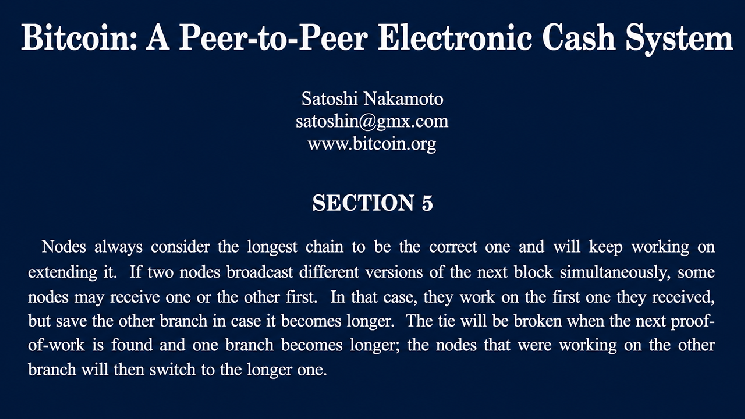
Nakamoto Consensus is not a single button Bitcoin pushes or one named algorithm in Satoshi Nakamoto’s white paper. It is a stack of rules. Miners compete and earn with proof-of-work (PoW), working nodes independently reject invalid blocks, miners get paid for valid work, and competing chains are resolved by following the valid branch carrying the greatest accumulated computational work.

The image above captures Nakamoto Consensus in action: miners chase the chain carrying the most accumulated proof-of-work. When two blocks land almost simultaneously, the network briefly splits. Nodes keep extending whichever branch reached them first, but once one side gains even a single block, its accumulated work takes the lead. Miners quickly ditch the shorter branch and pile onto the winner because burning hashpower on a dying fork means burning money.

Two miners can find blocks almost simultaneously, briefly splitting the network. The next successful block usually tips one branch ahead, and the network converges. That produces probabilistic finality: reversing a transaction becomes progressively harder as work stacks above it, but Bitcoin never declares a payment irreversible after six confirmations.

Bitcoin Sets the Nakamoto Consensus Baseline

Bitcoin is the benchmark because the model began there. SHA-256 PoW miners compete in an unpredictable computational lottery akin to dice rolls, targeting a block about every ten minutes. Difficulty resets every 2,016 blocks, so changing mining power does not permanently alter issuance speed. Worker nodes follow the valid chain carrying the greatest cumulative work, not simply whichever branch contains more blocks. There is no scheduled producer or validator committee.

Ethereum Replaced Mining With Validators and Stake

Ethereum tore out PoW in the Merge and replaced miners with proof-of-stake (PoS) system, a hybrid consensus protocol dubbed Gasper. The chain runs in 12-second slots, with validators committing ETH to propose blocks and vote on the branch. LMD-GHOST weighs validators’ latest votes by stake to determine the leading branch, while Casper FFG adds checkpoint finality.

Ethereum proposes blocks every 12 seconds, with Gasper consensus pushing them toward finality in about 12.8 minutes.

Under normal conditions, Ethereum reaches finality in about two epochs, or roughly 12.8 minutes. The key break from Bitcoin is where consensus power comes from: Bitcoin counts computational work, while Ethereum counts economic stake that can be penalized, or slashed, for certain provably dishonest acts.

$BNB Smart Chain Trades the Mining Race for Speed

$BNB consensus today largely means the $BNB Smart Chain because $BNB Beacon Chain was shut down in 2024. BSC runs Proof-of-Staked-Authority, blending delegated stake, scheduled block production, and validator voting instead of an open mining race. Its elected structure has 45 validators, including 21 Cabinet validators and 24 Candidates.
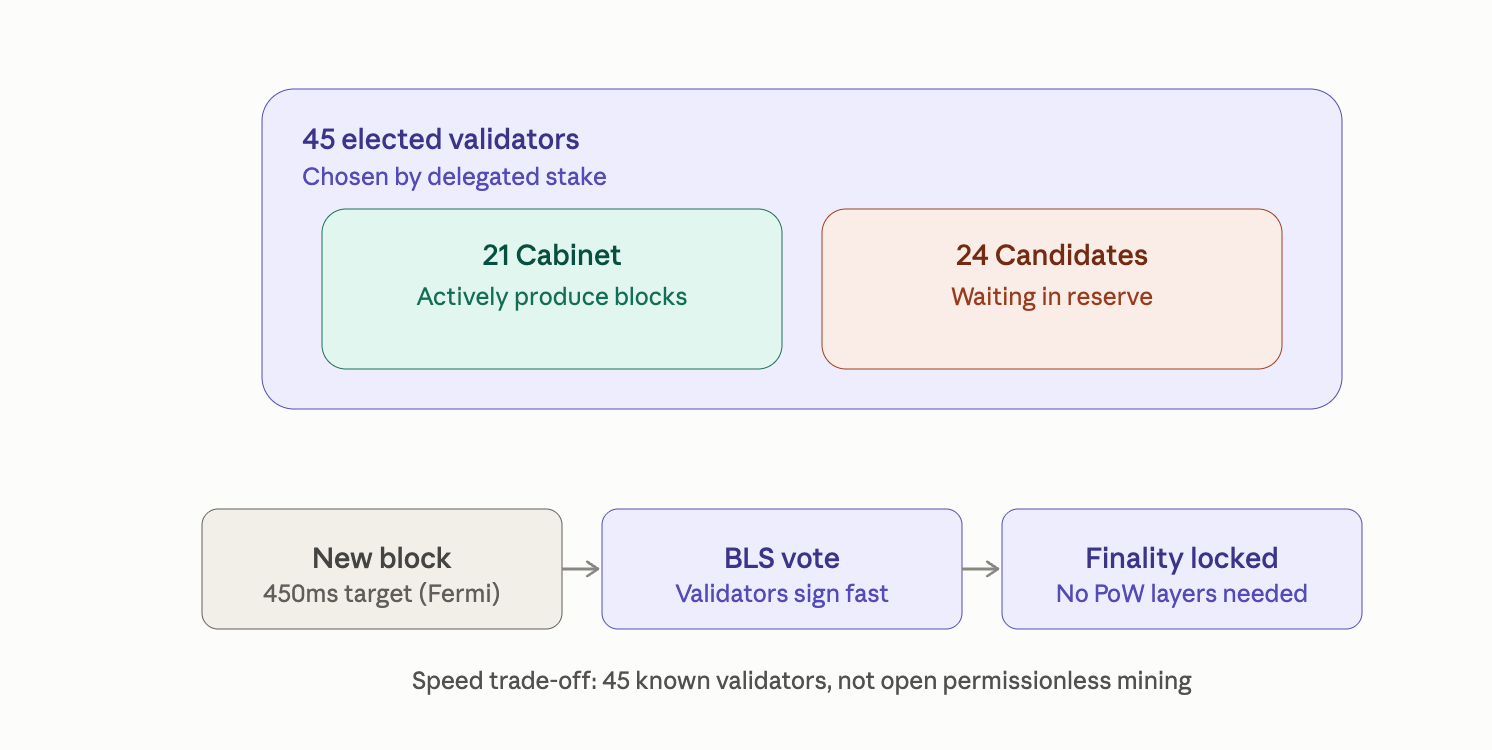
$BNB Chain trades open mining for speed, using 45 elected validators and fast BLS voting to lock in finality.

The Fermi upgrade in January 2026 pushed the target block interval down to 450 milliseconds, while BLS validator votes can lock finality without layers of proof-of-work.

The payoff is speed, but the trade-off is clear: far more consensus responsibility sits with a known, limited group of professional validators than with Bitcoin’s permissionless mining market.

$XRP Ledger Makes Trust Lists Part of Consensus

The $XRP Ledger or XRPL goes in another direction altogether. There are no PoW miners or PoS lottery systems. Servers maintain Unique Node Lists, or UNLs, containing validators they consider unlikely to collude, and participants repeatedly compare proposed transaction sets until enough trusted validators agree.
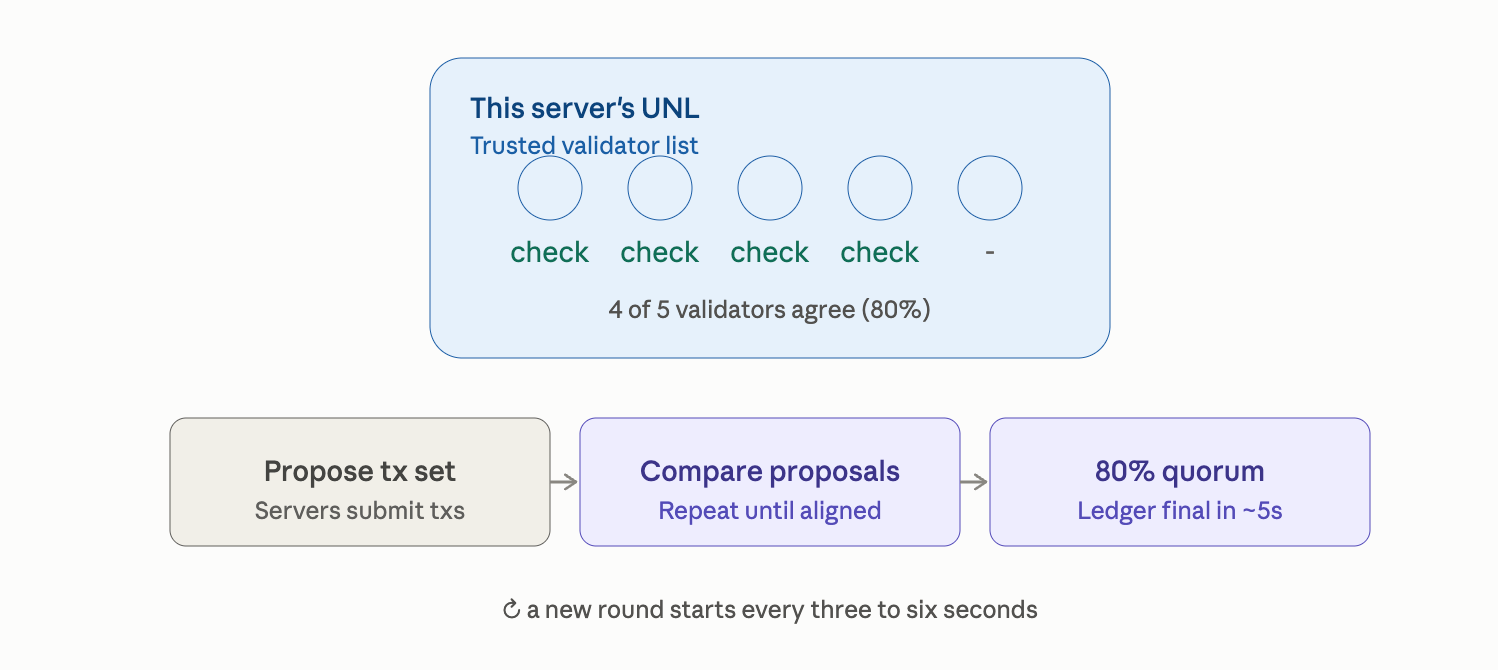
The trust-list panel above shows what really drives XRPL: no mining race or staking lottery, just each server’s handpicked validator list and repeated proposal rounds until the votes converge. Once four of five validators agree, the network clears the 80% threshold and the ledger locks in. That structure trades brute-force computing for validator agreement, letting XRPL settle transactions without miners burning electricity or stakers battling for block rewards.

The standard validation quorum is 80%, and once a ledger clears that threshold, it is treated as final under its trust assumptions. Settlement is generally described as taking about four to five seconds. The key dependency is whether trusted validator lists remain honest, available, and sufficiently overlapping across the network.

Solana Uses a Clock, Stake and Tower BFT

Solana’s proof-of-history model is often mistaken for proof-of-work, but it serves another job. Proof-of-history functions as a cryptographic clock, helping establish event order, while stake-weighted Tower BFT handles voting and fork selection. Leaders are scheduled ahead of time according to stake, and validators vote when competing branches appear.
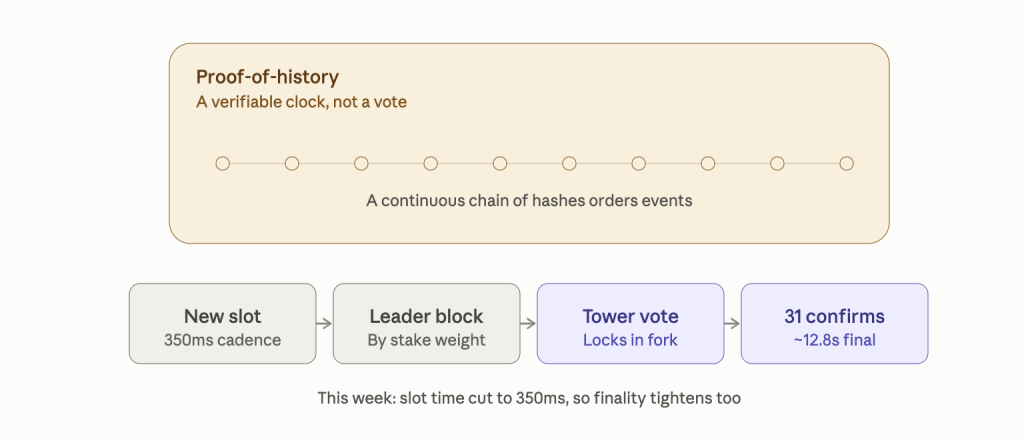
The visual above shows how Solana keeps time and reaches consensus without turning proof-of-history into a voting system. A continuous hash sequence acts as a verifiable clock, ordering events before validators weigh in. Every 350-millisecond slot gets a stake-weighted leader, Tower BFT votes lock validators into a fork, and after 31 confirmations, transactions reach finality in roughly 12.8 seconds.

Under Tower, a block becomes finalized after at least 31 confirmed descendants, producing roughly 12.8-second finality at the traditional 400-millisecond slot cadence. This past week, the network recently reduced slot cadence to 350 milliseconds.

Tron Puts 27 Elected Producers on a Schedule

Tron’s distributed ledger system has similarities and differences. Tron uses delegated PoS, with TRX holders voting for Super Representatives, with the top 27 becoming active block producers. Those producers rotate through scheduled three-second turns. Before finality, Tron can fall back on a longest-chain rule to sort out competing tips, giving it a narrow resemblance to Nakamoto-style chain selection.
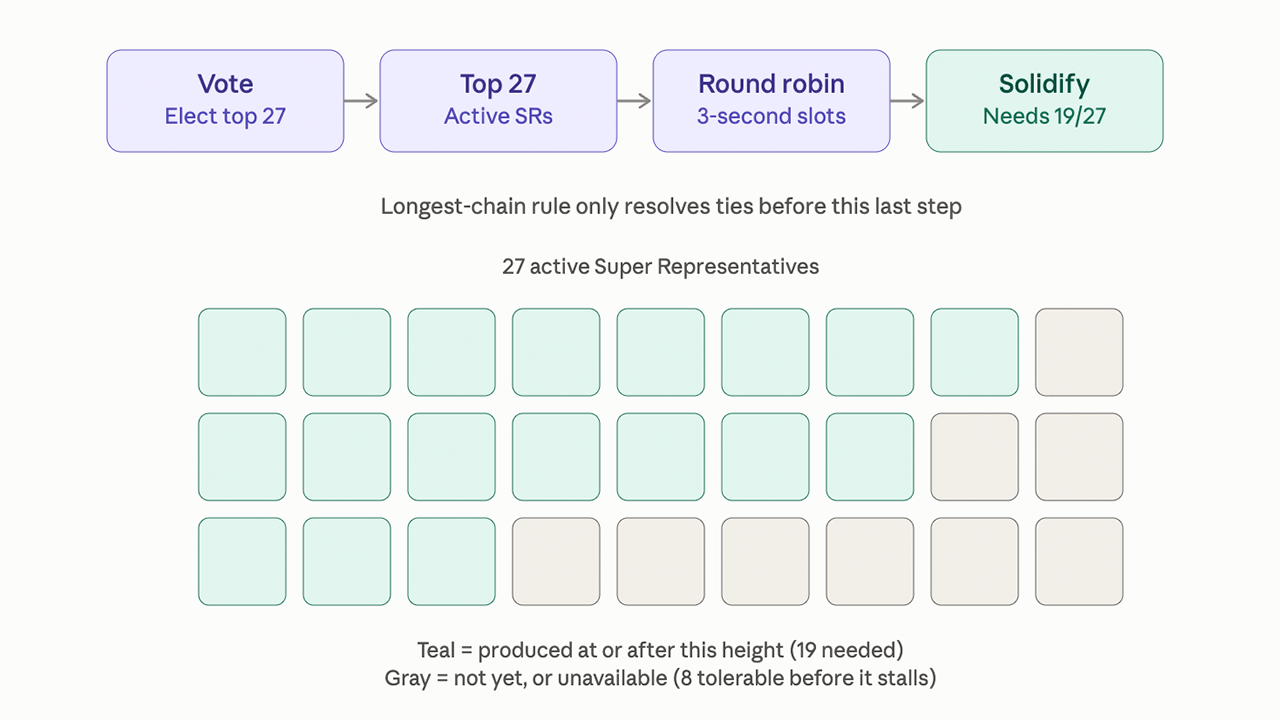
Tron elects 27 Super Representatives to rotate blocks, with 19 confirmations needed to lock in finality.

That resemblance ends at the settlement. A block becomes solidified after at least 19 of the 27 active representatives have produced at that height or later, normally leaving finality about a minute behind the head. If nine representatives are unavailable or uncooperative, that threshold cannot be reached.

Dogecoin Keeps Nakamoto Consensus but Changes the Machinery

Dogecoin sits squarely inside the Nakamoto Consensus family, although, the machinery under the hood differs sharply from Bitcoin. It uses Scrypt proof-of-work instead of SHA-256 and targets a new block roughly every minute. DigiShield adjusts difficulty after every block, far faster than Bitcoin’s 2,016-block adjustment cycle.

Dogecoin pairs Scrypt proof-of-work and Litecoin merged mining with Nakamoto’s cumulative-work rule to secure roughly 1-minute blocks.

Dogecoin also uses Auxiliary Proof-of-Work, or merged mining, letting Scrypt miners, especially Litecoin miners, reuse compatible work to help secure Dogecoin. Those changes reshape mining economics, not the core logic: miners supply work, cumulative work decides the winning chain and transaction confidence rises as more proof-of-work is stacked above a payment.

Zcash Keeps the Nakamoto Model Behind Its Privacy Technology

Zcash remains Nakamoto-style despite being better known for privacy than consensus. It uses Equihash proof-of-work, targets blocks every 75 seconds and follows the valid blockchain carrying the greatest total work. A Digishield-derived difficulty system adjusts after every block, letting Zcash react to mining changes faster than Bitcoin’s roughly two-week adjustment window.
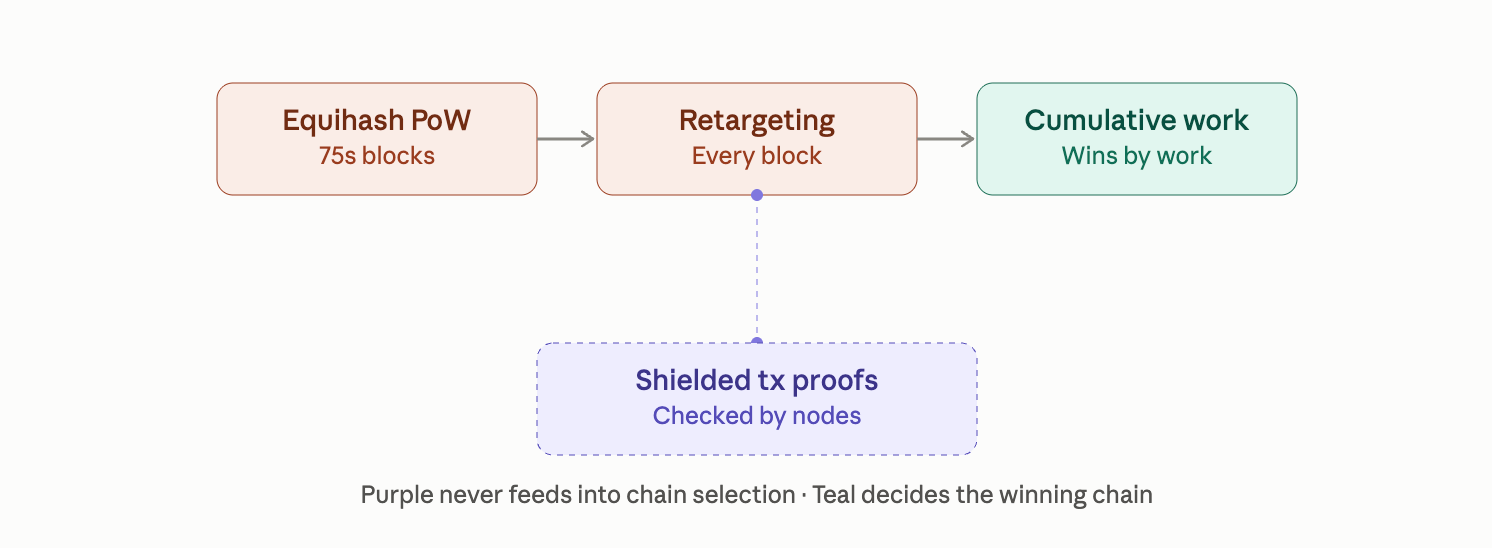
Zcash keeps Nakamoto-style proof-of-work and cumulative-work chain selection, but bolts shielded transaction privacy alongside the consensus engine. Unlike Dogecoin, Zcash is not swapping the machinery so much as adding a privacy layer that nodes verify but that never touches chain selection.

Zero-knowledge proofs behind shielded transactions do not replace consensus. Nodes enforce them as validity checks, while miners and proof-of-work still decide block production and chain selection. Like Bitcoin and Dogecoin, Zcash therefore settles probabilistically without absolute protocol-level finality.

Consensus Is Really a Choice About Who Must Be Trusted

The split among these networks runs deeper than the familiar proof-of-work versus proof-of-stake debate. Bitcoin, Dogecoin, and Zcash bet that honest miners can keep more computational work than an attacker. Ethereum puts the burden on economic stake. $BNB Smart Chain, Solana, and Tron lean on defined or stake-selected validator groups, while $XRP Ledger makes overlapping trusted-validator lists part of security itself.

Faster finality can be valuable for payments, applications and trading, but speed does not guarantee security, and slower proof-of-work is not automatically safer. The key question is what an attacker must control to rewrite history and how the protocol responds if that assumption fails. That difference is what users actually experience.

Share. Facebook Twitter Pinterest LinkedIn Tumblr Email
NBTC

NBTC is the editorial account for NBTC News, covering Bitcoin, Ethereum, DeFi, blockchain infrastructure, exchanges, mining, regulation and digital asset markets. The editorial team focuses on clear sourcing, timely updates and practical context for crypto readers.

Related Posts

EVM network halts block production after supply exploit as TON connection remains dark

24/08/2026

HyperEVM Daily Fees Hit Record $538K as HYPE Buyback Mechanism Gains Traction

24/08/2026

How Could XDC Network’s x402 Integration Enable AI Agent Payments?

24/08/2026

India to Pilot Tokenized Corporate Bonds Next Month in Blockchain Test

24/08/2026
Add A Comment

Comments are closed.

Top Posts
Get Informed

Subscribe to Updates

Get the latest news from NBTC regarding crypto, blockchains and web3 related topics.

Your source for the serious news. This website is crafted specifically to for crazy and hot cryptonews. Visit our main page for more tons of news.

We're social. Connect with us:

Facebook X (Twitter) LinkedIn RSS
Top Insights

what the White House crypto summit means for regulation

24/08/2026

BC Card completes South Korea’s first stablecoin payment proof of concept with Coinbase

24/08/2026

How 8 Crypto Networks Reach Consensus

24/08/2026
Get Informed

Subscribe to Updates

Get the latest news from NBTC regarding crypto, blockchains and web3 related topics.

Type above and press Enter to search. Press Esc to cancel.