
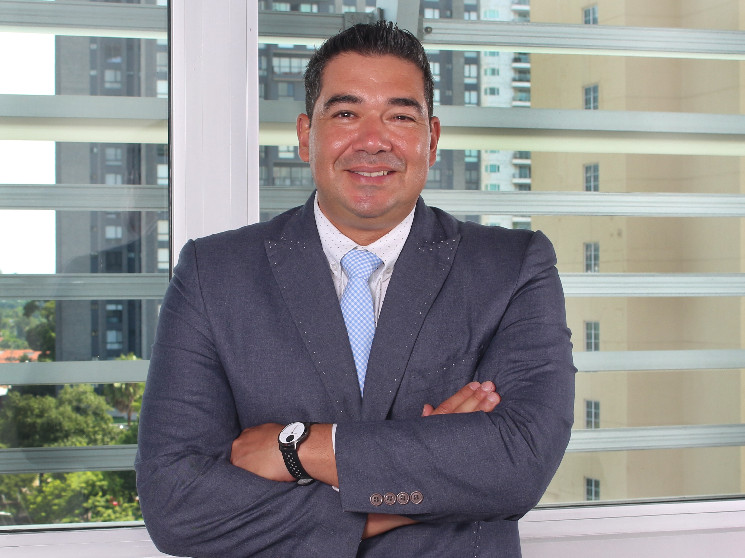

Juan Carlos Reyes, the CNAD’s president, sat down with CoinDesk for an exclusive interview.
Crypto regulators need to deeply understand the technology before offering regulatory frameworks, Reyes said.
Tokenization efforts are particularly attractive as they allow the democratization of access to structured securities.
When it comes to regulating crypto, El Salvador has a head-start on most other countries. It was the first nation to adopt bitcoin (BTC) as legal tender, in 2021, and has become home to a wide range of crypto companies.
“Looking at the big picture, most people won’t understand what we’re doing in El Salvador, they only see glimpses,” Juan Carlos Reyes, president of the National Commission of Digital Assets in El Salvador (CNAD) — which was created in February 2023 to regulate the crypto sector in the Latin American nation of 6.3 million souls — told CoinDesk in an interview.
“Even the foreign companies that are regulated here but don’t have a full office on-the-ground, they don’t understand how advanced we already are, and how quickly things are advancing in this industry.”
President Nayib Bukele’s initiative forced the nation’s agencies to grapple with the technology and the implications of working with a digital currency, Reyes said.
Consequently, El Salvador avoided giving crypto supervisory and regulatory authority to its traditional financial regulators — like, for example, the Superintendence of the Financial System (SFS) — and instead created the CNAD from scratch. The objective was to create a tailor-made regulatory framework to crypto instead of trying to bend existing rules to digital assets.
“There’s an old saying in English: ‘If it sounds like a duck, it looks like a duck, and it quacks like a duck, it’s probably a duck,’” Reyes said. “Well, in this case, it’s not a duck. Digital assets are not like traditional financial instruments at all.”
That’s why the CNAD took a technology-minded approach to regulating crypto as soon as Reyes — a computer science heavyweight — became the agency’s leader in September 2023. The results have been shocking, according to crypto companies that received El Salvador’s Digital Asset Service Provider (DASP) license.
“We were completely caught off-guard by how knowledgeable, how detailed, how completely versed in not just regulations, but the technology [the CNAD was],” Nick Cowan, Group CEO of tokenization solutions firm VLRM, told CoinDesk in an interview. “Without trying to over-praise El Salvador, we were completely stunned by how quickly they were able to get to the heart of the matter to review our application.”
Victor Solomon, partner at Salvador-based tokenization advisory firm Tokenization Expert, concurred.
“We didn’t have to spend time explaining the technical foundations of our operations — [Reyes] already understood the intricacies of tokenization and the compliance measures we had in place,” Solomon told CoinDesk.
“He understands the practical challenges [that] businesses face, from fundraising to navigating regulations, and this makes him not just a regulator but an advocate for businesses that aim to positively impact the Salvadoran economy,” Solomon added.
The Technologist
Born in El Salvador, Reyes moved to Canada as a child to escape the gang warfare that was, at the time, ravaging the country. A self-described “very high achievement person,” he has multiple bachelor’s degrees — computer science, math and physics — as well as a master’s degree in management from Harvard and a doctorate in philosophy from the People’s Friendship University of Russia. Not to mention the PhD in international economics that he’s now pursuing.
His professional background is just as varied. His experience ranges from leading a consulting firm for 15 years to developing business opportunities for the Missanabie Cree First Nation to opening a bar on the second floor of his beach house. A Bitcoin believer since 2013, he decided to move back to El Salvador in 2021 to take part in the cryptocurrency nationalization process.
The CNAD, which counts 35 employees, is fully independent, and modeled after Reyes’ image: everyone knows crypto (and the underlying technology) like the back of their hand. In fact, 20 members of the staff are currently enrolled in a post-graduate crypto program at the University of CEMA in Argentina to buff up their expertise.
“We have the most educated, most complete team when it comes to regulation of crypto assets in the world,” Reyes said. “If anyone doesn’t know how to do a transaction on Bitcoin, including my driver, they probably cannot work here.”
This crack team certainly leaves a strong impression on the companies that seek to obtain a license to operate in El Salvador.
Reyes “is a technologist,” Cowan, whose company has worked with dozens of other regulators over the globe, told CoinDesk. “He absolutely gets the tech. In other jurisdictions, you have regulators who understand the regulations and investor protection, which, of course, is critical, but they don’t necessarily understand the technology, and that can sometimes make it quite onerous to get to the point that you need to get to.”
“It was a very detailed and complex process. I mean, we submitted a 700-page application,” Cowan said. “But the decision-making process was a lot faster [than in other countries] after the application had been filed… It was incredibly thorough, I would say, as equal as any other regulatory process we’ve had to undergo before. It wasn’t easier, just quicker.”
For Reyes, the crypto-literacy of the agency means that it can abide by one of the space’s most valued philosophical tenets — don’t trust, verify — and go examine the blockchain each time they interact with a new company seeking a license. The team doesn’t rely on the documents provided by compliance officers, and that has already led to firms getting caught giving wrong information to the regulator.
El Salvador’s advantage
Reyes likes to use an analogy to explain why crypto needs its own regulator. If you buy an electric car and it breaks down, and you bring it to your mechanic of 20 years, well, when he pops the hood open, he won’t find an engine — just a battery. And he won’t know what to do with it.
That’s what crypto and traditional financial assets are like to Reyes. They look similar on a surface level. But dig a little deeper, and it’s a different beast entirely. It’s one of the reasons why jurisdictions around the globe have been slow to implement regulatory frameworks for digital assets.
El Salvador, however, is a small country. With a GDP of $35 billion, its economy is 17th among Latin American nations and 103rd in the world. It doesn’t have its own currency, nor does it boast of strong financial institutions, or even of an existing ecosystem of developers. But Reyes says all of these things turned out to be boons when it comes to regulating crypto, because El Salvador started “with a blank sheet of paper.”
To fall back on the electric car analogy, it’s as if El Salvador was able to specialize right away in fixing batteries and motors, instead of having to convert its existing infrastructure — designed for engines and pistons — into the kind of garage that can repair a Tesla.
“In other countries, a lot of these new technologies are created by innocent people trying to bring the crypto ecosystem forward, but they don’t always think about how the tech can be perverted and used as a money laundering tool,” Reyes said. “It’s hard for regulators to know how loosely to regulate.”
“We were able to make the CNAD the single point of entry for all digital assets in the country,” Reyes said. “Anyone that isn’t licensed by the commission is breaking the law.”
There’s also the fact that the financial institutions in Western countries have more to lose by a change of the status-quo than some Latin American nations. “They have lobbyists. They’ve been fighting it. They implemented Operation Chokepoint 2.0. They’ve done everything to ensure that this industry doesn’t thrive,” Reyes, who once had a Canadian bank account frozen because of his crypto activities, said. Countries like El Salvador have everything to gain in moving fast and seizing the opportunities presented by crypto.
How to Regulate Crypto
But what kind of regulatory environment does El Salvador want to nurture?
Reyes said that in terms of financial instruments, Bitcoin was “more than enough,” but that otherwise the CNAD is technology agnostic. Most of the companies regulated by the agency run on Ethereum. The size of the regulated firms varies: there are global heavyweights like Tether and Bitfinex Securities, but also Salvadoran companies “that started with, you know, $2,000,” according to Reyes.
Consumer security and financial security are at the top of the priority list. That means, for example, requiring exchanges to use multi-signature wallets to ensure that another FTX cannot happen, or for a firm’s private blockchain to follow certain security standards. The identification of each and every customer is also mandatory.
“You have to remember that we had gangs terrorize our country for multiple years,” Reyes said. “So we take financial transparency and money laundering and financial terrorism very seriously, and those have been strongly embedded into a regulation.” In his view, if a crypto company is regulated in El Salvador, it can obtain a license anywhere in the world.
There’s one sector Reyes is particularly enthusiastic about: real-world assets. Efforts like VLRM’s and Tokenization Expert’s will, in his view, expand the range of investment opportunities for retail investors. “Before Robinhood existed, most young people in the U.S. could never have bought Tesla or Nvidia [stocks],” Reyes said. “Robinhood democratized access to all these different stocks that were only available to the super elite. This is exactly what tokenization does.” The expectation is that in the coming years Salvadorans will get exposure to regulated products unavailable in other jurisdictions.
“For the first time in modern history, developing countries can lead the financial revolution, rather than being left behind and just picking up the scraps,” Reyes said. “We’re trying to encourage other nations to look at El Salvador and learn how they can adapt our model to their countries.”
