


Bitcoin mining is still running on the subsidy, not demand.
That is the more useful place to start as we head into the next Bitcoin difficulty adjustment window, which CoinWarz now estimates for April 18, 2026, with difficulty projected to fall from 138.97 trillion to 132.14 trillion, a decline of 4.91%.
The schedule matters less than the structure underneath it. YCharts, using Blockchain.com data, showed daily Bitcoin transaction fees at 2.443 $BTC on April 8, down 69% from a year earlier.
With the block subsidy fixed at 3.125 $BTC and the network producing roughly 144 blocks a day, fees are still contributing only a sliver of miner revenue in $BTC terms.
That leaves the next few weeks framed by a narrower and more useful question. If fees stay pinned near the floor, what actually determines miner survivability?
The answer starts with the revenue stack, then moves to the cost stack, then to the adaptation stack. Revenue still depends overwhelmingly on the subsidy and Bitcoin price.
Costs still depend on power, fleet efficiency, debt, and treasury policy. Adaptation depends on how much flexibility an operator has when mining alone no longer offers an attractive enough return on power and infrastructure.
The role of the coming difficulty is secondary. A lower difficulty target can ease pressure on operators by improving output per unit of hash when price and fees hold steady. In the current environment, that distinction shapes the entire operating map for miners.
Subsidy carries the revenue stack while fees stay close to the floor
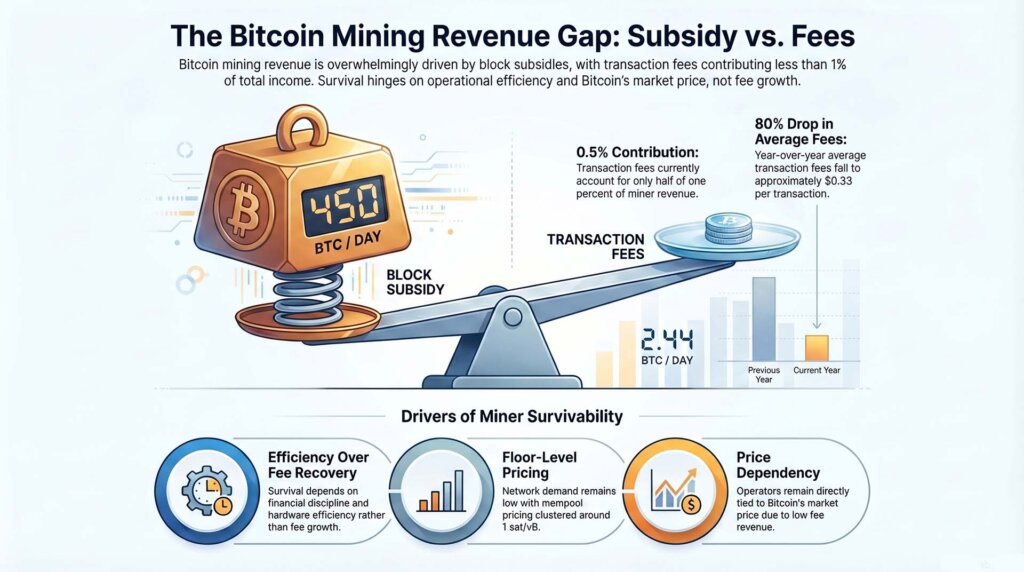
Bitcoin miners get paid from two sources: the subsidy and fees. Subsidy is the protocol-level issuance attached to each block. Fees are the extra amount users pay to get transactions confirmed.
In stronger on-chain environments, the fee layer becomes a genuine contributor to miner economics. In weaker ones, it shrinks back toward irrelevance, leaving miners tied much more directly to Bitcoin’s market price.
That is where conditions sit now. A recent snapshot from mempool.space showed low-, medium-, and high-priority transactions clustered around 1 sat/vB. YCharts put the average Bitcoin transaction fee at $0.3335 on April 8, down 80.53% from a year earlier. The network is still functioning smoothly, blocks are still getting mined, and users are still getting access to block space cheaply.
For miners, the revenue implication is straightforward. Fee income is providing very little incremental support. Bitcoin sits around $71,800 on April 10, up 7.4% over the past seven days and 3.1% over the past 30 days. That move helps, though mainly through the value of the subsidy rather than through any revival in user-paid demand for block space.
The scale of the imbalance is large enough to define the frame on its own. Bitcoin still produces about 144 blocks a day. At 3.125 $BTC per block, that means around 450 $BTC in newly issued subsidy every day before fees. Against that base, the April 8 total fee figure of 2.443 $BTC suggests fees contribute roughly half of 1% of miner revenue in $BTC terms.
This is why the live question is what keeps miners alive when the fee layer is barely helping. The next reset still belongs in the analysis, though it belongs in the right place.
A lower difficulty setting can improve economics at the fleet level because miners require less computational work to find a block. It can ease the pressure. Miner survivability over the next few weeks will still be determined largely by price, efficiency, power costs, debt, and treasury discipline. Power costs, machine quality, debt loads, and treasury policy decide who bends first
Once the revenue side is stripped down to subsidy plus price, the cost stack becomes much easier to see. Miner survivability depends on who can produce Bitcoin at a cost that still leaves room for operating cash flow.
That comes down to the price of electricity, the efficiency of the fleet, the cost of hosting, the level of debt on the balance sheet, and whether management has sufficient treasury flexibility to avoid selling in weak conditions.
CoinShares gives the clearest external framework for that hierarchy. In its Q1 2026 mining report, CoinShares said Q4 2025 was the toughest quarter for miners since the 2024 halving and put the weighted average public-miner cash production cost near $79,995 per $BTC in Q4 2025.
That figure does give a clear sense of how narrow the spread had become across the listed space. CoinShares also said any miner below an S19 XP paying 6 cents per kilowatt-hour or more was losing money at $30 per PH/day.
That helps build a much sharper three-tier hierarchy.
The first tier is made up of low-cost operators with modern fleets, favorable hosting or self-mined power, and balance sheets that can absorb volatility without immediate forced selling.
These miners still face pressure in a low-fee market, though they have sufficient efficiency and financial flexibility to ride it out. Their problem is margin compression, not immediate survivability.
The second tier is the disciplined middle. These operators can remain viable, though only with tighter treasury management, more selective deployment, slower expansion, and a harder filter on capital spending.
They can survive the next few weeks if Bitcoin price holds up and if the projected difficulty cut lands close to current expectations. They still have much less room for error than the top tier because the fee layer is offering so little support.
The third tier is where the real strain sits. These are higher-cost legacy fleets, operators running older machines, miners with weaker power economics, and firms carrying capital structures that do not give them much time.
This group breaks first because weak fees remove the one revenue line that could have softened a difficult quarter. For them, the question is often no longer about growth. It is about curtailment, site-by-site triage, machine shutdowns, opportunistic treasury sales, and whether any part of the fleet still deserves incremental capital.
This is the operating leverage point that mining coverage often blurs. Price still matters here, although mainly as an input into hashprice and cash margins. CoinShares estimated that hashprice could rise to around $37 per PH/day if Bitcoin recovered to $100,000 and to roughly $59 per PH/day if it retested $126,000.
Those ranges show how quickly conditions can improve when the price moves far enough. They also show why the current environment still feels tight. Bitcoin has stabilized, though it remains well below the levels that would create broader comfort across the mining stack.
That leaves treasury policy as a more important variable than usual. Operators with stronger treasuries can hold through periods of weak fees and middling hashprice.
Operators with less flexibility have to decide sooner whether to sell $BTC, cut capex, idle older rigs, or pull back from marginal sites. In a market where the subsidy is doing almost all the work, treasury management becomes part of the production model.
Curtailment, fleet triage, and the AI pivot define the adaptation stack into the next reset window
Once revenue stays thin and the cost stack tightens, the next question is adaptation. What do miners actually do when pure Bitcoin mining stops offering enough operating leverage?
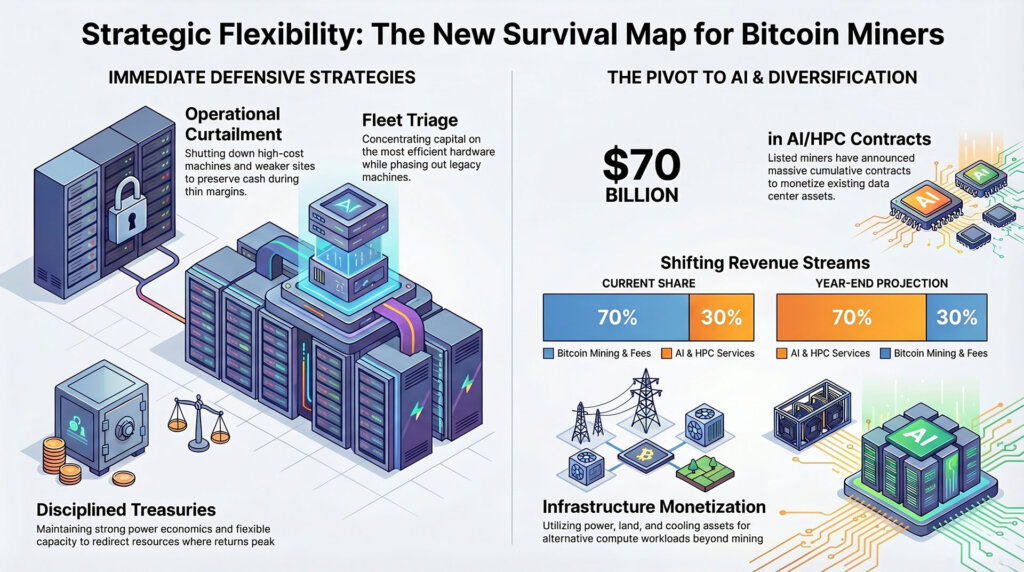
The first adaptation is curtailment. Operators shut off higher-cost machines, reduce exposure at weaker sites, and preserve cash while waiting for better price conditions or a more favorable difficulty profile.
The second is fleet triage. Capital is directed toward the most efficient hardware and the best-performing sites, while older machines remain online only if they can still cover power and hosting costs.
The third is strategic diversification, where miners begin looking beyond Bitcoin mining itself and ask what their power, land, cooling, and data center assets might earn in adjacent markets.
In its report, CoinShares said listed miners have announced more than $70 billion in cumulative AI and HPC contracts and could derive as much as 70% of revenue from AI by year-end, up from about 30% now.
That projection says a great deal about how miners are ranking their options. A site with sufficient power access and data center potential may earn more from another workload than from mining Bitcoin in a low-fee environment.
Weak fees also lower the relative attractiveness of mining compared with other compute-intensive businesses competing for the same infrastructure footprint. A miner does not need ideological conviction to make that shift.
The next reset window still gives the market a clear near-term test. CoinWarz places the next difficulty adjustment on April 18, with the projected move pointing lower to 132.14 trillion. If that adjustment lands near expectations, miners should get some marginal relief on output economics. The sharper question comes after that. Does anything in the fee layer actually change?
A meaningful improvement would require a firmer Bitcoin price, a visible fee rebound, or both. Without a fee recovery, a lower difficulty setting still leaves miners dependent on subsidy and price.
Over the next few weeks, the winners are likely to be miners with efficient fleets, better power economics, stronger treasury control, and enough strategic flexibility to shift capacity where returns are highest.
The losers are likely to be miners that need fee support to compensate for legacy equipment, high power costs, or fragile balance sheets.
Bitcoin mining is still producing blocks on schedule, and the next difficulty adjustment may give operators some relief.
The deeper condition remains the same. Demand for block space is contributing very little, and miner survivability is being determined by who can endure a weak-fee environment long enough for either price, fees, or both to improve.
