

Bitcoin’s first difficulty adjustment of 2026 was anything but dramatic. The network nudged the dial down to about 146.4 trillion, a pretty small retreat after the late-2025 grind higher.
But small isn’t the same as meaningless in mining, a business where margins are measured in fractions of a fraction and the main input (electricity) can turn from bargain to backbreaker in a week. Difficulty is Bitcoin’s built-in metronome: every two weeks or so, the protocol recalibrates how hard it is to find a block so that blocks keep arriving roughly every ten minutes.
When difficulty falls, it usually means the network noticed something miners feel before investors do: some machines stopped hashing, at least temporarily, because economics or operations demanded it.
That matters because in 2026, miners are navigating a squeeze with two layers. There’s the familiar post-halving reality of less new Bitcoin per block, and more competition for it. And then there’s the new backdrop: a tightening market for megawatts as AI data centers scale up and start bidding for the same power access miners once treated as a competitive moat.
CryptoSlate’s own reporting has framed this as an energy war where AI’s always-on demand and political momentum collide with miners’ flexible-load pitch.
To understand what the 146.4T print really means, we have to translate the mining dashboard into plain English, and then connect it to the parts of the story Wall Street often misses.
Difficulty is the stress gauge, not the scoreboard
Difficulty is often mistaken for a proxy for price, sentiment, or even security in a broad sense. It’s certainly related to those things, but mechanically it’s much simpler. Bitcoin looks at how long the last 2,016 blocks took to mine: if blocks came in faster than ten minutes, it raises difficulty; if blocks came in slower, it lowers difficulty.
So why does it read like a stress gauge if it’s that simple? Because hashpower isn’t some kind of theoretical quantity, it’s literally industrial equipment drawing electricity at scale. If enough miners unplug, blocks slow down, and the protocol responds by making the puzzle easier so the remaining miners can keep pace.
In early January, multiple trackers showed average block times drifting just under the ten-minute target (around 9.88 minutes in one widely cited snapshot), which is why projections pointed to the next adjustment swinging back upward if hashpower returned.
CoinWarz’s public dashboard, for example, has displayed the current difficulty around 146.47T alongside forward estimates for the next adjustment date.
The important takeaway is what difficulty doesn’t say, which is why miners dropped off. It doesn’t tell you whether it was a one-day curtailment during a power spike, a wave of bankruptcies, a flood, a firmware issue, or a deliberate strategy shift. Difficulty is just the protocol’s symptom readout. The diagnosis lives elsewhere.
That’s why miners and serious investors pair difficulty with a second metric, one that behaves much more like an income statement than a thermostat: hashprice.
Hashprice is the miner P&L in one number
Hashprice is mining’s shorthand for expected revenue per unit of hashpower per day. Luxor popularized the term, and its Hashrate Index defines hashprice as the expected value of 1 TH/s per day.
It’s a neat little way to compress block rewards, fees, difficulty, and price into a single number that shows where the money is.
For miners, this is the heartbeat that keeps them alive. Difficulty can fall and still leave miners hurting if the price is weak, fees are thin, or the global fleet remains intensely competitive. Conversely, difficulty can rise while miners print money if BTC rallies or fees spike. Hashprice is where those variables meet.
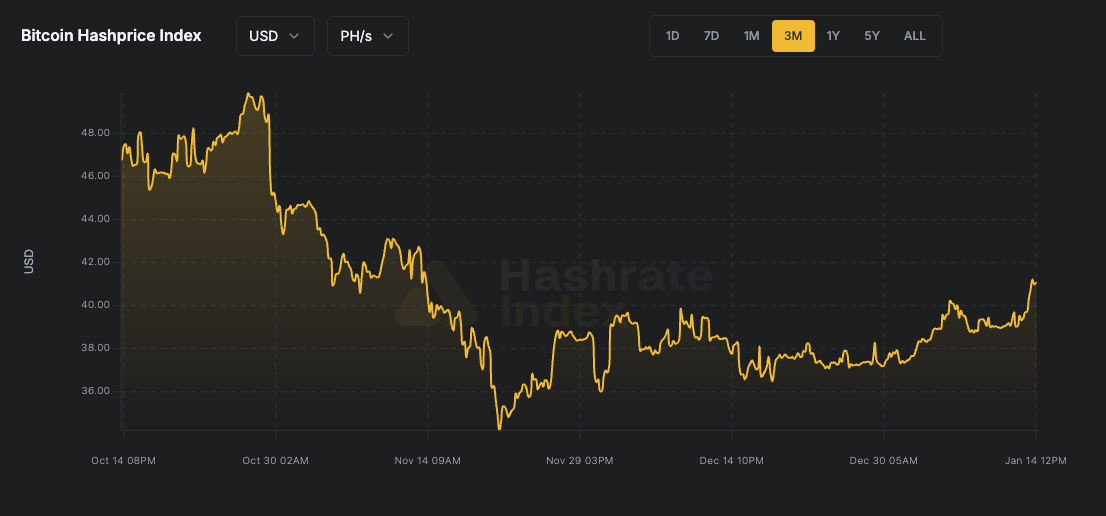
Early-January commentary from Hashrate Index noted that forward markets were pricing an average hashprice around $38 (and roughly 0.00041 BTC) over the next six months. That’s useful context because it signals what sophisticated participants expect profitability to look like, not just what it is today.
If you’re trying to interpret a modest difficulty dip like 146.4T, hashprice helps you avoid a common mistake, which is assuming that the network threw miners a bone. The network doesn’t know miners exist; it only corrects timing.
A difficulty drop is relief only in the narrow sense that each surviving unit of hashpower has slightly better odds. Whether that translates into real breathing room depends on power costs and financing, variables that have become much less forgiving.
Here’s where consolidation enters the story. Because when mining is flush, almost anyone with cheap power and access to machines can survive. When hashprice compresses, survival becomes a function of balance sheets, scale, and contracts.
The consolidation wave is the real difficulty adjustment
Bitcoin mining is often described as decentralized, but the industrial layer is brutally Darwinian. When profitability tightens, weak operators don’t just earn less; they lose their ability to refinance machines, service debt, and secure power at competitive rates.
That’s when consolidation accelerates: through bankruptcies, distressed asset sales, and takeovers of sites with valuable grid access.
This is where the mining narrative diverges from the market narrative. In the ETF-and-macro era, BTC trades like a risk asset with catalysts and flows. Miners, in contrast, live in a world of energy spreads, capex cycles, and operational leverage.
When their world gets tight, they make choices that ripple outward: selling more BTC to fund opex, hedging production more aggressively, renegotiating hosting deals, or shutting down older rigs earlier than planned.
A difficulty dip can be one of the first on-chain hints that this process is underway. Not because miners are capitulating in a dramatic, one-day event, but because enough marginal machines quietly go dark to move the average. The market might see a small number, but the industry sees a competitive shakeout beginning at the edges.
And in 2026, those edges are being pushed by something bigger than a single hashprice print, and that’s the rising value of power itself.
AI is changing the unit economics miners used to take for granted
Mining has always been an energy business disguised as a crypto business. The pitch has been straightforward: find cheap, interruptible power; deploy machines quickly, switch off when prices spike, and arbitrage the volatility of electricity into a steady stream of hashpower.
CryptoSlate’s January reporting made the argument that AI data centers are challenging that model at its foundation, because they want certainty, not curtailment, and they come with a political story (jobs, competitiveness, “critical infrastructure”) that miners often lack.
The same piece highlighted BlackRock’s warning that AI-driven data centers could consume an enormous share of US electricity by 2030, turning grid access into the scarce asset investors are underpricing.
Even if you treat the high-end forecasts as nothing more than provocative headlines, the direction here matters: more baseline demand, more interconnection bottlenecks, more competition for the best sites. In that world, miners’ old advantages (mobility and speed) can flip into disadvantages if the gating factor is securing transmission upgrades, transformer capacity, and long-term contracts.
CryptoSlate’s November feature pushed this one step further: AI isn’t just competing for power, it’s competing for capital and attention, pulling liquidity toward compute infrastructure and nudging miners to pivot from hashing to hosting.
That piece described miners repositioning themselves as data-center operators and “power platforms,” precisely because megawatts are becoming more valuable than machines.
None of this is an abstract narrative. It’s real data and real effects that change how you read difficulty.
A miner curtailing for an hour during a price spike is one thing. A miner mothballing a site because an AI tenant can pay more per megawatt over a multi-year contract is another.
In the first scenario, hashpower comes back when conditions normalize. In the second, hashpower may not return at all, not because Bitcoin is “dying,” but because the highest-value use of that power has changed.
That’s the subtle stress embedded in a 146.4T print. The network will keep adjusting, because that’s what it does. The question is what the mining industry looks like after repeated adjustments in an environment where energy is repriced by AI.
For investors and serious market observers, the practical value is in reading the mining tape like a set of linked signals rather than isolated metrics.
Difficulty shows whether hashpower is steadily expanding or briefly blinking out as marginal machines shut off, while hashprice translates that same environment into the one thing miners can’t negotiate with: whether the fleet is earning enough to keep running.
From there, the industry’s response tells its own story, because tightening economics tend to accelerate consolidation, determining who gets to keep playing and whether the network’s industrial base is becoming more concentrated.
And behind all of it sits the new constraint: energy competition, which will decide whether “cheap power” remains a durable moat for miners or a vanishing edge as AI data centers lock up long-term capacity.
Bitcoin won’t stop producing blocks because difficulty moved a few points, but mining can still slip into a regime shift while the protocol keeps humming along, quiet and indifferent.
If 2025 was the year the sector learned to live with the halving’s leaner baseline, 2026 may be the year miners learn their real competitor isn’t another pool, it’s the data center down the road that never wants to power down.
