

Close Menu
  • Coins
    • Bitcoin
    • Ethereum
    • Altcoins
    • NFT
  • Blockchain
  • DeFi
  • Metaverse
  • Regulation
  • Other
    • Exchanges
    • ICO
    • GameFi
    • Mining
    • Legal
  • MarketCap
What's Hot

Institutions Can Now Access Ondo Tokenized Stocks via Gate through Talos

06/04/2026

Lido Proposes $20M Buyback, Aave V4 Deploys, and More

06/04/2026

Ethereum Price Extends Losses, $2,000 Support Faces Breakdown Risk

06/04/2026
Facebook X (Twitter) Instagram
  • Back to NBTC homepage
  • Privacy Policy
  • Contact
X (Twitter) Telegram Facebook LinkedIn RSS
NBTC News
  • Coins
    1. Bitcoin
    2. Ethereum
    3. Altcoins
    4. NFT
    5. View All

    Price Breaks All-Time High Record Again – Here’s What We Know

    04/08/2025

    Bitcoin Switzerland? El Salvador to Host First Fully Native Bitcoin Capital Markets

    04/08/2025

    Bitcoin Breaks $119K, but XLM and HBAR Aren’t Impressed by Its Meager Percentage Gain

    04/08/2025

    High-Stakes Consolidation Could Define Q3 Trend

    04/08/2025

    Ethereum Price Extends Losses, $2,000 Support Faces Breakdown Risk

    06/04/2026

    Binance dumps nearly $1B in Ethereum after Trump’s statement – Korea buys the dip

    06/04/2026

    Ethereum Compression Deepens Near $2,000 — Volatility About To Explode?

    05/04/2026

    ShapeShift Crypto Exchange Founder Erik Voorhees Buys Ethereum (ETH)! Here Are the Details

    05/04/2026

    The Sui Ecosystem’s Top 3 Altcoin Performers

    29/07/2025

    Floki Launches $69000 Guerrilla Marketing Challenge With FlokiUltras3

    28/07/2025

    Crypto Beast denies role in Altcoin (ALT) crash rug pull, blames snipers

    28/07/2025

    $1.6 Billion XRP Surge: Here’s What’s Unfolding

    28/07/2025

    Justin Bieber Purchased a Bored Ape NFT for $1.3 Million; Here is How Much It Is Worth Today

    05/04/2026

    Top NFT Sales of the Week, Sales Increase 11%

    05/04/2026

    IP, Utility and the Fight to Stay Relevant

    03/04/2026

    Magic Eden will deprecate its native wallet, entering export-only mode on April 1

    01/04/2026

    Institutions Can Now Access Ondo Tokenized Stocks via Gate through Talos

    06/04/2026

    Lido Proposes $20M Buyback, Aave V4 Deploys, and More

    06/04/2026

    Ethereum Price Extends Losses, $2,000 Support Faces Breakdown Risk

    06/04/2026

    The Stablecoin Dilemma Facing Every Non-US Economy

    06/04/2026
  • Blockchain

    PeckShield Reports Major Service Disruption on Hyperliquid Network

    05/04/2026

    TRM Labs and Hypernative Labs Secure Crypto Transactions

    05/04/2026

    France All Set to Host the World’s First Fully On-Chain IPO

    05/04/2026

    Polygon Introduces Private Mempool Delivering One‑Line MEV Protection

    05/04/2026

    Hashgraph CEO warns permissionless systems pose compliance risks

    05/04/2026
  • DeFi

    Lido Proposes $20M Buyback, Aave V4 Deploys, and More

    06/04/2026

    As Wall Street moves on-chain, DeFi faces a $330 billion trust test it can’t dodge

    06/04/2026

    Alpha Pulse AI Partners With ManusPay To Allow Professional Traders To Harness Crypto Trading And DeFi Applications

    05/04/2026

    Mantle Emerges as Key DeFi Hub with Aave Deposits Approaching $1.5B

    05/04/2026

    Concrete Joins Forces with Euler to Build Institutional DeFi Lending

    05/04/2026
  • Metaverse

    Mark Zuckerberg’s Meta launches new AI initiative after metaverse retreat

    25/03/2026

    Meta partners with Arm to develop new CPUs for AI deployments

    24/03/2026

    Land values capitulate as $24M metaverse plot collapses to just $9,000

    20/03/2026

    Meta to shutter Horizon Worlds metaverse on VR in favor of mobile

    18/03/2026

    Meta expands AI agent push with Moltbook acquisition

    10/03/2026
  • Regulation

    The Stablecoin Dilemma Facing Every Non-US Economy

    06/04/2026

    21shares sees active strategies shaping next phase of crypto ETFs

    06/04/2026

    GameStop reports 14% revenue decline even as quarterly profit holds above $127 million

    05/04/2026

    Why Circle’s 20% Crash Might Be a Massive Bull Trap

    05/04/2026

    What It Means for Crypto Creators

    05/04/2026
  • Other
    1. Exchanges
    2. ICO
    3. GameFi
    4. Mining
    5. Legal
    6. View All

    Institutions Can Now Access Ondo Tokenized Stocks via Gate through Talos

    06/04/2026

    Ripple Quietly Announced a Major Partnership Today

    06/04/2026

    Galaxy expands retail platform with SOL staking, targeting 6.5% yield

    05/04/2026

    A Strategic Expansion for Millions of Users

    05/04/2026

    South Korea Poised to Lift Ban on Domestic ICOs After 7 Years

    19/12/2025

    Why 2025’s Token Boom Looks Both Familiar and Dangerous

    31/10/2025

    ICO for bitcoin yield farming chain Corn screams we’re so back

    22/01/2025

    Why 2025 Will See the Comeback of the ICO

    26/12/2024

    NeoFantasy Game Partners With AetheriumX To Advance Metaverse Gaming Global Expansion

    03/04/2026

    The Sandbox NEXT Stress Test Ignites Mobile Metaverse Ambitions with Unreal Engine Power

    02/04/2026

    PlaysOut and Magne.AI Shake Hands for AI-Powered Web3 Gaming Experiences

    01/04/2026

    World of Elements v1.12 introduces skill trees, Hubitz location

    30/03/2026

    Founder of a Chinese Bitcoin Mining Company Vehemently Opposed the Latest Proposed Updates to BTC

    05/04/2026

    Bitcoin Difficulty Climbs 3.87% as Hashrate Slips and Next Cut Looms

    05/04/2026

    Solo Bitcoin miner bags $210K Bitcoin block reward

    04/04/2026

    Bitcoin Miner MARA Slashes 15% of Workforce After Selling $1.1 Billion in BTC

    04/04/2026

    The time for clear financial privacy rules is now

    05/04/2026

    Charles Hoskinson not a fan of CLARITY Act, warns of ‘weaponization’ by future lawmakers

    05/04/2026

    Crypto dispute over Resupply exploit lands in Singapore harassment court

    05/04/2026

    Crypto gains political clout among 80% of UK young voters

    05/04/2026

    Institutions Can Now Access Ondo Tokenized Stocks via Gate through Talos

    06/04/2026

    Lido Proposes $20M Buyback, Aave V4 Deploys, and More

    06/04/2026

    Ethereum Price Extends Losses, $2,000 Support Faces Breakdown Risk

    06/04/2026

    The Stablecoin Dilemma Facing Every Non-US Economy

    06/04/2026
  • MarketCap
NBTC News
Home»DeFi»As Wall Street moves on-chain, DeFi faces a $330 billion trust test it can’t dodge
DeFi

As Wall Street moves on-chain, DeFi faces a $330 billion trust test it can’t dodge

NBTCBy NBTC06/04/2026No Comments6 Mins Read
Share
Facebook Twitter LinkedIn Pinterest Email


Wall Street spent the first quarter of 2026 systematically narrowing DeFi’s claim to the future of finance.

In January, ICE announced NYSE was building a tokenized securities platform with 24/7 operations, instant settlement, dollar-based order sizing, and stablecoin funding, with BNY and Citi providing tokenized deposits for clearinghouse funding outside normal banking hours.

In February, WisdomTree launched 24/7 trading and instant settlement for tokenized money-market fund shares under SEC relief.

In March, the Fed, FDIC, and OCC jointly said that eligible tokenized securities should receive the same capital treatment as their non-tokenized counterparts, calling the framework technology-neutral.

The SEC then approved Nasdaq’s proposal to trade certain securities in tokenized form, with settlement through DTC.

NYSE and Securitize followed with a partnership to build digital transfer-agent infrastructure around institutional operating standards.

That sequence did something concrete to DeFi’s competitive position. Regulated exchanges, broker-dealers, and bank-backed clearinghouses can now package 24/7 trading and on-chain settlement inside a supervised market structure, with the capital treatment to match.

The base pool of on-chain capital these moves target already exceeds $330 billion, including stablecoins at roughly $317 billion, tokenized US Treasuries at nearly $13 billion, and tokenized stocks at $1 billion.

That pool will attract institutional capital regardless of which rails it flows through.

Why this matters: the contest is no longer over whether finance will move on-chain. It is over who captures the capital once it does. If regulated venues can offer blockchain-based trading and settlement without DeFi’s governance and control-layer risks, open protocols have to prove why institutions should accept the added exposure.

A stacked bar chart shows the $331 billion on-chain capital pool, with stablecoins at $317 billion dominating tokenized Treasuries at $13 billion and tokenized stocks at $1 billion.

Composability is DeFi’s distinct advantage: the ability to build interconnected financial products on shared, permissionless infrastructure, where any protocol can connect directly to any other on open terms.

It is a genuinely DeFi-native feature. Nasdaq-approved tokenized securities still settle through DTC, are subject to exchange surveillance, and operate under existing order types and reporting frameworks.

WisdomTree’s tokenized fund sits inside a broker-dealer model. NYSE designed its tokenized platform around transfer agents and institutional operating standards. All of those architectures require a central gatekeeper to approve downstream connections.

Drift and the control-layer problem

Composability’s value as a moat depends entirely on whether capital allocators believe the surrounding controls are mature enough to contain localized failures.

Drift’s exploit exposed that dependency in the most direct way possible. Drift confirmed the attack exploited durable nonces and a takeover of Security Council administrative powers through a compromise of the access-control layer.

DefiLlama classified the incident as a $285 million hack driven by compromised admin access and price manipulation. Drift’s total value locked fell from roughly $550 million to below $250 million.

The contagion framing from post-incident analysis is where the competitive argument becomes sharpest.

Because Drift’s infrastructure is connected to downstream vaults, yield strategies, wrappers, and collateral positions across Solana DeFi, the administrative compromise radiated outward before the exposure map was clear.

Chaos Labs publicly said hidden dependencies kept surfacing in real time, leaving the final exposure tally open. Composability, functioning as a transmission channel for losses, precisely drives institutional capital allocators toward permissioned tokenization infrastructure over open protocol stacks.

The Drift incident fits a pattern that extends well beyond Solana.

Chainalysis found that private key compromises accounted for 43.8% of stolen crypto in 2024, the single-largest attack category it tracked.

TRM Labs said attackers stole $2.87 billion across nearly 150 hacks in 2025, with infrastructure attacks targeting keys, wallets, and access control planes driving the majority of losses and outpacing smart contract exploits.

TRM also noted the top 10 incidents accounted for 81% of 2025 hack losses.

The empirical record says the control layer, the governance layer, and the access management layer now carry more systemic risk than contract code alone. DeFi’s security culture is still catching up to that empirical record.

What DeFi has to do

Open composability must adopt the corrective to compete for the institutional capital now pooling on-chain.

Drift’s post-incident analysis and the broader Chaos Labs framing converge on the same operational list: stricter signer standards, timelocks on privileged transitions, segmented permission structures so that one compromised key cannot reach the entire control surface, explicit dependency mapping so downstream integrations are visible before a failure occurs, and faster public disclosure that lets the broader network act before contagion spreads.

Post-mortems show Drift’s administrative transition used a 2-of-5 multisig with no timelock. This configuration compressed the approval window for a catastrophic change to the point where detection and intervention had no time to operate.

Those fixes are unglamorous. They build the operational credibility that makes a CFO or risk committee comfortable routing institutional capital through open infrastructure.

ICE, Nasdaq, and NYSE are competing for the same pool. The protocols that earn a share of it will be the ones that can demonstrate composability with contained, visible risk, where an interconnection means expanded utility.

Two paths forward

The on-chain capital base currently sits above $330 billion and will grow as tokenized securities and stablecoin adoption expand.

The contest is over what fraction of that pool flows through open, composable DeFi versus permissioned or semi-permissioned tokenization infrastructure.
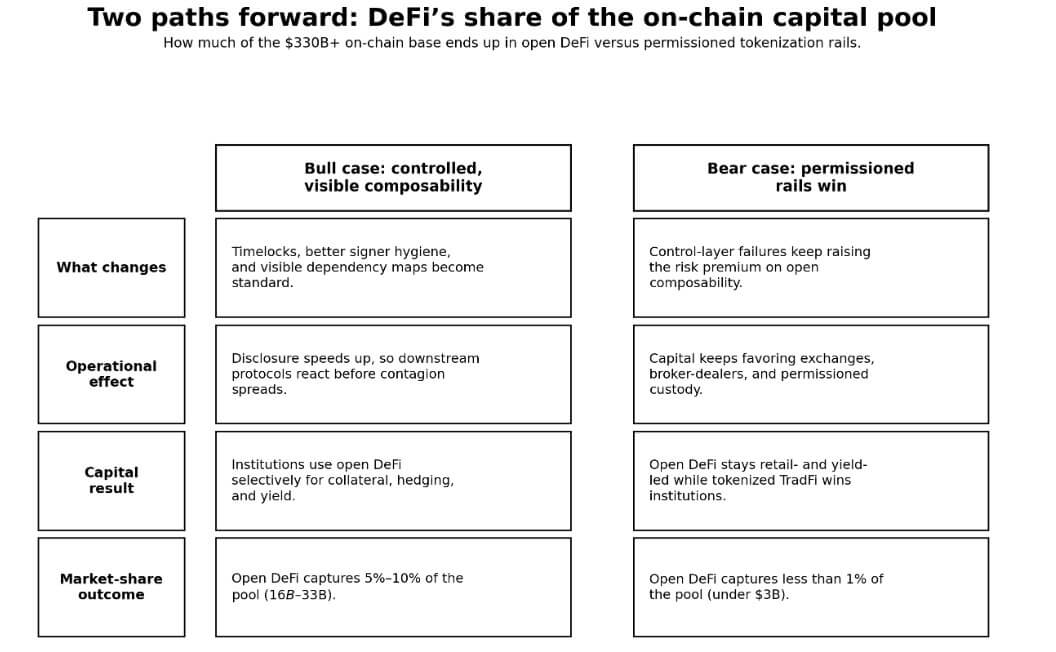
A two-column table maps bull and bear paths for DeFi’s share of the $331 billion on-chain pool, from 5–10% to under $3 billion.

In the bull case, DeFi protocols produce a visible, sustained upgrade in governance discipline: timelocks become standard for privileged transitions, signer hygiene improves across major protocols, teams publish dependency maps that let external allocators assess integration risk before committing capital, and disclosure lags shorten from days to hours.

Institutional allocators begin using open composability selectively for structured collateral, cross-protocol hedging, and yield strategies where the control layer is demonstrably stronger than before.

Open DeFi captures 5% to 10% of the on-chain capital pool, or roughly $16 billion to $33 billion. Composability becomes the premium layer atop the tokenization rails that traditional finance is building, running alongside a supervised market structure.

In the bear case, each successive control-layer incident raises the perceived risk premium on open composability faster than the industry can close the governance gap.

Tokenized securities, tokenized funds, and stablecoin settlement volumes have expanded, while capital stays within exchanges, broker-dealers, and permissioned custody structures.

Open DeFi captures less than 1% of the pool, with total assets of less than $3 billion. Traditional finance captures the blockchain upside through tokenization, faster settlement, and extended hours, while open composability captures retail flows and reflexive capital seeking yield on open infrastructure.

Wall Street spent 2025 and the early part of 2026 proving that blockchain rails can carry institutional assets within supervised frameworks.

DeFi’s path to winning requires proving that open interconnection is worth the additional governance, disclosure, and control overhead imposed by regulatory mandates on supervised venues.

Share. Facebook Twitter Pinterest LinkedIn Tumblr Email
NBTC

Related Posts

Lido Proposes $20M Buyback, Aave V4 Deploys, and More

06/04/2026

Alpha Pulse AI Partners With ManusPay To Allow Professional Traders To Harness Crypto Trading And DeFi Applications

05/04/2026

Mantle Emerges as Key DeFi Hub with Aave Deposits Approaching $1.5B

05/04/2026

Concrete Joins Forces with Euler to Build Institutional DeFi Lending

05/04/2026
Add A Comment

Comments are closed.

Top Posts
Get Informed

Subscribe to Updates

Get the latest news from NBTC regarding crypto, blockchains and web3 related topics.

Your source for the serious news. This website is crafted specifically to for crazy and hot cryptonews. Visit our main page for more tons of news.

We're social. Connect with us:

Facebook X (Twitter) LinkedIn RSS
Top Insights

Institutions Can Now Access Ondo Tokenized Stocks via Gate through Talos

06/04/2026

Lido Proposes $20M Buyback, Aave V4 Deploys, and More

06/04/2026

Ethereum Price Extends Losses, $2,000 Support Faces Breakdown Risk

06/04/2026
Get Informed

Subscribe to Updates

Get the latest news from NBTC regarding crypto, blockchains and web3 related topics.

Type above and press Enter to search. Press Esc to cancel.