

[ad_1]
This summer, crypto restaking protocols were rallying to new heights. Almost without exception, these leveraged plays on the native yield of proof-of-stake blockchains like Ethereum and Solana were attracting all-time high capital inflows.
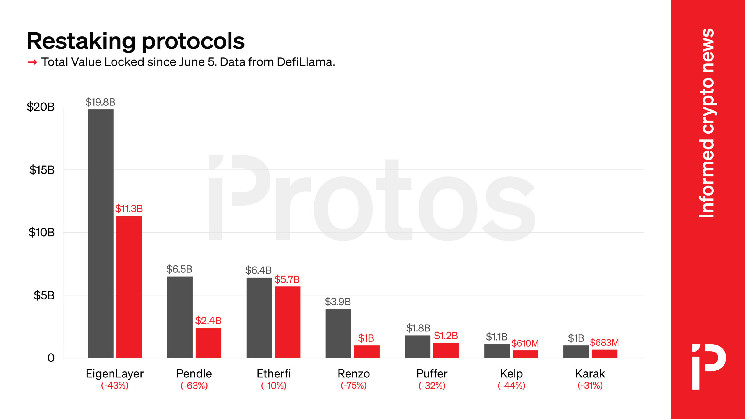
As of June 5, their total value locked (TVL) — a convenient albeit incomplete metric for judging the size of crypto protocols — had crested $21 billion.
Protos has created a chart illustrating the breakdown of this TVL — click here to view.
However, as of publication time, the assets in those protocols had declined by one-third to $14 billion.
As investors return from summer vacation, university classes restart, and capital allocators reassess their portfolios with sober professionalism, the world has decided to take some risk off the table at the start of the third quarter.
Declines in these USD values are influenced by general declines in ETH, SOL, and other restaking assets. Since June 5, the crypto market has shed 26% of its total market capitalization.
Read more: Ethereum Foundation blasted for EigenLayer conflicts of interest
Restaking: More leverage, liquidation, complexity, and risk
Restaking protocols enable crypto asset holders to leverage staked assets like ETH or SOL to generate additional yield. Anil Lulla of Delphi called it “the rehypothecation of ETH to riskier networks,” and it certainly has both of those qualities.
Restaking rehypothecates, or ‘double-allocates,’ an asset across two or more protocols. A common restaking strategy involves Ethereum + Lido + EigenLayer, among many other examples. The introduction of these additional protocols beyond the base layer — in this case, Lido and EigenLayer — introduces the additional risk of two networks into one’s investment.
As compensation for these additional risks, restaking schemes advertise yields with annualized percentages in the double and even triple digits.
“Looping,” or taking out additional loans after restaking in order to restake yet again can transform these numbers into quadruple digits and beyond.
[ad_2]
