


[ad_1]
In a new paper, Ethereum co-founder Vitalik Buterin examines memory access time, one of the most overlooked limitations in computing, and how a better understanding of it might change the way cryptographic systems are developed. Even though the subject seems extremely technical, it has a direct bearing on the potential efficiency of blockchains, cryptographic proofs and even AI models.
Memory access issue
Buterin contends that it is incorrect to assume that reading or writing to memory takes a fixed amount of time, as is frequently done in computer science. Rather, he presents a model that proposes that the cube root of memory size determines the memory access time. Put simply, retrieving data from your memory becomes progressively slower as it gets bigger, because signals must travel greater physical distances.
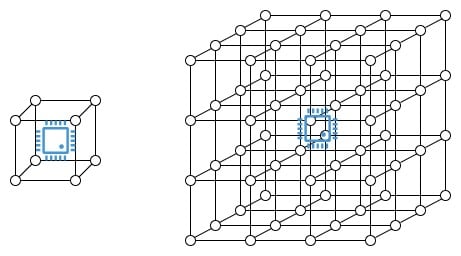
He provides evidence from the real world to support this, demonstrating that the time it takes to access data increases with memory size, from CPU caches to RAM, which surprisingly aligns with his theoretical model. This realization goes beyond mere academic nitpicking —– it radically changes the way we think about algorithm optimization, particularly in the field of cryptography, where it is typical practice to precompute and store intermediate results.
Solving blockchain memory management
Vitalik Buterin uses an example involving elliptic curve cryptography, a fundamental part of blockchain security, to demonstrate this point. To expedite processes, developers frequently precompute large tables of numbers. Any speed gains could be lost, though, if the tables grow too big to fit in cache memory due to the slowdown caused by more memory access. A smaller cache-fitting table proved to be faster than a larger one kept in RAM in one of his tests.
The conclusion is straightforward but profound: Efficiency in cryptography involves more than just faster processors — it also involves more intelligent memory management. Comprehending the principle he laid out could direct the hardware optimization of future blockchain and zero-knowledge systems, as the industry shifts toward specialized hardware like ASICs and GPUs.
[ad_2]
